Get Full Government Meeting Transcripts, Videos, & Alerts Forever!
Get email alerts on the Cable Infrastructure topic
No spam. Unsubscribe anytime.
Foggy Bottom resident urges OCTFME to apply street design standards to historic alleys
Summary
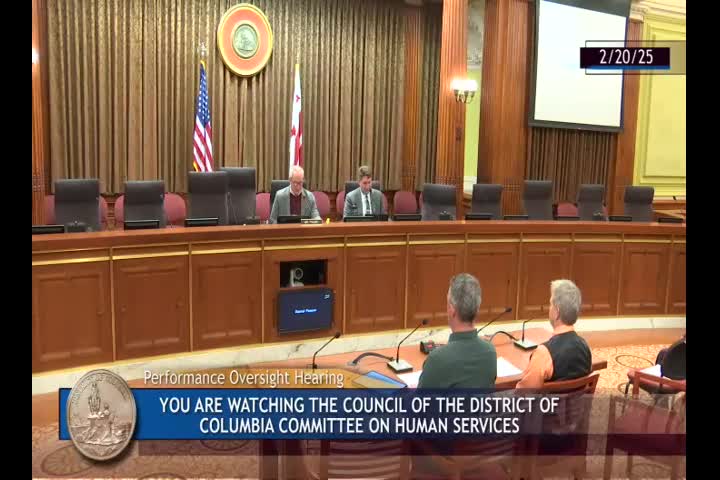
At a Feb. 20 Committee on Human Services oversight hearing, a Foggy Bottom resident told council members the Office of Cable Television, Film, Music and Entertainment should extend cable-design oversight and undergrounding requirements to residential alley dwellings to protect historic properties and reduce hazardous wire congestion.
Councilmember Matt Fruman, chair of the Committee on Human Services, heard testimony Feb. 20 from a Foggy Bottom neighborhood leader who asked the Office of Cable Television, Film, Music and Entertainment to treat historic alley homes like street‑facing houses when approving cable runs.
Will Crane, vice president of the Foggy Bottom Association and chair of its infrastructure committee, told the committee his alley has more than 30 residences and ‘‘one house in particular has over 40 wires traversing, on or hanging from his home.’’ He said cable runs often ignore the character and safety needs of alley dwellings.
Crane asked the agency to differentiate commercial alleys from residential alleys, to raise cable runs above second‑story windows for egress and roof access, to require installers to remove duplicate wire runs, and to expand underground cable requirements to residential alleys in the District.
The request was framed as a call for OCTFME policy changes rather than new historic‑preservation law. Crane thanked Mabel Gist, identified in his testimony as OCTFME’s cable inspector, for long‑running assistance and said he feared loss of institutional knowledge if she retires.
Councilmember Fruman said the wire problem is broader than Foggy Bottom and noted that some poles and certain wires fall under the Public Service Commission while OCTFME regulates cable infrastructure. He acknowledged that abandoned or orphaned lines and multiple poles next to each other create hazards and visual clutter, and he said he would coordinate with other council members and task forces working on poles and street surfacing.
Latoya Foster, director of OCTFME, answered later in the hearing that the office’s legal and regulatory team works with providers to resolve infrastructure issues and escalates customer concerns, but the transcript records no commitment to a specific regulatory change covering alleys.
The exchange highlighted a jurisdictional gap: residents said Verizon‑owned poles and some utility wires are handled by other regulators, while cable runs fall under OCTFME. Crane and Fruman both urged multi‑agency coordination so that pole removals, undergrounding, and cable installations do not leave historic alley façades at risk.
The committee did not take formal action during the hearing; members signaled interest in follow‑up coordination and data sharing with agencies working on poles, cable franchises and public‑space maintenance.
For now, residents seeking relief will continue to navigate a mix of regulators and company contacts while the council considers how to reduce the burden on neighborhoods with historic alley dwellings.