Get Full Government Meeting Transcripts, Videos, & Alerts Forever!
Get email alerts on the Tax Increment Development District topic
No spam. Unsubscribe anytime.
Bernalillo County holds public informational meeting on proposed TID for State Fairgrounds; county vote set for March 11
Summary
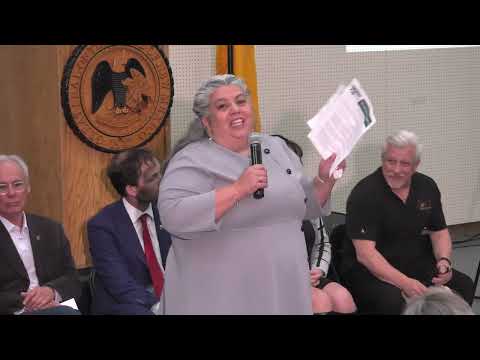
Bernalillo County officials and state representatives held an informational meeting at Expo New Mexico’s African American Pavilion to explain a proposed Tax Increment Development District, or TID, for the State Fairgrounds and to collect public comment before the county commission’s March 11 vote on the county’s portion of the plan.
Bernalillo County officials and state representatives held an informational meeting at Expo New Mexico’s African American Pavilion to explain a proposed Tax Increment Development District, or TID, for the State Fairgrounds and to collect public comment before the county commission’s March 11 vote on the county’s portion of the plan.
The TID would be a public financing tool that captures a share of incremental tax revenue generated within the district — principally county gross receipts and property taxes above a 2024 base year — to pay for public infrastructure such as roads, water and sewer, and other public improvements, Bernalillo County executive development officer Marcos Gonzalez said. “The increments that are gonna be used in this is up to 75% of the base, which meaning the base here is looking at 2023… anything after 2024… 75 percent of the increment above that base is gonna be used, to pay for bonds to reimburse the developer,” Gonzalez said.
The proposed geographic boundary for the TID is the State Fair/Expo New Mexico property; speakers emphasized state law prevents gaming revenue from being included, so the racetrack and racino would not be part of the TID and would not receive TID-funded public infrastructure. “The district is contained to just the expo in New Mexico,” Gonzalez said. County and state approvals would be required to form the TID and to secure bonding authority; officials said the plan will also be reviewed by the New Mexico Finance Authority, the State Board of Finance and the Legislative Finance Council.
Why it matters: proponents say a TID would let local investments stay in the neighborhood instead of flowing entirely to the state general fund, enabling concentrated capital work in an area county and state leaders called “not sustainable” in current conditions. Mayor Marty Chavez, appearing on behalf of the governor’s office, framed the TID as a tool to direct revenue toward area-wide reinvestment but stressed that no final decision has been made on the future location of the fair. “There is 0 decision about the state fair yet,” said Bernalillo County Commissioner Adrienne Badboa, who convened the meeting.
Public process and studies: officials said a formal master plan for the fairgrounds will be prepared through a forthcoming request-for-proposals (RFP) process; that RFP, previously issued by Expo New Mexico, was canceled at the meeting and county staff said it will be resolicited through the New Mexico General Services Department. The master plan is expected to run roughly six months and will include condition assessments, economic analysis and public engagement to test alternatives including keeping the fair at the site or relocating it.
Questions from vendors, neighborhood residents, service providers and event organizers focused on who would benefit, how the TID boundaries would be drawn and whether the TID proceeds could fund neighborhood priorities such as affordable housing, schools, off-site street improvements, and services for people experiencing homelessness. Paul Chavez, executive director of State of the Heart Recovery, said programs serving people with substance use and mental health conditions need investment: “We spend all through December… Why isn't this money going to something like that?” he said. Derek Matthews, founder of the Gathering of Nations Powwow, warned of economic impacts if the fair moved: “To take this fairgrounds from under here, you're gonna lose a million dollars in the neighborhood every year or more,” he said.
Finances and local examples: speakers offered concrete figures discussed at the meeting. County representatives said the State Fair flea market generated about $49,000 in gross receipts last year while the racino associated with the grounds generated more than $12 million in gross receipts; because racino revenue cannot be included in a TID under state law, that revenue stream would not be captured by the proposed district. Officials also said the TID would be limited to revenues generated after the 2024 base year.
Next steps and how to participate: commissioners and staff told attendees the county commission will take a final local vote on March 11 to adopt the county’s portion of the TID formation; the state legislature must also authorize bonding authority for the joint state–county TID and two Senate bills referenced at the meeting (Senate Bill 481 and Senate Bill 482) were described as pending in the legislature. County staff and state representatives encouraged written public comment to be submitted before the March 11 hearing and described a public survey and planned community meetings that will be used during the master-planning process.
What wasn’t decided: no binding land-use or relocation decision for the State Fair was made at the meeting. Officials repeatedly said formation of a TID is a financing step and not itself a decision to move or close the fair; any relocation would be subject to the master-plan process and to future board or legislative approvals. Attendees expressed broad disagreement: some urged reinvestment that preserves the fair and its vendors, while others asked that revenue be directed to homeless services and neighborhood improvements.
The county provided a webpage and a public survey link and encouraged residents and stakeholders to submit comments, attend the March 11 hearing and follow the bills pending in Santa Fe.