Get Full Government Meeting Transcripts, Videos, & Alerts Forever!
Get email alerts on the Excavation Safety 811 Notice topic
No spam. Unsubscribe anytime.
Underground Safety Board workshop targets 'failure to notify 811' with training, partnerships
Summary
The California Underground Safety Board’s Education Outreach Committee picked “failure to notify 811” as the focus for a statewide education campaign and discussed a mix of training, partnership and regulatory options to reduce excavation damage and improve safety.
The California Underground Safety Board’s Education Outreach Committee picked “failure to notify 811” as the focus for a statewide education campaign and discussed a mix of training, partnership and regulatory options to reduce excavation damage and improve safety.
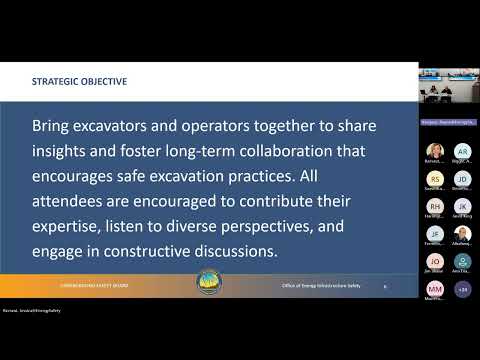
Committee member Johnson said the workshop — the second in a coordinated statewide series — would build on the January session and move from identifying problems toward developing implementable solutions. Workshop staff and industry representatives used a live poll that produced 28 responses and selected failure to notify 811 as the root cause to address during the current series of workshops.
Participants said durable outreach will require partnerships, consistent training materials, and changes to existing education channels. Steve Cleaver, senior manager for PG&E’s damage prevention and compliance group, urged broadening outreach beyond utility operators and 811 centers and said enforcement tools available to operators are limited. "The only thing that we can do is recover the costs that it took for that," Cleaver said, adding that stronger regulatory coordination and clearer enforcement roles are needed to change behavior.
Industry representatives described several approaches discussed at the workshop: creating a standardized training package from the Underground Safety Board or Office of Energy Infrastructure Safety for distribution through trade associations and call centers; a train‑the‑trainer model so associations can deliver a consistent message; embedding basic 811/Code 4216 content into the Contractor State License Board licensing or renewal process; and tying 811 awareness to permit issuance by local jurisdictions.
Michael Wurster, representing the California Regional Common Ground Alliance and USIC locating services, described a proposed stakeholder panel that will work on the topics between sessions and urged using associations and municipal groups to reach contractors. Julie Permina of SoCalGas said company data show a large share of damages stem from missing 811 tickets and recommended adding excavation‑code material to licensing and permit processes: "There needs to be some type of process in place for one to apply and get a license," she said.
Workshop attendees emphasized in‑person outreach as more effective for engagement and behavior change, while acknowledging online tools are needed to reach remote or time‑constrained workers. Several speakers noted in‑person sessions allow follow‑up, direct Q&A and relationship building; PG&E reported its dig‑reduction team ran roughly 390 workshops in the prior year. At the same time, participants urged multilingual materials and outreach to nontraditional excavators, such as fence and landscaping contractors, homeowners, and small operators.
Other technical and program proposals raised during the session included expanding vocational and trade‑school exposure to locating and damage‑prevention careers, developing entry‑level locator training, improving locator qualification language (the transcript cited older references to NOLCA and CGA best practices in statute), and improving electronic positive response (EPR) and permit integration so ticket and permit processes align.
Speakers also discussed barriers: limited budgets at utilities and one‑call centers, concerns about imposing costs on small contractors, reluctance among some workers to engage with formal licensing, and the practical problem of tickets created months before work that may no longer reflect marks on site. Several attendees recommended data‑driven prioritization — target outreach first at the contractor types and geographies that show the most no‑call damages — and using incentives (for example, insurer discounts or permitting prerequisites) where feasible.
The committee did not adopt new regulations at the workshop. Instead, it asked attendees to continue working through a stakeholder panel and said staff will analyze comments and prioritize topics for future sessions. Member Jacqueline said the committee plans to continue the series on March 27, May 2 and June 5 and invited further input by email to digboard@energysafety.ca.gov.
The workshop combined broad agreement on goals with differing views on tactics. Attendees repeatedly called for a consistent, government‑endorsed training package distributed via associations, call centers and permitting channels; many urged that package be available in multiple languages and suitable for short, on‑demand delivery as well as in‑person sessions.