Get Full Government Meeting Transcripts, Videos, & Alerts Forever!
Get email alerts on the City Budget topic
No spam. Unsubscribe anytime.
San Luis reviews conservative FY26 budget after expected state, federal revenue hits
Summary
City staff presented a reduced FY26 continuation budget that trims capital projects, special events and some hiring after projected state and federal revenue losses; council asked for more detail and proposed a state‑capitol advocacy trip.
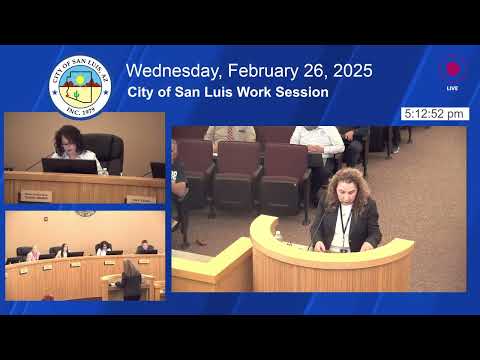
San Luis city staff presented a reduced fiscal year 2026 continuation budget on Feb. 26, saying they built the plan around an anticipated loss of revenue from state and federal changes and recommended cuts to capital projects, special events and new hires while preserving core services and proposed salary market adjustments.
The presentation, by Sonia Rola, director of finance, outlined a department-requested total of $153,850,000 and a proposed continuation budget of $139,920,000 — a $13,930,000 reduction driven largely by a $9,750,000 cut to capital items, with additional reductions in other financial sources and special services. Rola said management is proactively reducing spending by $4,000,000 to align with the projected revenue loss if the state fully eliminated the local food tax, and that a pending legislative amendment that would cap the food tax at 2% could reduce the city’s exposure to approximately $2,000,000 instead of $4,000,000.
Why it matters: The budget shapes near‑term city services, staffing and the timing of capital projects. Council members repeatedly pressed staff for detail about which positions and projects would be continued or postponed and asked how the city would respond if anticipated state or federal funds were reduced or rescinded.
Citywide changes and fiscal math
Rola said the city expects multiple revenue impacts: a proposed change to the state transaction privilege tax on remote sales that reallocates revenue to the buyer’s shipping address (she estimated $1,000,000 in lost revenue), the loss of $100,000 annually from residential rental tax receipts and uncertainty around federal grants. To prepare, she said, management proposes a conservative continuation budget that, among other items, reduces the citywide budget request from $153.85 million to $139.92 million.
Staff presented salary adjustments that would bring pay to 97.5% of market in the current fiscal year and to 100% of market in FY26, with longevity pay budgeted at $85,000. Rola said total salaries and benefits in the continuation proposal rise by $2,030,000 to $33,460,000; new personnel requests were reduced by $1,090,000 and reclassification/promotions were reduced by $83,800.
Council questions focused on consistency of job titles and pay grades for reclassifications, the number of part‑time-to‑full‑time conversions in Parks, and the mechanics of improvement districts. When asked how many positions would move from part time to full time in Parks, staff said two positions would be converted and paid from improvement district revenues; the parks maintenance conversions represent one employee each in two distinct ground teams.
Public safety pay and hours
Council members asked why firefighter hourly rates appeared lower than police officer rates even though annual pay was similar. Finance staff and the fire chief explained the difference stems from annual hours: the police schedule is based on 2,080 hours per year while firefighters work about 2,756 hours per year under 24‑hour shift schedules; additional certification or paramedic pay also applies to some firefighter wages. "The difference is the 2,756 hours that the fire department works as opposed to the 2,080 hours that police work," the fire chief said.
Special events and community programs
Parks and recreation and finance staff proposed cutting many cultural and community events to save costs, while retaining two symbolic community events: the July 4 celebration and the Founders Day (Asala and Brew Festival). Parks Director Haley Carolland explained staff considered donation‑funded events but found sponsorship capacity limited and warned that pursuing donations could require dedicated staff time.
Council members suggested stronger partnerships with local businesses, and one council member proposed redirecting a previously requested 50% internal cost reduction for medical benefits (an $87,229 saving cited by that council member) to cover event costs; the council did not take action during the work session.
Capital projects and federal grant uncertainty
Staff flagged several capital projects that were postponed or reduced; vehicles and design work for facilities were among the identified savings. Council members asked whether grant‑matching columns in the capital spreadsheet reflected only the city’s match or the full project costs; staff explained that grant awards and matches live in separate funds but are reported together in the capital outlay view, which can make the continuation column show the full project amount even when the city’s match is smaller.
The city also discussed a previously awarded U.S. Department of Transportation rural surface transportation grant for $25 million related to Cesar Chavez Boulevard. City staff said a grant agreement with the Federal Highway Administration has not been signed and warned that, given recent executive orders and federal funding freezes, the award could be at risk. "If a grant agreement is not executed, is our funding in jeopardy?" a council member asked; staff said they had been told the answer could be yes by the governor’s office legal counsel.
Next steps
No formal votes were taken during the informational work session. Council members asked staff to return with more detail and requested the administration consider organizing a "day at the Capitol" to meet state legislators within the next two to three weeks to advocate on the city’s budget priorities and pending bills affecting municipal revenue. Staff said they and economic development had considered such a trip and could coordinate meetings with the League of Cities and local representatives.
The council did not adopt changes during the session; staff recommended continuing to build a conservative FY26 budget and returning with a revised document and classification structure for further council review.