Get Full Government Meeting Transcripts, Videos, & Alerts Forever!
Get email alerts on the Special Districts Governance topic
No spam. Unsubscribe anytime.
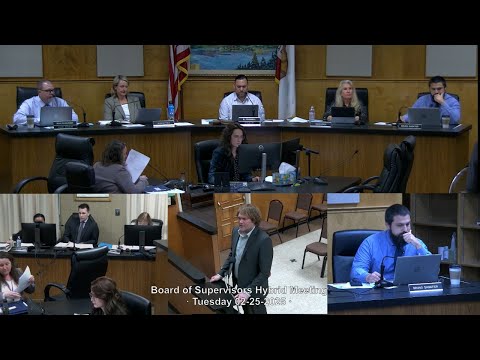
Lake County supervisors approve talks with Clear Lake on Lake O'San governance; motion passes 3-2
Summary
The Lake County Board of Supervisors voted 3-2 to begin talks with the City of Clear Lake about possible changes to the governance model for Lake O'San, approving a delegation makeup and agreeing to start formal meetings after July 1 at the CAO's request.
The Lake County Board of Supervisors voted 3-2 to authorize initiating discussions with the City of Clear Lake about potential changes to the governance model for Lake O'San.
Board members said the vote responds to an April 2024 resolution from the Clear Lake City Council asking Lake O'San's board of directors to open talks. Supervisor Sabatier, a sponsor of the item, told the board that previous years had seen substantial sewer-system problems in the Highlands Harbor area, noting “there was about a million gallons” of raw sewage released and later saying, “I think it was actually about 600,000 when you add up the, the years.”
The request before the board was limited to opening dialogue rather than approving any specific structural change. “This is saying we are in agreeance to come to the table and see how can we do things better together,” Supervisor Owen said during the discussion.
Why it matters: The county oversees and interacts with multiple special districts that serve Clear Lake and nearby communities. Supervisors split over whether a formal review could lead to fairer representation and stronger system oversight or whether it would give the city disproportionate influence over areas outside its jurisdiction.
City and district officials attended the meeting and urged cooperation. Alan Flores, city manager for the City of Clear Lake, told the board, “I appreciate Supervisor Sabatier and Supervisor Owen bringing this forward, and hope that the rest of the board supports us getting together and talk about this more.” Special Districts Administrator Robin said she was “primarily here to answer any questions you may have and [about] the operation, ongoing operations of our systems.”
Opposition and staff concerns: Supervisor Pyska said she did not see a county benefit and warned that the change could give “unfair representation from a certain area” and harm constituents outside the city. County administrative staff cautioned about available staff time: a county administrator asked that, if the board moved forward, the county begin formal discussions after July 1 because administrative staff are committed to existing priorities through June 30.
Board action and next steps: The board approved two related actions. First, it voted to initiate discussions with the City of Clear Lake about potential governance-model changes for Lake O'San; that motion passed 3-2. Second, the board approved a proposed delegation composition — the District 1 and District 2 supervisors, the district director (referred to in the meeting as Director Bridal), and a member of the CAO's office — to carry out those discussions; that motion also passed 3-2. County staff and counsel are expected to participate in follow-up work and legal review, and the CAO asked that substantive meetings be scheduled after July 1 to avoid conflicts with current administrative workloads.
Board members and staff outlined other options that could satisfy the request without altering governance seats, including resurrecting a previously disbanded sewer advisory group or forming an ad hoc committee to review definitions of district boundaries and the delegation makeup. Vice Chair (unnamed in the transcript) and other supervisors suggested staff-level meetings or a Clear Lake–area meeting for special districts to share budget and operational information as lower-effort alternatives to formal governance changes.
Public comment: One member of the public, Douglas Clark, spoke during the public-comment portion and was acknowledged by the board; no substantive technical proposals were submitted during public comment.
What remains unresolved: The discussions authorized by the board do not change existing governance or representation. Any structural change would require additional reviews, legal analysis and subsequent formal actions. The April 2024 City of Clear Lake resolution that prompted the conversation remains the initiating document for the talks.
The board did not provide a timeline for concluding the discussions; staff said next steps include coordinating the proposed delegation, scheduling meetings after July 1 if the CAO's availability request is accepted, and engaging county counsel for legal review.