Get Full Government Meeting Transcripts, Videos, & Alerts Forever!
Get email alerts on the Student Mental Health topic
No spam. Unsubscribe anytime.
District social worker tells parents how to support students’ mental health amid enforcement anxiety
Summary
José Macías, a district social worker, described common anxiety symptoms in children and listed techniques and school resources families can use, saying counselors and social workers are available at every school in the district.
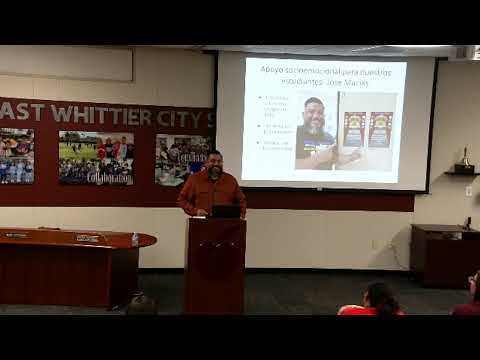
At a community meeting hosted by East Whittier City Elementary, district social worker José Macías urged parents to recognize and respond to anxiety in children linked to immigration enforcement concerns and described school-based mental-health resources.
Macías said anxiety can show itself as excessive worry, headaches or sleep problems and urged parents to create calm, talk openly and model healthy coping skills. “Crear un ambiente tranquilo donde podemos asegurarles que, aunque ahorita los tiempos son difíciles, estamos seguros,” he said during his remarks.
Why it matters: Parents told presenters they and their children are seeing upsetting social-media reports and news items, and some parents asked how schools will reassure students. Macías said every school in the district has counselors and social workers who can provide support, referrals and connection to community resources.
Key guidance and supports described - Recognize and validate feelings: Macías advised parents to ask children how they feel and to validate those feelings rather than hide all information. He said children often pick up cues from adults’ faces and behavior. - Teach calming techniques: He recommended simple exercises such as breathing, visualization and counting to ten as tools children can use to manage acute anxiety. - Limit harmful media exposure: Macías suggested reducing children’s exposure to graphic social-media posts or repeated news coverage that can amplify stress, while acknowledging parents still need information. - Use school resources early: He said counselors and social workers are available at every school and can connect families to community resources, legal referrals and counseling. “Tenemos consejeros y trabajadores sociales en todas nuestras escuelas que los pueden apoyar con recursos comunitarios, legales, consejería,” Macías told the meeting. - Crisis protocols: Macías said any report of suicidal thoughts or self-harm is routed to school mental-health staff immediately for intervention and referral.
Programs and school initiatives Macías described existing district efforts such as anti-bullying programs, mental-health awareness days and other monthly initiatives that prompt staff to check in with students. He said staff will connect families to support when they detect changes such as social withdrawal, appetite or sleep changes.
What the meeting did not change Presenters described supports already in place; there were no new district mental-health programs or budget commitments announced during the meeting.
Ending Macías said he would remain after the meeting to take questions and that parents should contact school counselors or the district’s mental-health staff if they notice troubling changes in a child’s behavior. “Si ustedes reconocen que hay cambio en sus actitudes... Hable con alguien,” he said.