Get Full Government Meeting Transcripts, Videos, & Alerts Forever!
Get email alerts on the Immigration topic
No spam. Unsubscribe anytime.
Immigration attorney explains rights, district staff outline response if ICE appears at schools
Summary
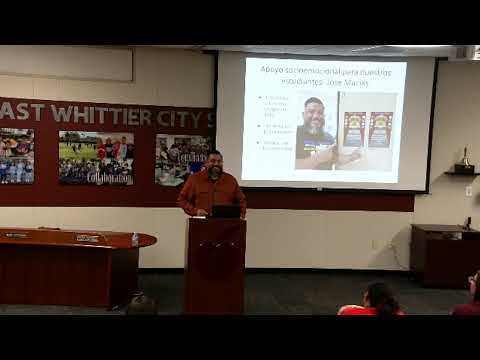
At a community meeting hosted by East Whittier City Elementary, immigration attorney Gustavo Mora walked families through what ICE can and cannot do, while district officials said school administrators and office staff have been trained on the district’s response and family-notification procedures.
At a community meeting hosted by East Whittier City Elementary, immigration attorney Gustavo Mora told families what to do if Immigration and Customs Enforcement (ICE) officers try to detain a household member and district staff described how schools will respond to any ICE presence.
Mora, who said he has practiced immigration law in Los Angeles since 2006, told attendees that ICE generally needs a judicial arrest warrant to take a student or family member from school and that families should ask to speak with an immigration attorney before answering questions. “La cosa más importante es, primero, no decir nada y demandar que usted quiere hablar con un abogado de inmigración,” he said during the meeting.
The district’s director of student services, Trina González, said administrators and office staff at the district’s schools have received training on the district’s response. “Todos los administradores de estas escuelas y la personal de oficina han recibido entrenamiento,” she told attendees, and she said families would be contacted immediately if officers sought to speak with a student or family member.
Why it matters: Parents and caregivers told district leaders they are anxious about recent national enforcement activity and social-media reports. The attorney’s guidance and the district’s stated protocols address two separate concerns: how families can protect legal rights during enforcement encounters, and how schools will manage student safety, notification and staff roles if enforcement activity occurs on or near campus.
Key points from Gustavo Mora’s presentation - ICE authority: Mora said ICE can detain people with existing removal orders or those accused of serious crimes, but does not automatically remove people without due process through immigration court. He advised families to demand counsel and to present receipts for any pending immigration applications: presenting those receipts, he said, can reduce the chance that officers will detain someone whose case is already moving toward approval. He said, “si usted tiene una aplicación de ajuste para su residencia ya pendiente y presentas ese documento, hay muy alta probabilidad que el director de ICE... van a decir, ok, pues califica para la residencia.” - Arrest warrants and sensitive locations: Mora emphasized that officers must show a judicial arrest warrant with the named individual; he instructed parents that they have the right to ask to see the warrant. He also said schools are considered “sensitive locations” and that a 2011 memo advises ICE to avoid enforcement at schools, hospitals and places of worship, though policies can change across federal administrations. - Expedited removal and border returns: He told attendees that expedited removals at the border have been in place since April 30, 1997, and that those removal records may affect future immigration relief, depending on the circumstances. - Defensive relief and cancellation of removal: Mora explained that certain defensive forms of relief—most notably cancellation of removal that requires more than 10 years’ presence and qualifying relatives—can only be requested in immigration court. “Esa aplicación solo es elegible para alguien que está en procedimiento de corte con un juez de inmigración,” he said. - Visas and other relief: He described the U nonimmigrant status (Visa U) for victims who cooperate with law enforcement and said Congress caps U visas at about 10,000 approvals per year, which has produced long waits in some cases. He also discussed DACA and TPS, noting renewals remain available even where new applications are restricted. - Notarios vs. attorneys: Mora warned families about the difference between notarios and licensed attorneys. “La otra diferencia entre los licenciados, abogados y notarios son que solo abogados te pueden dar avisos legales,” he said, and cautioned against fraudulent or improper filings that can cause collateral consequences.
District response and recommended family actions reported at the meeting - Training and notification: Trina González said administrators and office staff have been trained and that the district will contact families immediately if officers seek to speak with a student. She said staff may accompany a student when officers are present and will remind students that they do not have to answer questions from officers. - Communication options: Mora recommended that families keep copies of any pending immigration receipts and contact an immigration attorney or trusted legal-help organization if ICE appears. He named local nonprofit resources and referred to organizations such as MALDEF and CHIRLA as sources of low-cost legal help.
What the meeting did not decide or change There were no formal votes or policy changes recorded at the meeting. Presenters provided legal information and described existing district training; they did not announce new district rules, new memoranda of understanding with external agencies or changes to state or federal law.
Resources mentioned Attorney Gustavo Mora offered to take follow-up calls from community members. Presenters also referenced community legal organizations including MALDEF and CHIRLA and recommended contacting school staff, district administrators or local legal-aid organizations for case-specific advice.
Ending District officials said they will continue outreach to families and staff training; families with immediate legal concerns were urged to contact an immigration attorney or one of the legal-aid organizations named at the meeting. The district did not provide a formal written protocol during the meeting beyond the staff training and family-notification steps described by Trina González.