Get Full Government Meeting Transcripts, Videos, & Alerts Forever!
Get email alerts on the Pike River Restoration topic
No spam. Unsubscribe anytime.
Kenosha County hears plan to restore South Branch Pike River; funding and flood benefits remain uncertain
Summary
Kenosha County supervisors received an informational presentation on the proposed South Branch Pike River restoration, a project that project partners say would re-meander about 1.5 miles of channel, restore roughly 215 acres of floodplain and wetlands, create about 1.5 miles of multi-use trail, and reduce an estimated 1,000 tons of sediment entering the waterway.
Kenosha County supervisors received an informational presentation on the proposed South Branch Pike River restoration, a project that project partners say would re-meander about 1.5 miles of channel, restore roughly 215 acres of floodplain and wetlands, create about 1.5 miles of multi-use trail, and reduce an estimated 1,000 tons of sediment entering the waterway.
The project team, led by Kenosha County planning staff and partners from Root Pike Win, the U.S. Army Corps of Engineers' Chicago District and the Wisconsin Department of Natural Resources, described a long-running effort that the Corps deemed to have federal interest under the Corps' Continuing Authorities Program, Section 206. "The restoration of the South Branch is not just an environmental project, though. It's a promise to the next generation," said Dave Giordano of Root Pike Win.
Why it matters: presenters said the South Branch has been straightened and tiled for agriculture over the last century, contributing to high erosion and poor water quality in the Pike River watershed and Lake Michigan. Restoring meanders, creating wetlands and establishing native vegetation are intended to reduce sediment and improve habitat and recreational access.
Project details and partners
Andy Buehler, Kenosha County director of planning and development, summarized the location as the corridor between Highway K and Highway S and said the Corps completed a feasibility study and advanced plans to roughly 60% design. Captain Tom Kinney of the U.S. Army Corps of Engineers described the Corps' role and authorities. Josh Brown of the Wisconsin Department of Natural Resources said DNR funding through the Wisconsin Wetland Conservation Trust is a key piece: "The amount of money that they have available from the funds that they bring in is about 60 acres. The area that we have in the South Branch is about 60 acres. So that's pretty cool." The Fund for Lake Michigan and the Brookwood Foundation were also cited as grant partners.
Cost, funding split and next steps
Chris Walton, who presented cost figures, said the project moved from a 50/50 feasibility-share to a roughly 65/35 cost-share with the Corps for design and construction as the proposal advanced. Walton said grant commitments and partner fundraising have reduced the county's anticipated outlay compared with earlier projections and estimated a county share on the current path could be in the low hundreds of thousands to under $1 million, depending on final costs and partner contributions. He said if the Corps must spend up to its $10 million cap, the county could face incremental obligations; "If the project were to end today, we owe about $18,000 of those expenses," Walton said, referring to previously incurred design cost shares.
Giordano and presenters said Root Pike Win has a letter of intent to pursue roughly $1.6 million in additional outside funding, and that earlier grants totaling about $2.3 million from the Brookwood Foundation and the DNR help reduce the county's share. Presenters said a county initial-resolution would request authority not to exceed $2.5 million in additional county funds; that resolution was described as planned to go to PDEC and finance committee meetings in mid-March and to the full County Board on March 18.
Flood mitigation and outstanding questions
Multiple supervisors and members of the public asked whether the restoration would reduce flooding on private property downstream. Andy Buehler and county staff repeatedly emphasized that the Corps project is an ecosystem-restoration project, not a formal Corps flood-mitigation (Section 205) project. Buehler said officials' 60% design analysis did not show a clear, measurable reduction in downstream flooding: staff told supervisors the project may reduce some local inundation on nearby parcels, but "not necessarily downstream." Several supervisors requested follow-up analyses and figures before the board considers bond authorization, including: a Corps cost breakdown tied to the 60% design, an operations and maintenance (O&M) estimate once design is completed, and the projected county property-tax revenue loss on parcels the county would acquire.
Public comment and local response
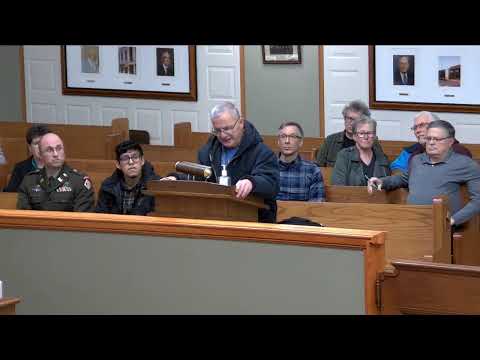
Two citizens spoke before the presentation under special permission. Rod Grimes, who said he has lived adjacent to the South Branch for 56 years and described repeated basement flooding, said the project would "have a very positive impact on everything downstream" and declared his support. Alderman Rockle Lamaki of the Fifth District, identifying himself as a local elected official, also spoke in favor, saying the project "is beneficial not only to the residents, [but] the whole city of Kenosha."
Process and timeline
Presenters said the Corps completed feasibility work and a 60% design in 2024; the Corps' federal interest determination dates to a 2017 process that authorized up to $10 million in Corps funding under CAP Section 206. County staff said the next formal steps are committee referrals in March and a County Board vote on an initial resolution to authorize additional county financing; staff cautioned that final construction costs and design changes could alter the county share. No funding resolution was voted on at the Committee of the Whole meeting; the session was informational.
What remains: supervisors asked staff to provide (1) the Corps 60% cost estimate and cost breakout, (2) an O&M estimate to be produced at completed design, (3) the expected property-tax revenue loss for county-acquired parcels, and (4) clarification of whether areas south of Highway K might experience drainage improvements from this phase. Presenters said they would return with those details as design advances.
The meeting concluded with a routine adjournment vote. The restoration proposal will return for committee and finance review before the County Board considers bond authorization.