
Frederick County School Board adopts FY‑26 budget with bus, tech changes after debate on teacher pay, preschool and school meals
Get AI-powered insights, summaries, and transcripts
Subscribe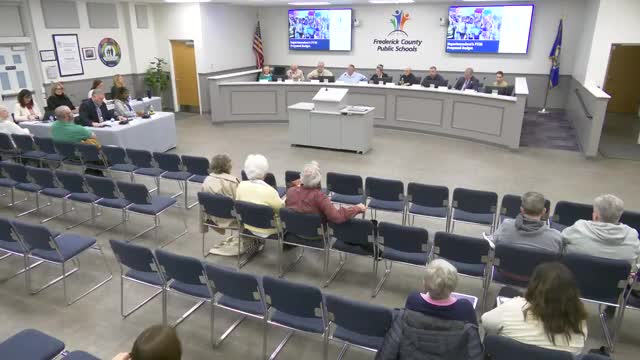
Summary
The Frederick County School Board on Feb. 25 adopted Superintendent Dr. Hamer’s FY‑26 budget with two amendments — adding two bus replacements (four total) and reducing a technology line from $100,000 to $75,000 — after extended discussion about teacher pay scale options, preschool funding and the Community Eligibility Provision for school meals.
The Frederick County School Board voted Feb. 25 to adopt Superintendent Dr. Hamer’s proposed fiscal year 2026 budget with two amendments: add four school bus replacements (up from two) and reduce the technology refresh allotment from $100,000 to $75,000.
Board members approved the motion by roll call: Atkins, Erskine, Klein, Sturtevant, Bell, Funes and Martin all voted aye. The amended adoption does not change the superintendent’s original pay‑scale proposal, which remains the motion on the table.
The budget vote capped a two‑hour work session in which board members and staff discussed five items the board asked the division to re‑examine: teacher pay scales, additional school buses, a technology reduction, preschool/VPI programming and the Community Eligibility Provision (CEP) for school meals. Superintendent Dr. Hamer presented timeline context for the FY‑26 process, noting the division will send the adopted budget to the Board of Supervisors for appropriation in April and that the board can reallocate funds after appropriation but cannot exceed the county’s appropriation.
Why it matters: the budget sets staffing, program and capital priorities for the coming school year and will be incorporated into the county appropriation process. Several board members framed the vote as balancing teacher recruitment and retention, services for early‑childhood students and stewardship of local taxpayer dollars.
Teacher pay scales: Dr. Hamer reviewed the division’s needs‑based pay proposal and three pay‑scale options discussed by staff and the finance committee. The superintendent’s original proposal (column A) was a 4.9% increase in base teacher pay; an option discussed earlier in committee (column E) equated to a 5.6% increase; combining A and E (referred to as scale F) would produce an estimated 6.4% increase and was presented as adding about $866,000 to the budget. Board members expressed differing priorities: some favored accelerating raises for early‑career teachers, others raised concern about mid‑career retention and the effect on staff with 13–16 years of service. Board member Klein said she remains “a very huge proponent of pay scale option F,” but the formal budget motion adopted the superintendent’s originally proposed (A) pay scale; the board did not take a separate roll‑call vote to move to E or F during the meeting.
Preschool and early‑childhood services: Dr. Hamer and staff outlined the three strands of early‑childhood services: the Virginia Preschool Initiative (VPI, a state‑funded, income‑based program), Head Start (federally funded and run by a community partner in Frederick County), and Early Childhood Special Education (ECSE) required under the Individuals with Disabilities Education Act (IDEA). Frederick County Public Schools currently operates four VPI classrooms (Stonewall, Apple Pie Ridge, Evendale and Gainesboro), each with 18 students (72 VPI slots filled) and about 40–41 children on a VPI waiting list. The division has 327 VPI slots allocated by the state.
Staff proposed reallocating a portion of VPI slots to ECSE to reduce the division’s local ECSE match; that reallocation — described in the presentation as taking roughly 25 VPI slots — was estimated to lower local ECSE costs by about $315,000 and could be implemented beginning next school year. Staff said VPI is not a required program (unlike ECSE) but that VPI provides instructional support for economically disadvantaged children and that the division’s VPI classrooms meet state quality criteria.
School nutrition and CEP: the board held an extended debate about the Community Eligibility Provision (CEP), a federal option that allows qualifying schools to serve breakfast and lunch at no charge to all students while the district receives federal reimbursements based on identified student percentages and participation. Staff said the division’s nutrition program costs roughly $9.5 million to operate; the division receives between $4 million and $6 million in federal reimbursement dollars, roughly $2.5 million from student purchases and contributes about $1 million from the operating fund.
Currently nine Frederick County schools participate in CEP. Staff explained that if a school participates in CEP the division receives federal reimbursement for every qualifying meal served at the CEP reimbursement rate for that school; if CEP were removed, reimbursements would be tied only to families who complete free‑and‑reduced applications. Staff cautioned that removing CEP from the nine schools would produce only about $200,000 in immediate local savings while risking higher local costs because of reduced federal reimbursements and additional administrative work to collect applications and manage accounts. Board members asked staff to model several scenarios, including full CEP for all 21 facilities and pre‑CEP baseline comparisons, before making long‑term policy changes. Staff committed to returning historical and projection data to the board for further review.
Other amendments and items: the adopted motion increased the number of school bus replacements from two to four (the operating budget line moved from approximately $300,000 to $600,000 for that item) and reduced the planned technology refresh allocation from $100,000 to $75,000. Staff said the bus increase responds to fleet needs tied to new construction and enrollment growth; several board members said earlier procurement is less expensive than delaying replacement.
Votes at a glance: the board adopted the superintendent’s FY‑26 budget as amended (motion passed by roll call: Atkins, Erskine, Klein, Sturtevant, Bell, Funes and Martin — ayes). No board members recorded a no vote on the final motion.
What happens next: the division will forward the adopted budget to the Frederick County Board of Supervisors for appropriation in April. Dr. Hamer and staff will continue to meet with county officials and return to the school board with updated models if the supervisors’ appropriation differs from the division’s request. Board members asked staff to return detailed pre‑CEP and post‑CEP financial comparisons, projected meal‑debt scenarios, and a clearer cost analysis for implementing CEP across all schools.
The board scheduled its next meeting for March 18, 2025.