Get Full Government Meeting Transcripts, Videos, & Alerts Forever!
Get email alerts on the Cte Career Investigation topic
No spam. Unsubscribe anytime.
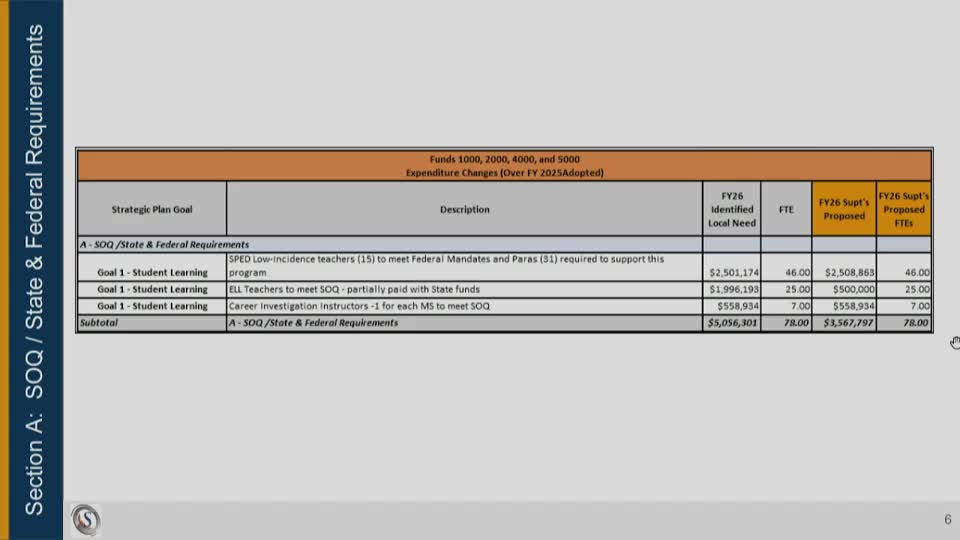
Board reviews plan to add career‑investigation instructors at middle schools and expand CTE
Summary
The superintendent proposed adding a career‑investigation teacher at each middle school and several CTE instructors to expand access to career pathways, while board members asked about capacity, dual enrollment and grant funding.
Superintendent staff proposed adding career-investigation instructors at each middle school and adding several CTE instructors at the high school/CTE center to meet demand in programs such as culinary, welding and cosmetology.
Staff described the career-investigation instructor as a contract teacher assigned to a grade (likely seventh), teaching a semester‑long course that incorporates VDOE competencies and aligns students with pathway choices. “All seventh graders will have the opportunity to go through the course,” a budget presenter said.
Board members pressed staff on capacity and pathways. The board discussed the difference between a middle‑school career‑investigation teacher and high‑school career counselors; the former is a classroom position teaching exploration, the latter supports postsecondary planning, resumes and placements. Staff said they expect the middle‑school instructors to collaborate with high‑school counselors and the SCTC (career‑technical center) to steer students to appropriate pathways prior to high school.
The SCTC waits and capacity were central themes. Board members noted applications exceed seats in programs such as medical assisting, culinary and welding; one board member asked staff to re-evaluate whether the highest‑demand CTE instructor requests (welding, culinary, cosmetology) should be altered to add instructors for medical assisting, which also showed a high applicant-to-seat ratio in the division data packet.
Staff discussed grant funding (Perkins and other federal grants) and said Perkins increases were minor and not expected to fund the requested CTE expansion. Members suggested pursuing partnerships and evening or community-based options to increase capacity without immediate capital investments. Staff said the long‑term solution could include a new career-technical center but would require bond authority and board of supervisors support.
Board members asked staff to return additional data on past pilots and grant-funded positions at the CTC and to provide the rationale for prioritizing the three identified CTE hires.