Stafford school board adopts $503.1 million FY26 funding request after debate over teacher pay, support staff and health benefits
Loading...
Summary
The Stafford County School Board on Thursday unanimously adopted a $503,109,363 FY26 local funding request to the Board of Supervisors, increasing the district’s ask to complete phase 4 of the teacher pay scale and to advance support staff to phase 3.
The Stafford County School Board on Thursday unanimously adopted a $503,109,363 FY26 local funding request to present to the Board of Supervisors, increasing the district’s ask to pursue full phase 4 of the teacher pay scale and advancing support staff to phase 3.
The board’s funding request — amended during the meeting to add money to the support-staff scale — also reflects projected state revenue increases and growing local costs. Board and staff speakers repeatedly cautioned the total still depends on the state budget being signed and on the supervisors’ final appropriation.
Why it matters: The vote formalizes the school system’s highest-priority funding request ahead of the county budget process and follows weeks of public comment pressing for more competitive pay for teachers and support staff. School leaders said the request is intended to keep Stafford competitive with neighboring divisions and to address rising health-insurance and mandated staffing costs.
The board began the meeting hearing a detailed mid‑year financial update from finance staff. "We have an overall projected surplus in the operating fund of approaching $4,000,000," Mr. Fulmer said during that presentation, referring to mid‑year revenue and expenditure projections. Staff cautioned, however, that a major pressure point is rising health‑benefit claims: the division projects a multi‑million dollar deficit in the health‑benefits fund unless additional steps are taken.
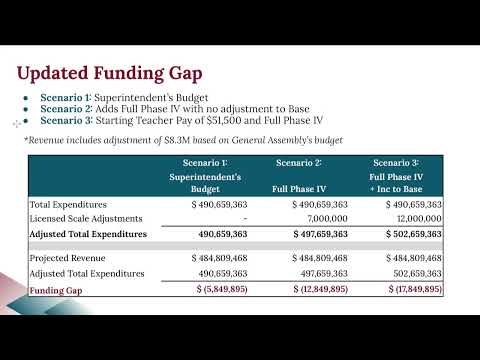
Key figures and scenarios presented by staff showed the sensitivity of the budget to state revenue and pay decisions. With the governor’s and General Assembly’s proposed state funding, staff said recurring state revenue could rise by about $18.8 million and total projected revenue by roughly $24 million, but portions of that increase remained uncertain until the governor signs the budget. The superintendent’s baseline budget reduced the division’s funding gap under one scenario to roughly $5.8 million; expanding to the full teacher phase 4 added about $7 million to that baseline and pushed the gap higher under other scenarios. Staff also said a $5 million proposed local transfer was already included in some calculations and would be added to the board’s county request.
Board members emphasized recruitment and retention goals. Several school board members described the multi‑year compensation plan adopted in prior years as a road map they are trying to follow; the motion the board approved requests funding that would complete phase 4 for licensed staff and advance support staff pay further than the superintendent’s original ask. Miss Halstead, Miss Guy and other members said asking for the larger amount preserves the board’s priorities and lets the county and public know the full scale of the division’s needs.
Public comment was extensive. Logan Paulenstein, a Drew Middle School teacher, testified that the proposal as initially presented shortchanged experienced teachers and urged a pay scale that recognizes years of service. "When we fail to reward experienced educators, we risk losing them," Paulenstein said. Several other speakers, including support‑staff employees who identified themselves as administrative assistants and school clerks, said years of low relative pay have made it hard to recruit and retain critical non‑licensed personnel.
Staff also highlighted programmatic pressures: substantial growth in English‑language learners (ESOL) that drove requests for additional ESOL teacher positions, continuing increases in special‑education caseloads and the operational cost of opening new schools next year. Mr. Fulmer and other staff said average teacher experience in the division has risen (about 12.13 years in the current data), which increases salary costs even without changing pay scales.
Health‑benefit costs drew repeated attention. Staff presented current-year health‑claims data showing a projected increase in claims that would push the health‑benefits fund into a deficit (staff projected a roughly $7 million shortfall in a stressed scenario). The division also holds an OPEB (other post‑employment benefits) trust with approximately $45 million in assets; staff suggested options that could include a limited use of trust assets or other one‑time transfers to manage FY25 shortfalls, but stressed any move would need county appropriation to authorize the spending.
What the board approved: The board formally approved the FY26 local funding request with a late friendly amendment that added roughly $550,000 to fund support staff at phase 3 rather than phase 2. The final number the board will send to supervisors is $503,109,363. Board members and staff stressed the request remains a proposal: final appropriation will be determined by the Board of Supervisors and by state budget action.
Ending: Board and staff said they will continue to refine numbers and bring any required follow‑up items to additional budget meetings and work sessions. The board also voted that night on several facilities items — including emergency canopy removal and replacement contracts and bleacher replacement at Stafford High School — and discussed a schedule change and other operational issues. The school system’s budget timeline means the adopted funding request will be part of a public discussion at the county level in the weeks ahead.