Get Full Government Meeting Transcripts, Videos, & Alerts Forever!
Get email alerts on the Redistricting topic
No spam. Unsubscribe anytime.
School board reviews redistricting policy language, seeks clear priorities for elementary boundary work
Summary
Board members discussed revisions to Policy 1403-P and proposed Regulation 1403-R to clarify criteria and priorities for upcoming elementary redistricting, focusing on capacity thresholds, neighborhood stability, Title I impacts and transition supports for affected students.
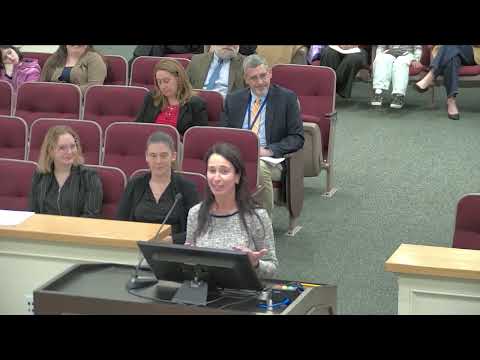
The Stafford County School Board reviewed proposed revisions to Policy 1403-P and a draft Regulation (1403-R) intended to guide elementary redistricting, and discussed the priorities staff should use when drafting initial boundary scenarios for 2026 implementation.
Board members and staff debated numerical thresholds for 'crowded' schools, how to define capacity utilization, and whether criteria should be presented in alphabetical order to avoid implying priority. Members emphasized the need to balance proximity, transportation efficiency and stability for students who rely on school-based services.
Key issues surfaced - Capacity thresholds: Board members questioned whether '105% of capacity' is an appropriate trigger for action and asked staff to propose clearer capacity-utilization definitions so a 'crowded' designation is consistent across older and newer buildings. - Order of listed criteria: Several board members recommended listing criteria alphabetically or explicitly stating that items are not ranked so the order does not imply priority. - Stability and vulnerable students: Board members stressed the importance of minimizing disruption for special-education and Title I students, and requested transition plans (community events, principal-led outreach, and staff transition supports) be included in regulation language. - Neighborhood integrity: Some members pushed to preserve neighborhoods where practical, while others warned large new developments make strict neighborhood preservation impractical.
Process and timeline Staff said they would present initial redistricting scenarios and analysis to the board in a work session in March, provide public engagement sessions in April and May, and bring scenarios for public hearing later in the spring. Board members asked staff to prioritize transportation and demographic data, utilization and programmatic stability in round-one scenarios so commissioners can provide timely feedback.
Discussion vs. decision No formal policy vote occurred at the meeting; the board provided direction to staff about threshold values and presentation order for the criteria and asked staff to return with scenarios and refined policy/regulation language.
Ending Board members asked staff to clarify technical definitions, add explicit transition planning language to the regulation, and ensure public sessions are scheduled at times board members can attend.