Get Full Government Meeting Transcripts, Videos, & Alerts Forever!
Get email alerts on the Land Use topic
No spam. Unsubscribe anytime.
Seattle committee hears sharply split testimony on bill to allow housing in Stadium Transit overlay
Summary
Seattle City Council Governance, Accountability and Economic Development Committee Chair Sarah Nelson opened a public hearing on Council Bill 120933 on Feb. 24, seeking comment on a proposal to amend the city—s land-use code to allow residential uses as a conditional use in the Stadium Transition Area Overlay District (STAOD).
Seattle City Council Governance, Accountability and Economic Development Committee Chair Sarah Nelson opened a public hearing on Council Bill 120933 on Feb. 24, seeking comment on a proposal to amend the city—s land-use code to allow residential uses as a conditional use in the Stadium Transition Area Overlay District (STAOD).
The proposed ordinance would align the STAOD with other urban industrial (UI) zones in the city by allowing residential uses under conditions that include a requirement that 50 percent of dwelling units be affordable at 60 to 90 percent of area median income for 75 years. The bill would also remove a prohibition on residential uses within 200 feet of a designated major truck street for a roughly two-block stretch near T-Mobile Park.
The meeting drew large turnout: the clerk announced 10 remote speakers and 50 in-person speakers signed up for the hearing. Supporters from small-manufacturing groups, housing advocates and several construction trade unions said the change would create affordable, union-built housing and dedicated production space for "makers." Erin Adams, executive director of the Seattle Good Business Network, said, "The Stadium Makers District is an important step towards making that investment," citing the potential to keep local manufacturers and artisans in the city.
Public Stadium Authority Executive Director John Marchioni told the committee the authority "is fully supportive" and said the proposal would "create jobs, housing, transportation, and entertainment for the whole city." Several labor speakers, including representatives of building trades unions and IBEW Local 46, urged the council to approve the change as a way to create construction jobs and apprenticeship opportunities.
Opponents included the Port of Seattle, the Northwest Seaport Alliance and multiple maritime and agricultural industry groups, who argued the change would threaten freight mobility and family-wage maritime jobs. Port Commission President Toshiko Hasegawa told the committee: "Do not proceed with this bill and please enable the certainty that we all agreed to in 2023." She added that "putting pedestrians in direct conflict with freight and trains is reckless urban planning."
Labor leaders representing longshore and waterfront workers also opposed the change. Dan McKiss, a member of ILWU Local 19 and president of the Washington Area District Council, summarized the panel—s central concern simply: "No ships, no jobs." The point was echoed by Northwest Seaport Alliance deputy CEO Don Esterberg, who warned that "customers have choices" and that port users consider reliability and certainty when choosing gateways.
Speakers on both sides cited technical and policy details from the 2023 environmental review and the earlier citywide compromise on industrial lands. Supporters pointed to provisions in the draft allowing 50 percent of units to be permanently affordable and to developer claims of 500 affordable homes in the proposal; opponents said the STAOD sits immediately across primary heavy-haul corridors and adjacent to an international cargo terminal and that placing permanent residents there would create safety, noise and air-quality conflicts and undermine the city—s ability to compete for maritime business.
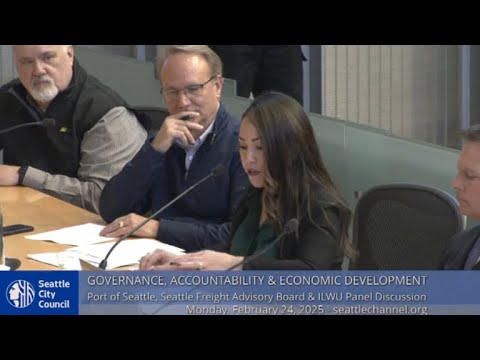
After hearing roughly an hour and a half of public comment and an extended panel briefing from port and freight representatives, the committee closed the public hearing and moved to a separate panel discussion that featured Port Commission President Toshiko Hasegawa, ILWU Washington Area District Council President Dan McKiss, and freight advisory representatives and port staff. The panel reiterated concerns about freight mobility, the economic importance of maritime operations to the region, and the need for "certainty" that industrial lands will remain available for cargo handling. Don Esterberg said, "If we are not able to offer our customers this highly efficient reliable consistent service they have alternatives."
No committee vote or final action on the bill was taken at the meeting; the public hearing was recorded and closed. Chair Sarah Nelson said the committee would continue discussions and that she brought the item forward to increase housing opportunities and maker-space capacity in the city.
What comes next: Committee members and city staff will continue follow-up briefings and deliberations. The hearing record and the environmental review remain the primary documents the council will rely on for future action on Council Bill 120933.