Get Full Government Meeting Transcripts, Videos, & Alerts Forever!
Get email alerts on the Library Levy topic
No spam. Unsubscribe anytime.
Seattle Public Library reports levy-funded gains, flags future maintenance and digital-cost pressures
Summary
Seattle Public Library Chief Librarian Tom Fay updated the Seattle City Council Education and Neighborhoods Committee on Feb. 27 about programs and capital work supported by the 2019 library levy and outlined planning for a proposed future levy in 2026.
Seattle Public Library Chief Librarian Tom Fay updated the Seattle City Council Education and Neighborhoods Committee on Feb. 27 about programs and capital work supported by the 2019 library levy and outlined planning for a proposed future levy in 2026.
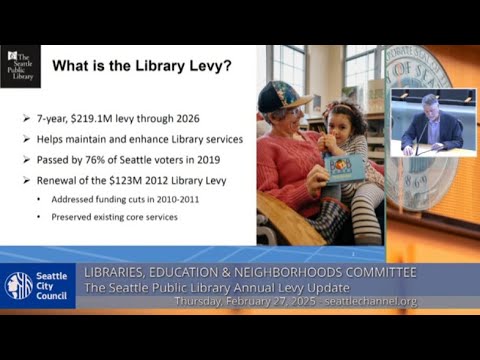
Fay told the committee the seven-year 2019 levy — a $219,000,000 renewal that runs through 2026 — supplied more than one-third of the library’s revised 2024 budget and funds collections, children’s programs, open hours, technology and building maintenance. “To do this, we know we need sustainable long term funding and that we are operating in uncertain times when it comes to federal funding availability,” Fay said.
The update detailed usage and service metrics for 2024 and raised several forward-looking challenges. The library reported a 160% increase in ebook and eaudiobook checkouts since 2019, from 3,400,000 checkouts in 2019 to 5,400,000 in 2024, and said digital and physical collections together now total about 2,900,000 items. Levy dollars fund roughly 40% of open hours, about 20% of collections, about 17% of building maintenance and 9–10% of technology. The levy also funds roughly one-quarter of the library’s staffing and about 35% of children and teen services librarians.
Fay and Kirsten Nelson, government relations manager for the Seattle Public Library, listed 2024 accomplishments funded wholly or in part by levy dollars: adding more than 45,000 new digital titles (nearly 100,000 copies) and more than 168,000 physical items; expanding the “no holds, no wait” peak-picks collection by over 19,000 copies; increasing world-language materials by roughly 4,000 titles and 13,000 copies; preserving and digitizing thousands of Seattle history items (about 3,800 digital items added to the Seattle Room in 2024, bringing that digital collection to about 30,000 items); and adding more than 1,000 new Seattle Room physical items. Programming figures included about 4,000 in-person programs, 300 Kaleidoscope play-and-learn sessions with 7,600 attendees, more than 900 story times across 19 branches drawing 34,000 attendees and after-school homework help that supported roughly 6,000 students at nine locations.
Capital and facilities work highlighted reopening the renovated Green Lake branch after a seismic retrofit and remodel that added study rooms, air conditioning and accessibility improvements. Fay said 22 of 25 branches now have air conditioning following recent HVAC installs and replacements; remaining HVAC work at Fremont, Queen Anne and West Seattle is expected to be funded in part by a FEMA grant. The Columbia branch remains the largest unfinished 2019 project and faces cost increases: Fay said projects estimated at roughly $6,000,000 when planned are now arriving at $10–$13 million. He said state and federal earmarks and foundation funding have helped, and an earmark request was pending with Representative Smith.
On technology, Fay described two levy-funded initiatives now beginning: a new library app and replacement of the library’s integrated library system (ILS), the 35-year-old back-end software that manages catalogs, holds and checkouts. Fay said the first phase of the ILS replacement is expected to finish around mid‑2026. He also outlined steps taken after the library’s 2024 ransomware incident, including moving systems toward the cloud, implementing multi-factor authentication and hiring a cybersecurity analyst.
Council members pressed Fay on several topics. Council Member Moore asked about efforts to address rising ebook pricing; Fay described a request to the Washington Legislature for a study of ebook and eaudio pricing that would include publishers, distributors and other stakeholders, and said the library’s advocates were pursuing legislative support in Olympia. Moore also asked how perceptions of safety affect patron use; Fay said the library trains staff in de‑escalation, funds a social‑services referral team that connected patrons to shelter, health care and other resources more than 1,100 times in 2024, and noted that security measures must be “multidimensional,” including social‑work classifications to intervene earlier.
Public comment included two speakers. Vivian Song, a parent, former school board director and board member of the Denise Louie Education Center, urged bold investment in early‑learning and expanded after‑school and summer programming and said such programs are “a matter of public safety.” Remote commenter David Haines said the Central Library was “overrun with homeless who have nowhere to go” and described personal frustration with disruptions inside the building; the library team acknowledged such concerns and described partnerships with city outreach teams and other service providers.
Fay said the library is beginning community engagement and internal planning this year as it works on a 10‑year strategic plan and a tentative 2026 levy proposal with the mayor’s office and City Budget Office; he cautioned that final levy contents and amounts have not been decided and that fiscal variables — including federal grants such as E‑rate reimbursements — remain uncertain.
The Seattle Public Library will transmit its official annual levy report to the council in April; Fay said the presentation materials and fuller data will be provided to the committee when available.