Get Full Government Meeting Transcripts, Videos, & Alerts Forever!
Get email alerts on the Zoning Nonconforming Lots topic
No spam. Unsubscribe anytime.
Planning commission hears staff case to shrink minimum lot width, tighten side setbacks and redraw conservancy areas
Summary
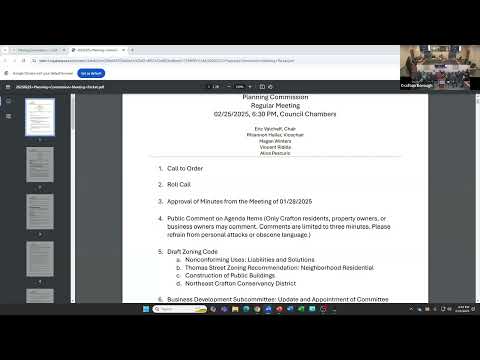
Planning Commission members heard a staff presentation Feb. 20 on proposed changes to the borough's draft zoning code aimed at reducing the number of nonconforming properties by lowering minimum lot width and modifying side-yard setbacks.
Planning Commission members heard a staff presentation Feb. 20 on proposed changes to the borough's draft zoning code aimed at reducing the number of nonconforming properties by lowering minimum lot width and modifying side-yard setbacks.
The presentation, led by planning staff members Jim Price and Mike (last name not given), said the current draft zoning would leave about 611 lots — roughly 28 percent of the borough — nonconforming, and that lowering the minimum lot width in residential districts to 25 feet would make many existing homes conforming. Mike said the change “would allow properties that already exist in Crafton to be conforming,” and that the recommendation was intended to match the zoning to “what is happening on the street in reality.”
Why it matters: staff told commissioners that nonconforming designations carry market and regulatory risks for homeowners and can complicate sales, lending and property improvements. The presentation cited language from the Pennsylvania State Real Estate Commission's standard purchase agreement and the standard residential appraisal form to show buyers and appraisers may treat nonconforming status as a material issue. Mike said, “If it is marked anything other than legal, there's a very real chance it will reduce the value of that appraisal.”
Staff analysis and recommendations
Jim Price presented maps and counts showing existing lot widths across Crafton and noted several neighborhoods with many 25-foot and 30-foot lots (examples cited: Mueller, Fountain, Thomas, Clearview, South Emily). Under the current code, roughly half of borough lots are nonconforming by one metric or another, Price said. Under the draft code before commissioners, about 28 percent would remain nonconforming.
Price and Mike recommended three primary changes to reduce that number: - Lower the minimum lot width in the NR and CR residential districts to 25 feet so many existing small lots become conforming; staff said this would not create new buildable lots but would reduce regulatory burdens for existing homes. - For lots under 35 feet, reduce the required side-yard setback to 2.5 feet (5 feet between houses) so small existing houses are not penalized when owners want minor expansions. - Reclassify a handful of parcels currently mapped as conservancy (steep-slope/protected) into NR or CR if the buildable frontage is not on steep slopes, which would move additional properties into conformity.
Staff emphasized limits: Price said an owner of a 50-foot lot would not be allowed to put two principal single-family dwellings on the lot; the change would not permit multiple principal dwellings on a single lot. Mike and Price also said the change would not, in itself, add new buildable lots.
Public comment and concerns
More than a dozen residents spoke during the agenda-item public-comment period. Several homeowners who live on 25-foot lots said they value spacing between houses and raised safety, privacy and flooding concerns. One commenter, identified in the transcript as Sandy, said she opposed changing side-yard setbacks to 2.5 feet and asked the commission to “reject these requests.” Another commenter, Nicole Kuravan (South Grandview), said she “emphatically second[ed]” earlier speakers' objections.
Several residents framed the proposal as part of a broader push toward density. A public commenter (recorded as speaker 14) called the recommendation “a pathway for large scale development” and said it could enable outside investors to buy up properties; the speaker urged more time for review. Others asked staff for concrete evidence that nonconforming designation lowers sales prices; one resident said local sales in recent months had been “astounding.” Commissioners and staff responded that the market effect is nuanced and that many factors affect value, but that industry documents treat nonconformance as a material issue for appraisals and purchase contingencies.
Legal and practical implications
Staff outlined regulatory consequences for nonconforming properties: owners seeking expansions or rebuilding often must use special procedures or take appeals to the zoning hearing board, described by staff as “a public meeting and expensive…a quasi-judicial process.” Mike said the current code’s nonconforming provisions “are regulatory hurdles” that make ordinary repairs or expansions more burdensome for those owners.
On abandonment and continued use, independent legal counsel Mandy (last name not provided) clarified during public comment that a continuing, active use transfers to a new owner but extended discontinuance can create a presumption of abandonment (counsel referenced the standard 12-month/18-month thresholds in practice).
Commission response and next steps
Commissioners asked for more data and time. Some members said the presentation helped them understand the problem but that they were not ready to vote on code changes at the meeting. One commissioner urged staff to prepare FAQs and clearer outreach materials because the memos and slides had generated fear among some older residents.
Staff said the analysis originated in residents’ requests (Thomas Street residents had asked staff at an earlier meeting whether their houses could be made conforming) and that the work was intended to align the written code with existing built conditions.
Ending
No zoning vote or formal action was taken at the Feb. 20 meeting; the presentation was educational and staff asked commissioners and the public to review the analysis and the memos included in the packet. Commissioners directed staff to gather feedback and to prepare clearer explanatory materials for the public before any final code decisions.