Get Full Government Meeting Transcripts, Videos, & Alerts Forever!
Get email alerts on the Student Harassment Policy topic
No spam. Unsubscribe anytime.
Waunakee subcommittee advances updated harassment, nondiscrimination policies to policy committee
Summary
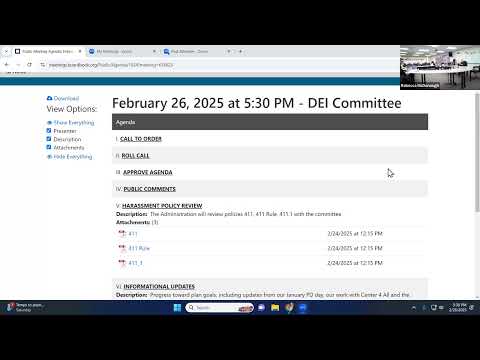
A Waunakee Community School District DEI subcommittee voted to advance revisions to student nondiscrimination and harassment policies (Policy 411 and 411.1, Rule 4-11) to the district policy committee after discussion on legal alignment, reporting follow-up, and staff/student training.
The Waunakee Community School District DEI subcommittee voted to advance proposed revisions to the district's student nondiscrimination and harassment policies to the policy committee, the group decided at its March meeting.
The subcommittee motion sought approval to move Student Nondiscrimination and Equal Educational Policy 4-11, Complaint Procedures Rule 4-11, and Student Harassment Based on a Legally Protected Status Policy 411.1 to the policy committee for further consideration and then to the full board for finalization and implementation. "Please consider approval of the harassment policy for protected classes with the next point of consideration being for the policy committee and then to the full board for finalization and implementation," said an administration presenter, identified in the meeting transcript as the district's new superintendent.
The motion passed after a second and an "Aye" vote from the subcommittee; the chair announced the motion passed. The subcommittee membership present included Mark (subcommittee member), Don (subcommittee member) and Ted (substituting for Jack Hinman).
Nut graf: The revisions consolidate a previously proposed standalone anti-hate-speech draft into the district's broader harassment policy, incorporate guidance from legal counsel and recent Title IX regulatory updates, and add clearer reporting and follow-up language. District leaders said the changes aim to make enforcement more consistent and to provide clearer protections for students whom the district identified as frequently targeted, including students of color and LGBTQ students.
Subcommittee discussion and key changes District presenters said the anti-hate-speech language originally drafted as a separate policy was integrated at the subcommittee's request into the harassment policy to create "a more comprehensive and enforceable framework." The administration said they worked with legal counsel (Barry Forbes) to revise language and to replace some terms with alternatives such as "offensive" where appropriate.
Presenters said the revisions reflect federal Title IX changes and that legal counsel reviewed the draft multiple times. The administration described Rule 4-11's follow-up language (noted in the packet as "standard behavior reporting procedures" on page 9) and said building principals and administrators are expected to make a face-to-face contact with reporting students or send a follow-up email (without student-identifying information) to confirm the complaint was received and addressed.
Public comment and staff observations Gina Pagel, a Waunakee Community School District elementary world-language teacher, spoke during public comment in support of the updated harassment policy but urged clearer communication while revisions were in process. "I appreciate the work that has gone on since then to get to this point, but I do have hesitations about a lack of access to information while that was taking place," Pagel said. She asked that future changes be posted with strikethroughs or other markings to make edits easier for the public to review.
Administrators and subcommittee members repeatedly asked for a user-friendly summary or "CliffNotes" version of the policy and rule so parents, students and staff can quickly find how to report an incident and what steps to take. In response, presenters agreed to produce a short summary, and said the district already posts a reporting tool on its website that can be used by students and parents.
Training, implementation and data tracking District staff described training that has taken place and will continue alongside policy changes: a January professional development day that included training on microaggressions and classroom strategies; a Middle School initiative using short lessons to teach students how to interrupt or report incidents; and work with an outside trainer from McFarland. The district said it has seen an increase in reports after training as students and staff learn how to use the reporting tool.
Administrators also noted partnerships and resources the district intends to use, including guidance from the Wisconsin Association of School Boards (WASB)-style formatting, a Center for All partnership through CESA 6, and planned participation in the MSAN (Minority Student Achievement Network) annual meeting in Madison in April. The subcommittee was told the district will report aggregate data (belonging and academic progress) to the state DPI mid-year and at year-end (generally by June).
Vote and next steps The subcommittee approved the motion to advance the policy package to the policy committee; the presenters said they will upload both the clean draft and the draft with strikethroughs to the policy committee packet as requested. After policy committee review, the package will return to the full school board for final action and implementation planning.
The subcommittee also discussed continuing DEI implementation work under a three-year plan, including baseline data collection on belonging and engagement and steps for year 2 depending on accomplishments in year 1.
Ending: The policy package will be considered next by the district's policy committee; subcommittee members asked staff to include marked-up versions showing changes, provide a user-friendly summary for the public, and continue coordinating training and data collection tied to the policy changes.