Get Full Government Meeting Transcripts, Videos, & Alerts Forever!
Get email alerts on the Bethesda Master Plan Amendment topic
No spam. Unsubscribe anytime.
County council hears divided testimony on Bethesda Minor Master Plan Amendment, including proposal to remove development cap
Summary
The Montgomery County Council held a public hearing in Bethesda on the Planning Board’s draft Bethesda Downtown Minor Master Plan Amendment, which would remove the 2017 development cap covering roughly 450 acres and revise park impact payments, incentive zoning and affordable-housing incentives.
The Montgomery County Council held a public hearing in Bethesda on the Planning Board’s draft Bethesda Downtown Minor Master Plan Amendment, which would remove the 2017 development cap covering roughly 450 acres and revise park impact payments, incentive zoning and affordable-housing incentives.
Supporters, including the Montgomery County Planning Board and the Bethesda Downtown Implementation Advisory Committee (IAC), told the council the changes are needed to preserve development certainty and to accelerate delivery of parks, recreation facilities and housing. Opponents said removing the cap is not a “minor” change, warned of traffic and environmental consequences, and pressed the council for stronger, periodic monitoring tied to amenity delivery.
Artie Harris, chair of the Montgomery County Planning Board, told the council the draft amendment makes “necessary adjustments that will ensure Bethesda remains that economic engine and the community has the amenity it needs to thrive,” and he encouraged council members to approve the draft.
The amendment’s principal changes in the Planning Board draft include eliminating the 32,400,000-square-foot development cap established by the 2017 plan, increasing the park impact payment (PIP) rate and allowing new incentive mechanisms to promote a recreation center, additional affordable housing (MPDUs) and public art. The draft also recommends expanding the area eligible for height incentives along Arlington Road to encourage redevelopment in underused parcels near the Bethesda Metro station.
Supporters argued removing the cap would reduce uncertainty for investors and speed the production of housing and public benefits. Jack Alexander and Amanda Farber, co-chairs of the Bethesda Downtown Implementation Advisory Committee, said the IAC supports removal of the cap if the council requires additional “check‑in points” in the Bethesda overlay zone to ensure parks, transportation improvements and a recreation center keep pace with development. Farber said the 2017 plan’s main goal was new parks — 13 parks and 13 acres — and that “so far none have been delivered and there's no certainty as to when they might be.” She told the council that roughly $10,000,000 of park‑impact funds are currently tied to a property the county now considers unviable for a park.
Property owners and real‑estate representatives also backed the Planning Board draft. Elizabeth Rogers, representing an owner with development potential near Montgomery Lane and Arlington Road, told the council the proposed expansion of the height incentive area would encourage underutilized sites to redevelop and provide more MPDUs while noting proposed limits on the allowable height increase. Vince Biazzi, representing ProMark Partners, said investors withdrew interest when the cap was perceived as a constraint and urged the council to eliminate the cap.
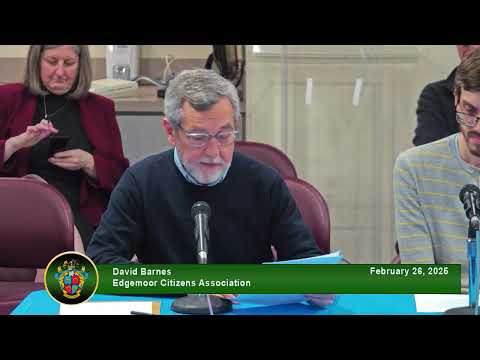
Opponents said the change amounts to a fundamental rewrite of the 2017 plan. Karen Bolti of the Rogers Manor Citizens Association said removing the cap “is not a minor amendment” and warned of increased greenhouse‑gas emissions and longer travel times, citing traffic growth on Maryland 187 since bike lanes were installed. David Barnes of the Edgemoor Citizens Association told the council the cap’s original purpose was to assure residents there was “a finite limit” on development and urged the council to retain or, if it changes the cap, clearly explain the rationale and adopt regular monitoring.
Other public testimony addressed related issues: Strong Towns’ Rich Biogetsky and local student Alex Campbell argued that raising housing supply is necessary to address affordability and that removing the cap would allow developers to meet demand. Several speakers supported staggering or reducing the upfront park‑impact payment; the Planning Board draft proposes limiting PIP increases to match inflation and phasing the PIP into multiple payments to ease developers’ initial cash burden.
Speakers also pressed the council on school capacity. Farber told the council Bethesda Elementary was recently redistricted to reduce overcrowding yet remains over capacity; she said about 1,000 new housing units are expected to come online in the school’s boundary before next school year and asked for clarity on school plans for September.
On public art, Jane Fairweather, chair of the Bethesda Art and Entertainment Board, supported a Planning Board recommendation to update the Bethesda overlay code to allow incentive‑zoning payments for public art to be accepted by the Bethesda A&E Board or other civic art organizations the county designates.
Several participants urged guardrails: the IAC, Town of Chevy Chase representative Joy White and others recommended a data‑driven five‑year comprehensive review of downtown outcomes that would assess school capacity, parks delivery, transportation performance and housing goals, and include structured community input. White said existing tools provide useful data points but “often provide isolated data points” and do not substitute for periodic, holistic reviews.
The Planning, Housing and Parks Committee has scheduled work sessions on March 10 and March 24, and the council’s deadline for submitting materials for consideration was stated as the close of business on March 3.
The public hearing produced no formal vote; council deliberations and any amendments will take place at subsequent committee and council sessions.