Get Full Government Meeting Transcripts, Videos, & Alerts Forever!
Get email alerts on the School Budget topic
No spam. Unsubscribe anytime.
Prince George County schools propose $99.5 million FY26 budget, ask for 5% pay increase; two supplemental appropriations approved
Summary
Superintendent Dr. Lyle presented a FY26 budget that would increase the school division’s total spending to about $99.5 million and includes a proposed 5% salary increase. The board approved two supplemental appropriations for the child nutrition and grant funds and scheduled further budget work sessions ahead of the March adoption.
Superintendent Dr. Lyle and finance staff presented a proposed fiscal year 2026 budget for Prince George County Public Schools that would raise the school division’s total budget from just over $94 million to about $99.5 million and includes a proposed 5% salary increase for employees.
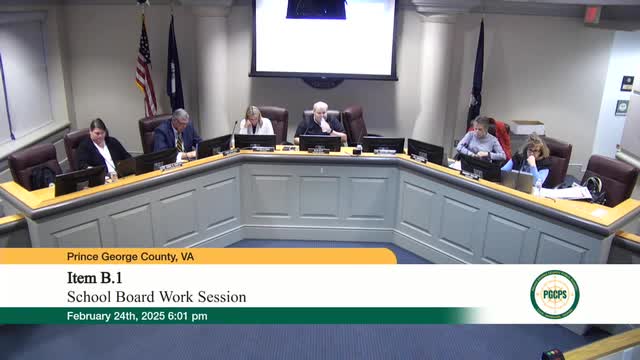
The proposal, presented at a special school board budget work session on Feb. 24, 2025, would increase the regular (general) fund from $84.9 million in FY25 to about $90.0 million in FY26. “A 5% salary increase is paramount for recruitment and retention of staff,” Dr. Lyle said, framing the raise as the administration’s priority to reduce costly reliance on contracted services and long‑term substitutes.
The nut graf: Board members were given line‑by‑line revenue and expenditure detail, state budget context and a list of school‑level staffing requests tied to student needs. After public comment, the board approved two supplemental appropriations for the current year—one to the Child Nutrition Services Fund and one to the Grant Fund—and directed staff to schedule additional budget work sessions before the March meeting when the board will consider final adoption.
At a high level, finance staff member Mr. Sorensen said the total FY26 proposal across all school division funds is about $99,500,000, a $5.4 million, or 5.8 percent, increase over the current adopted budget. “In total, the current year budget is just over $94,000,000. We're proposing a budget of $99,500,000 or $5,400,000 increase or 5.8%,” Sorensen said. The increase for the regular fund alone is roughly $5.2 million (6.2 percent) and is driven primarily by salaries and benefits, which together account for roughly 86% of the division’s regular fund expenditures.
Revenue assumptions and state budget update: The FY26 presentation used the governor’s proposed budget as its baseline and acknowledged recent General Assembly action that could add about $1.8 million in state funding to the division. Mr. Sorensen cautioned the board that the General Assembly’s adopted numbers must still be reconciled with the governor before they are final: the state budget “is not final,” he said, and could change if the governor alters provisions.
Key school‑level staffing and program requests tied to the proposed budget included: - A 5% across‑the‑board pay increase to improve recruitment and reduce reliance on contracted staff and long‑term substitutes. - Three additional English learner (EL) teachers required by an adjustment to the Standards of Quality; state funds were identified to support those positions. - Continued funding or replacement of school resource officer (SRO) positions currently paid by expiring state grants at Beasley, Middle Road and South Elementary schools. - Dedicated instructional coaches at JEJ Moore Middle School, MB Clements Junior High School, and Prince George High School to support provisionally licensed teachers and long‑term substitutes. - A behavior support specialist to address discipline‑driven needs across grade levels. - Additional paraprofessionals, learning specialists, an itinerant early childhood special education teacher, and a school‑based secretary for Middle Road Elementary to align administrative support with comparable schools.
Mr. Sorensen presented fund‑level detail: the grants fund is proposed to decrease modestly (reflecting expiration of several COVID‑era federal grants), the textbook fund is held largely steady, and the school nutrition fund is proposed to increase to $4.7 million for FY26 with planned use of some fund balance. He said the division is asking the county for a transfer of $21.2 million, a request that reflects a $3.4 million increase over the current year under the governor’s budget assumptions.
Public comment: Three residents addressed the board during the public hearing. Jean Shanks, of Blackwater Farm Lane, questioned the scale of the proposed increase and suggested prioritizing raises for teachers and other frontline staff rather than higher administrative salaries; she said, “I see, over a million dollars in the room here of just administrative salaries.” William Steele called the proposed increases “kind of outrageous” and urged the board to examine leadership and efficiency rather than seek additional tax dollars. Rick Tetherton supported raises for qualified teachers and criticized past administrative contract payouts, saying the buyout paid under prior leadership reduced funds available for staff.
Board action and votes: The board approved two supplemental appropriations during the meeting. The first was a request to add about $526,000 to the current‑year Child Nutrition Services Fund (Fund 0540) to cover projected FY25 expenses driven by recent pay adjustments and higher food costs; the board approved the appropriation by roll call (all members voting yes). The second supplemental appropriation increased the Grant Fund (Fund 510) to reflect updated awards, including an increase to Title I funding, a school safety grant, and a new literacy grant (combined requested increase about $580,227); the board approved that appropriation by roll call (all members voting yes).
Next steps: Dr. Lyle and staff asked board members to coordinate with the clerk, Ms. Kirk, to schedule one or more detailed work sessions before the March meeting when the board will consider adoption of the FY26 budget. The chair also asked staff to check room availability and coordinate livestreaming with Swagit so any budget work sessions can be recorded and broadcast.
Ending: Board members set the next formal action date for a March meeting to consider final adoption and asked staff to provide more detailed materials and dates in advance of that session.