Get Full Government Meeting Transcripts, Videos, & Alerts Forever!
Get email alerts on the Literacy topic
No spam. Unsubscribe anytime.
Franklin County schools report early gains and challenges as Bookworms literacy rollout continues
Summary
Division staff said the Bookworms curriculum and related interventions are producing measurable gains in early grades while administrators flagged gaps, a need for more in-person professional development and added supports for upper elementary and middle school students.
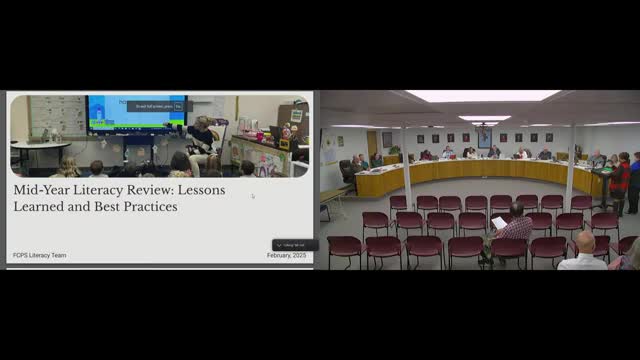
Franklin County Public Schools officials told the school board on Feb. 10 that its new Bookworms literacy program has produced noticeable growth in some elementary classrooms but requires more training, progress monitoring and targeted interventions to reach all students.
Division literacy leaders said the curriculum has increased student dialogue, vocabulary use and fluency in early grades and that the state literacy coaches told the division it is "miles ahead of most divisions," a finding leaders said they will ask to receive in writing for teachers. "Students enjoy the books and look forward to reading them," Miss Fields, a division literacy staff member, told the board.
The presentation included several data sources. Staff said VLA screener risk-band reporting shows movement of some students out of high-risk bands and highlighted particular growth for students with special needs. Lexia progress data for third through fifth graders showed a drop in the share working two or more grade levels below from 83% to 55% in the tested sample; staff said these figures represent the subset of students who were assessed and tutored, not the entire grade cohort.
Leaders acknowledged implementation challenges: limited face-to-face professional development, difficulty covering all ELA skills in a standards-linked program, and the lack of a state-approved list of middle-school supplemental interventions. "We don't have all the grades used in the past," a presenter said, explaining that standards-based materials don't produce the same SOL-style numeric items staff previously used for progress monitoring.
To address the gaps, the division plans a two-day paid literacy summit this June for K–5 teachers, expansion of screener coverage to grades 4–8 next year, more embedded reading plans for students with disabilities and a summer training series for middle-school teachers to align local curricula with any future state-approved supplements. Staff also described continued use of Lexia, PowerUp and other intervention tools and emphasized human-led remediation—teachers and tutors—alongside computer programs.
Board members asked for clarification about samples and testing windows; staff said some increases in apparent risk reflected midyear testing of students who transferred into the division and that risk bands are not directly comparable across test periods because assessments become more difficult as the year progresses.
The board did not take a vote. Staff will return with follow-up materials and proposed schedules for the June literacy summit and expanded screening next school year.