Get email alerts on the Sba 7a Program topic
No spam. Unsubscribe anytime.
Senate hearing examines rising defaults, underwriting changes and Community Advantage role in SBA 7(a) program
Summary
Senate Small Business and Entrepreneurship Committee members and lenders debated the effects of recent SBA rule and fee changes on 7(a) loan defaults, the role of fintech and nonbank lenders, and how the Community Advantage pilot supports startups and underserved borrowers.
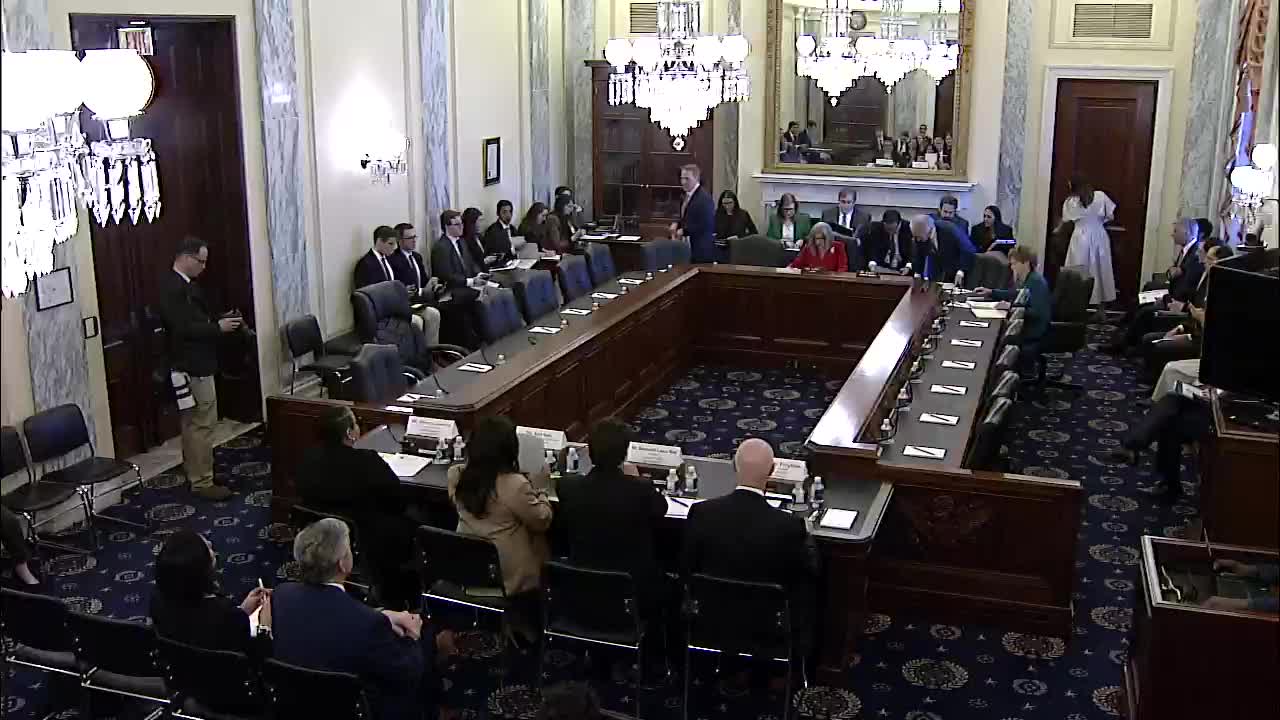
Chair Joni Ernst, chair of the Senate Committee on Small Business and Entrepreneurship, opened a hearing on the Small Business Administration's flagship 7(a) loan program by warning that recent rule changes and fee cuts have increased taxpayer risk and borrower defaults.
The hearing focused on two linked concerns: whether loosened underwriting standards and the addition of nonbank lenders have raised default rates and losses in the 7(a) portfolio, and whether mission-driven lenders using the Community Advantage (CA) pilot continue to serve borrowers who cannot obtain traditional bank financing.
Why it matters: The 7(a) program is the SBA's principal vehicle for guaranteeing loans to small businesses. Witnesses and senators said program solvency matters for taxpayers, for small-business owners who rely on credit to start or expand ventures, and for community lenders that provide technical assistance in addition to capital.
Timothy Fitzgibbon, senior vice president at First National Bank (Iowa) and testifying for the Iowa Bankers Association and his bank, told the committee that “good underwriting protects the consumer along with the lender and in the case of the government backed SBA program, the taxpayer as well.” Fitzgibbon and other bank witnesses urged restoring stricter underwriting and some fees to reduce defaults and negative cash flow.
Raymond Lanza Weil, president of Common Capital, a Springfield, Massachusetts CDFI and an early Community Advantage lender, described CA loans as high‑touch, relationship-driven financing for borrowers with limited collateral or startup histories. Lanza Weil said Common Capital has made more than 900 loans totaling about $35,000,000 since 1990 and that CA loans “help us fulfill our mission of creating economic opportunities for people with low to moderate income.”
Itzel Sims, director of SBA lending at First Security Bank (Searcy, Arkansas), told senators that community banks “see people” and provide education and budget counseling that fintech lenders do not. Sims said the SBA lifted a moratorium on nonbank entrants and relaxed underwriting rules for smaller loans, and she attributed a rise in defaults—especially among loans originated by nonbank lenders—to those changes.
Entrepreneur Mirena Guerrero, owner of Colorful Resilience in Massachusetts, told the committee that Common Capital’s Community Advantage loan made it possible for her mental‑health clinic to open and grow. “The SBA Community Advantage Loan changed my life,” Guerrero said, adding that she used a $250,000 Community Advantage loan plus a $50,000 microloan to start operations and now employs 15 people.
Data and disputed points: Committee speakers cited several program metrics. In opening remarks, Chair Ernst said the 12‑month default rate more than doubled to roughly 3.2 percent since the new rules took effect and that defaults on loans under 18 months rose to about 1.5 percent. Fitzgibbon and others said SBA reported negative cash flow in 2024 and that fee reductions contributed to that outcome. Sims cited third‑party data (Lumos Technologies) showing 7(a) loans originated by nonbank lenders had a default rate of 8.1 percent in 2023 versus a substantially lower rate for bank‑originated loans.
Panelists disagreed about causes. Lanza Weil said many CDFIs and mission lenders have not seen rising defaults and warned against penalizing high‑touch lenders because of imprudent behavior by some new entrants. Fitzgibbon cautioned that reduced underwriting criteria (for example, waiving some equity injection and relaxing personal financial requirements) and temporary fee waivers have likely increased risk.
Policy and regulatory issues raised: Senators and witnesses discussed multiple levers to address risk: restoring borrower and lender fees that had been waived for certain loan sizes, reinstating prior underwriting and documentation requirements (for example, franchise directory guidance and loan authorization forms), tighter oversight of nonbank SBA lending companies (SBLCs), and better SBA supervision of lender service providers (LSPs) and fintech partners. Several witnesses urged preserving or expanding the Community Advantage program to continue serving startups and low‑asset borrowers.
Other testimony touched on supplemental issues: the SBA Inspector General's recent review of SBLC approvals (witnesses said the IG report did not evaluate whether SBA procedures were adequate or whether there was inappropriate coordination between applicants and agency officials) and the Consumer Financial Protection Bureau rule implementing Section 1071 of the Dodd‑Frank Act, which witnesses said increases data reporting burdens on lenders.
What the hearing produced: No formal actions or votes were taken at the hearing. Committee members asked for follow‑up and pledged to keep the record open for two weeks for additional questions and documents.
Looking ahead: Senators repeatedly emphasized the need to balance program access for underserved entrepreneurs with safeguards that reduce default risk and preserve 7(a)'s zero‑subsidy goal. Witnesses urged more granular oversight of new nonbank entrants and continued funding and codification of Community Advantage to expand mission‑oriented lending.
Ending note: The witnesses combined lender perspective, CDFI experience and a borrower success story to illustrate competing priorities—broad access to capital and program integrity—leaving the committee with requests for more data and documents to guide legislative or administrative fixes.
AI generated
The text on this page is AI generated. Summaries, highlights, analysis, and video transcripts are all produced from the original source material.
AI can make mistakes, so if you spot one, and we will fix it for everyone.
Note: the source content is unaltered by us. Any content source we link to, be it a video, an audio recording, or a document, is presented exactly as its publisher released it. That publisher is usually a government body, sometimes an individual official or another organisation.