Get Full Government Meeting Transcripts, Videos, & Alerts Forever!
Get email alerts on the Transportation topic
No spam. Unsubscribe anytime.
Skagit County outlines Cook Road–I‑5 improvements to ease congestion near Sedro‑Woolley
Summary
Skagit County project manager Devin Willard briefed the Sedro‑Woolley City Council on short‑ and long‑term fixes at the Cook Road/I‑5/Old Highway 99 corridor, including signalization, a future grade separation, coordination with BNSF and WSDOT, and funding and schedule milestones through 2029.
Devin Willard, a project manager with Skagit County Public Works, told the Sedro‑Woolley City Council the county is advancing short‑ and long‑term improvements at the Cook Road/I‑5/Old Highway 99 corridor that currently experiences heavy congestion and vehicle queuing onto the I‑5 mainline.
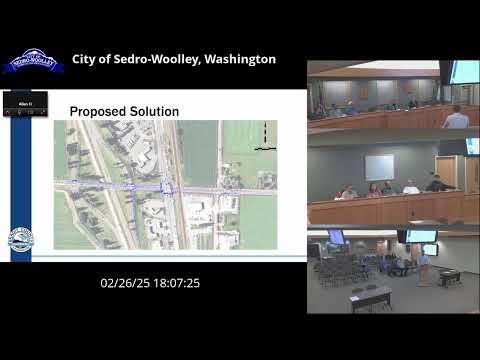
Willard said the short‑term package — the primary focus of his presentation — would add traffic signals at the I‑5 ramp intersections, a northbound right‑turn lane at Old Highway 99 onto eastbound Cook Road, an additional eastbound lane on Cook Road, interconnection of the new signals with the nearby BNSF crossing gate, pavement resurfacing and ADA improvements. He said the county is designing the project to accommodate traffic growth through 2045 and that the short‑term improvements are expected to open in 2028.
The plan also includes a long‑term grade separation between Cook Road and the BNSF railroad tracks; Willard said that remains a later phase being evaluated during long‑range planning.
The project’s history includes earlier work by the Washington State Department of Transportation (WSDOT). Willard said WSDOT completed a basis of estimate in 2018 but asked the county to be the project proponent because the county was better positioned to secure federal funds. Skagit County subsequently received National Highway Freight Program funds and Federal Surface Transportation Block Grant (STBG) funds to support design and construction; Transpo Group was selected in 2023 as design consultant.
Willard described design‑process delays tied to successive statewide guidance. He said WSDOT’s Olympia traffic office initially preferred roundabouts, which required redesign; after further review WSDOT accepted the county’s signal‑based design, but the back‑and‑forth added schedule and consultant costs and a roughly nine‑month delay.
Railroad agreements are the other critical path. Willard said the county and Burlington Northern Santa Fe (BNSF) must sign a preliminary engineering agreement to allow BNSF to review and be compensated for design work; later the parties will execute a crossing agreement. Willard said the parties had been negotiating contract terms and that revisions were sent back to BNSF for signature.
Willard identified three approvals or conditions needed to proceed to 60/90/final design: (1) WSDOT approval of the county’s basis of design, (2) a preliminary engineering agreement with BNSF, and (3) securing a 13.5 percent project match. He said that match equates to about $223,000 for the design and right‑of‑way phases, and about $1,320,000 for all phases (design, right of way and construction). He laid out schedule milestones: final design no later than second quarter 2026 (to allow advertising in third quarter 2026, the county’s deadline to obligate National Highway Freight funds), construction starting spring 2027 if funding aligns, and a hoped‑for short‑term opening in 2028. Willard noted the Federal STBG funding that would help construction is currently not programmed until 2029.
Council members praised the work and raised safety concerns at the rail crossing. “I just think eventually there’ll be a tragic collision there and I think the eventual solution is to go above it,” said Councilman Cocke, recounting long experience commuting through the area. Councilman LaVaca and Councilman Burns said they supported completing the project sooner rather than in phased pieces, and Councilman Henderson thanked the presenter for the information.
Willard said the project team is also coordinating with Cascadia high‑speed rail planning referenced by council members and will share contact information and the presentation slides in the meeting packet.
Why this matters: the corridor currently ties regional traffic, freight and passenger rail operations together; the county’s short‑term package aims to reduce queuing onto I‑5 and improve safety while a longer‑term grade separation is studied.