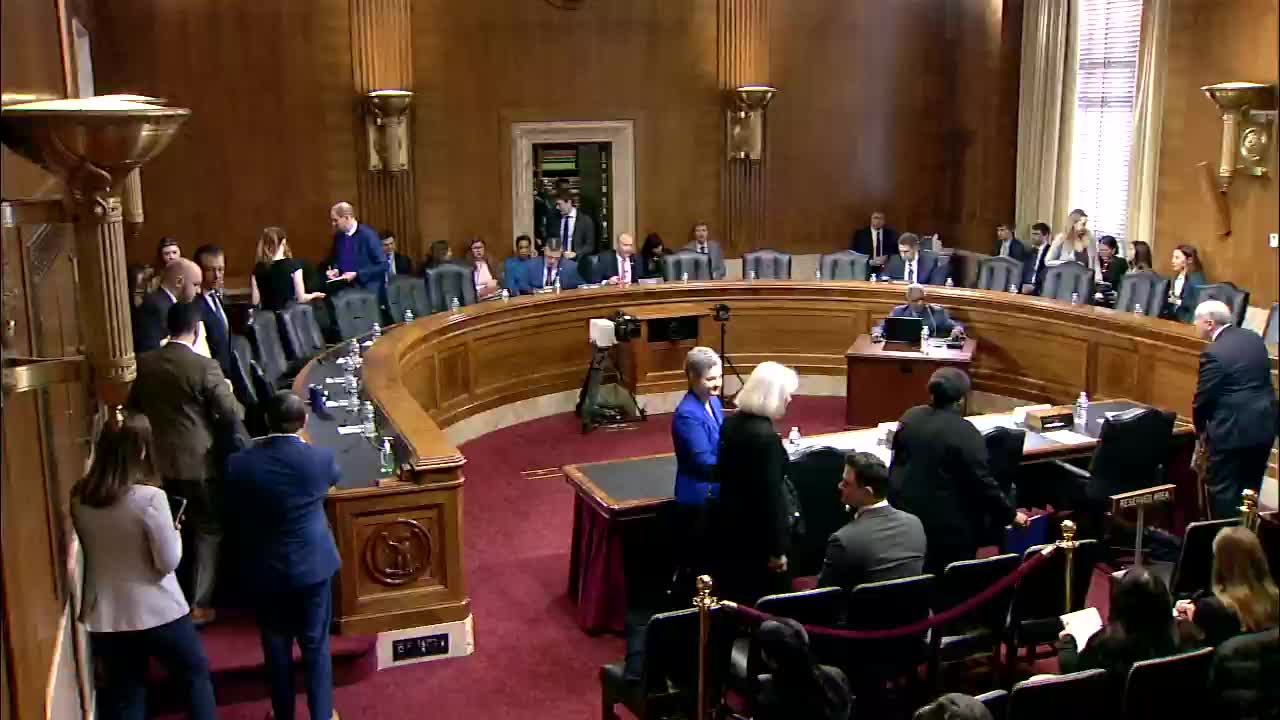
Senate hearing spotlights research-security risks at DOE national laboratories
Get AI-powered insights, summaries, and transcripts
SubscribeSummary
At a public hearing of the Senate Energy and Natural Resources Committee, senators and outside experts on research security described sustained risks to U.S. technology stemming from foreign recruitment and commercial transfer tied to work at Department of Energy (DOE) national laboratories.
At a public hearing of the Senate Energy and Natural Resources Committee, senators and outside experts on research security described sustained risks to U.S. technology stemming from foreign recruitment and commercial transfer tied to work at Department of Energy (DOE) national laboratories. Witnesses and committee members said research-security gaps have allowed adversaries to appropriate U.S. inventions and that Congress and DOE must strengthen safeguards while preserving beneficial scientific collaboration.
Chairman Lee opened the hearing by saying the DOE "oversees 17 national labs" and quoted Secretary Chris Wright’s recent confirmation remark that "we must protect and accelerate the work of the DOE labs to secure America's competitive advantage and security." He and other senators framed the hearing around alleged exploitation of academic and lab collaborations by the Chinese Communist Party and other adversaries.
The hearing featured three outside witnesses who previously served in or advised government: Paul Debbar, cofounder of Bohr Quantum Technologies and a former DOE undersecretary for science; Anna Pugliese, a visiting fellow at Stanford University's Hoover Institution and a former National Counterintelligence Officer for East Asia; and Dr. Jerry Richmond, former DOE undersecretary for science and innovation and a professor of chemistry at the University of Oregon. Debbar and Richmond described actions DOE took in prior administrations — including banning specific talent programs and drafting a technology risk matrix — and both argued for stronger controls. Pugliese recommended a national, comprehensive approach including an open-source information center, a pre-check for prospective collaborations, and investments to sustain U.S. research capacity.
Witnesses and members repeatedly cited China-specific recruitment programs such as the "Thousand Talents" initiative as a vector for transferring technology developed with U.S. funding. Debbar testified that, in his view, DOE policy had been overly delegated to lower levels inside the lab system and recommended changing the default: prohibit access by nationals of countries of concern unless a high-level waiver is granted. In response, Senator Lee asked whether committee-backed safeguards that make exclusion the default with limited secretarial waivers would be acceptable; Debbar said yes.
Dr. Richmond described DOE’s existing risk-management tools including a science-and-technology risk matrix, the ARTAS (science and technology risk) approach, and the departmental research-security office that reviews foreign interactions and funding. She said DOE and partner universities have begun adapting to new requirements such as NSPM 33 (National Security Presidential Memorandum 33) and protections in the CHIPS and Science Act, but she urged continued engagement between DOE, labs and universities to close remaining gaps. "Security is in the DNA and the structure of our national laboratories," Richmond said, while noting that university systems historically lacked equivalent security apparatus.
Senators raised workforce and implementation concerns. Ranking Member Senator Heinrich warned that recent dismissals and workforce churn create counterintelligence and morale risks, saying the loss of experienced personnel could be exploited by adversaries. Chairman Lee corrected reporting he said had been misleading and stated his view of the scale: he described the recent personnel actions as relating to probationary hires and said "less than 700 probationary employees have been dismissed," and that nuclear weapons production facilities and labs were not part of those dismissals. The committee left the record open for additional written questions through close of business on February 21.
Members pushed for clarity about authorities and execution. Multiple senators — including Cotton, Wyden, McCormick, Gallego and others — pressed witnesses on who currently has final sign-off for foreign visitors or collaborations at lab sites, whether exclusions at one lab apply systemwide, and how DOE coordinates counterintelligence, lab directors and program offices. Debbar and others said implementation varies by lab and that delegation to lab-level authorities has sometimes made control uneven; at least one witness urged elevating waiver and approval authorities to more senior headquarters levels.
Witnesses and members repeatedly warned that research security policy must balance protecting sensitive economic and national-security technologies (for example, AI, quantum, fusion, high-performance computing, advanced materials and certain biotech areas) and preserving beneficial international cooperation and the U.S. ability to attract global talent. Pugliese summarized that "we can't protect what we don't have. We have to invest in the future," and urged a coordinated national program rather than piecemeal fixes.
The hearing record will remain open until close of business on February 21 for written questions and submissions. Committee members signaled plans to consider legislation and oversight steps that would tighten controls, clarify approval authorities and expand DOE’s capacity to vet and monitor foreign collaborations, while several members said they want DOE to brief the committee in a classified setting about specific counterintelligence procedures and the implementation status of recently passed statutes and guidance.
Votes or formal committee actions were not recorded at the hearing; panelists provided testimony and senators asked questions and made statements. The committee chair closed the hearing after summarizing corrections to public reporting about the scale and scope of recent DOE personnel actions.