Clean Air Task Force and others point to agency coordination, staffing and state alignment as principal causes of transmission bottlenecks
Get AI-powered insights, summaries, and transcripts
SubscribeSummary
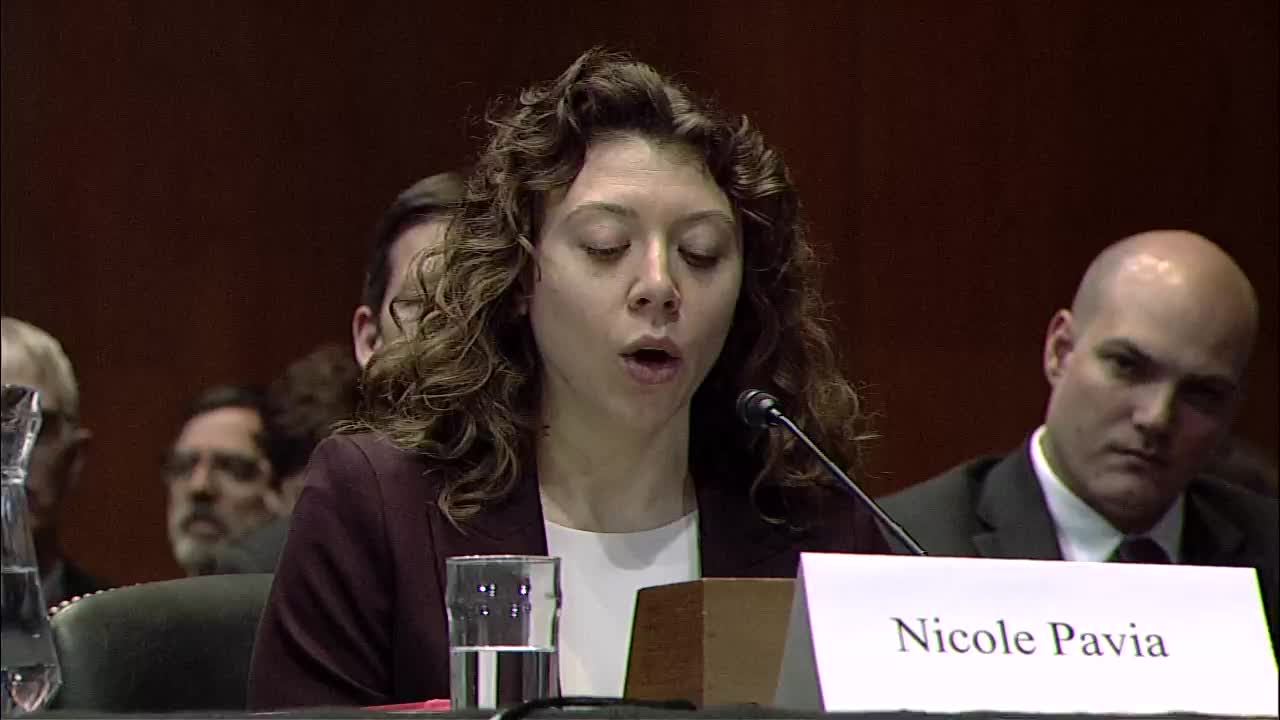
Nicole Pavia of the Clean Air Task Force told the Senate EPW committee that NEPA is improvable but not the primary cause of transmission delays; agency coordination, insufficient staffing and state jurisdictional differences were cited as key drivers keeping 2.6 terawatts of potential clean capacity in interconnection queues.
Nicole Pavia, program director for clean energy infrastructure deployment at the Clean Air Task Force, told the Senate Environment and Public Works Committee that long-range interstate transmission is underbuilt and that permitting slowdowns arise primarily from "gaps in leadership and federal agency coordination, lack of steady appropriations for permitting related tasks, insufficient permitting expertise at agencies, data inaccessibility, and local opposition or lack of state support." She said these process and resource constraints, more than NEPA itself, explain much of the delay for transmission.
Pavia cited an industry-scale backlog: "2,600 gigawatts or 2.6 terawatts of energy capacity, 95% of which is zero-emitting or storage capacity, sits in interconnection queues today, waiting for an opportunity to plug into the grid." She and other witnesses urged stronger interregional planning, harmonization of state and tribal requirements, and consideration of consolidating siting and permitting authority for interstate transmission projects under the Federal Energy Regulatory Commission, similar to FERC’s authority over interstate natural gas pipelines under the Natural Gas Act section 7.
Jeremy Harrell of ClearPath said the United States needs both upgrades to existing lines and substantial new transmission, estimating an approximate 75/25 split favoring new buildout for the coming decades. He and other witnesses recommended improving agency data transparency, deploying modern technologies to speed reviews, and targeting procedural reforms that limit duplicative reviews. Harrell also cited litigation statistics to make the case for judicial-review limits: an analysis he referenced found that litigation delayed energy projects by an average of four years and that agencies prevailed in roughly 71% of such challenges; for transmission projects that completed review, 24% faced litigation and agencies won 88% of those cases.
Senators pressed witnesses on concrete fixes: Senator Kelly asked whether increased interregional planning and longer-term regional transmission planning (FERC Order 2023/1920 initiatives referenced in testimony) would reduce misalignment. Witnesses said it would help but emphasized that states retain much of the siting authority and so any federal backstop must coordinate with state and tribal processes. No legislative text was passed during the hearing; witnesses recommended a mix of statutory clarifications, resourcing and administrative reforms to increase throughput of transmission projects.