
Cumberland County commissioners approve multiple contracts and grants including recycling, lab upgrades and human services funding
Get AI-powered insights, summaries, and transcripts
Sign Up Free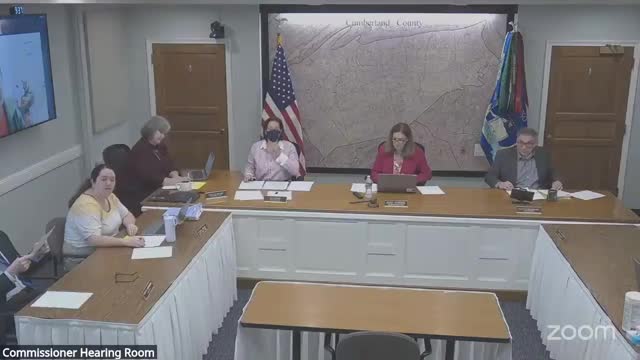
Summary
At its Feb. 20 meeting, the Cumberland County Board approved a package of contracts and grant applications across departments: agreements with community coalitions, a third-party vendor for one-time human services payments, small grants for courts and the lab, contract increases for early‑intervention providers, and recycling program funding.
The Cumberland County Board of Commissioners voted to approve a series of contracts, grant applications and addendums across county departments at its meeting. The approved items included agreements with local coalitions, maintenance and lease agreements, software and equipment purchases for county labs, and multiple contract increases for early‑intervention and mental‑health providers.
Key approvals: - Aging & Community Services: Agreements to partner with the Cumberland County Reentry Coalition and the Housing Coalition of Cumberland County to support the county’s homeless assistance and landlord engagement programs. Presenters described these as participation agreements with no county revenue or expense impact. - Commissioner’s Office: A one‑time agreement with Maranatha (third‑party vendor) to administer one-time needs payments from a Human Services Policy Team Fund; funding was described as coming from interest revenue tied to proceeds from the sale of the county nursing home. A commissioner recorded opposition to this item during the voice vote. - Courts: A $5,200 grant application to the Administrative Office of Pennsylvania Courts (AOPC) to cover a trauma‑informed court specialist’s time and travel for TOMS court observation and recommendations. - District Attorney / Forensics: An $18,947.68 contract with Diogen Qualtracs for laboratory quality-management software, and acceptance of a $15,000 grant from Norfolk Southern Railway to help pay for a laboratory water-purification system. - Drug & Alcohol: A formalized memorandum of understanding with Westshore School District to continue school-based vaping-prevention and life-skills programming. - Elections: Approval of maintenance and new lease agreements for a mail machine and folder/insert machine; the county will consider grant funding if awarded. - Facilities/Capital Projects: A contract with C and Finche Scholl Architectural Engineering for engineering drawings and permit documents related to the MDJ Beckley renovation; cost had been included previously in an approved capital project request. - MHIDD (Mental Health/Intellectual/Developmental Disabilities): Eight contract addendums were approved. Several early‑intervention providers received increases based on billing and fiscal-year-end production (dollar increases listed below). An extension and increase for Maranatha Carlisle was approved to provide social‑determinants‑of‑health assistance; funding is from HealthChoices reinvestment dollars with a cited increase of $108,000 and an extension “to December 30, 2025” as stated in the presentation. - Recycling/Waste: Approval to participate in household hazardous waste events, leveraging Department of Environmental Protection reimbursement (estimated 50% of eligible costs) and a Department of Agriculture pesticide‑disposal allocation of $16,000. The presenter estimated total costs for four events at about $171,000 with approximately $88,000 in user fees and roughly $86,000 from DEP reimbursement. The board also approved submitting documentation for an Act 101, Section 903 recycling coordinator grant (estimated award $61,227.37).
Vote details: Most items passed by voice vote with “aye” recorded. The Maranatha agreement from the Commissioner’s Office drew a recorded “opposed” vote from Commissioner Eckerdinger; the minutes record the opposition but do not include a detailed public rationale beyond noting the negative vote. All other listed contract and grant items were approved as presented by staff.
The meeting record includes requests to track audits and future reporting for the Maranatha transactions and noted that some contracts are state‑funded (early intervention increases) while others use specific grant funds. Presenters indicated that the Maranatha fund would be administered through the Commissioner’s Office and departmental review. Several presenters invited questions; none were raised that changed the approvals at the meeting.