Get Full Government Meeting Transcripts, Videos, & Alerts Forever!
Get email alerts on the Comprehensive Plan topic
No spam. Unsubscribe anytime.
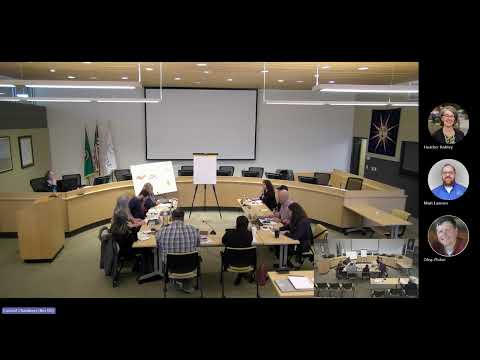
Sequim council holds comprehensive-plan retreat centered on housing targets, climate planning and growth scenarios
Summary
At a Sequim City Council retreat planners and council members heard a briefing on state Growth Management Act requirements, new housing-unit allocations by income band and three land-use scenarios the city could use to accommodate projected growth; no formal votes were taken.
Carla Bowden, a planning consultant with Cross Sound Consulting, told the Sequim City Council at a retreat that state-driven housing and climate requirements are reshaping how the city must plan for the next 20 years.
Bowden said the meeting was intended to ground the council in the Growth Management Act, review county and state allocations and the public outreach completed in 2024, and to test three land‑use scenarios for meeting Sequim’s housing allocation. “It’s about access to your shoreline and to the water. It’s about access to your parks, open space, trails, and biking,” Bowden said, summarizing themes the consultant heard from residents.
The retreat focused on several items that Bowden said Sequim must address as part of a 2025 comprehensive-plan update required by state law: (1) a new housing-element approach that assigns housing-unit targets by income band; (2) a climate/resiliency element and related active‑transportation planning; and (3) updates to the city’s land‑use map and capital facilities plan so utilities and transportation work match the planned growth allocation.
Bowden summarized county and state roles in the process: the Office of Financial Management provides population forecasts; Clallam County translates those into housing‑unit needs and allocates a share to Sequim and its urban growth area; and the Department of Commerce and other state agencies issue guidance and statutory requirements. Bowden said the county’s allocation process produced a Sequim target she described in the retreat as “about 1,850 new housing units” to plan for over the planning horizon, and that Sequim’s share of county growth was roughly 31 percent of the county allocation. Bowden emphasized these are planning targets the city must accommodate rather than guarantees that development will occur.
Council members and planning staff discussed three land‑use scenarios developed during 2024 outreach: (1) status quo zoning; (2) a downtown‑emphasis strategy that allows taller, denser buildings in the core; and (3) a corridor/nodes strategy that concentrates higher densities along Washington Street and at existing commercial nodes. Council reactions favored a version of scenario 3 or a combination of scenarios 2 and 3 — concentrating new housing near commercial corridors and nodes rather than spreading low‑density growth across the entire urban growth area. Several council members said they did not want to lose downtown’s small‑town character and expressed caution about tall buildings in the historic core.
Bowden and staff also described the state’s new “by‑income‑band” approach: Commerce guidance and an Excel‑based methodology assign how many units jurisdictions should be able to accommodate at multiple AMI bands (for example, units affordable at 80% of area median income and below). Bowden said the preliminary land‑capacity analysis shows available capacity in Sequim’s R4A (single‑family) zones and in some mixed‑use and planned‑resort zones, but also a shortfall in capacity for the lowest income bands under current zoning.
On climate, Bowden noted the 2025 update must address resilience and hazard mitigation; Sequim has a $150,000 Commerce grant to support climate planning, and staff expect to present the county hazard‑mitigation plan for council adoption in the spring. Bowden and council members discussed active‑transportation (walking, biking and other non‑motorized travel) and transit as central tools for meeting greenhouse‑gas and resilience goals.
No formal motions or votes were recorded during the retreat. Bowden and staff laid out a high‑level work plan for the rest of 2025: finish the housing needs assessment and land‑capacity work, draft goals and policies, continue utility and transportation master‑plan work, run further public check‑ins and begin the formal Planning Commission and council review and public‑hearing process toward a December 2025 comprehensive‑plan adoption deadline set by the state.
Council members asked staff to prioritize code and permitting changes that remove barriers to the types of housing the state now expects jurisdictions to allow, including ADUs and low‑ and mid‑rise multifamily options in appropriate locations. Bowden and staff said development‑regulation amendments would be delivered in phases: the first package would address state‑required housing items and the City’s highest‑priority code changes; additional updates (for example, a full critical‑areas code update) would follow as resources and state guidance permit.
For follow‑up, staff and consultants will refine the land‑capacity analysis (including pipeline projects), finalize the housing‑needs assessment, and return with draft policy language and options for where to allow low‑ and mid‑rise multifamily and mixed‑use development. The council did not adopt any policy or vote during the retreat; members provided preferences and direction for staff to prepare draft code and map options for later public hearings.
Ending: The retreat produced a council preference for focused growth at commercial nodes and corridors rather than wholesale up‑zoning of the downtown core, while identifying downtown preservation and permitting efficiency as priorities. Staff will incorporate the council’s input in drafts the planning team will bring back to the Planning Commission and council this year.