Get Full Government Meeting Transcripts, Videos, & Alerts Forever!
Get email alerts on the Transportation Budget topic
No spam. Unsubscribe anytime.
State transportation budget outlook shows multi‑billion shortfall after updated fuel forecasts and rising project costs
Summary
A committee briefing from staff shows the transportation financial plan faces two‑ and six‑year deficits driven by lower fuel tax forecasts, higher construction costs and a federal court-ordered culvert replacement program, pushing potential six‑year shortfalls into the billions.
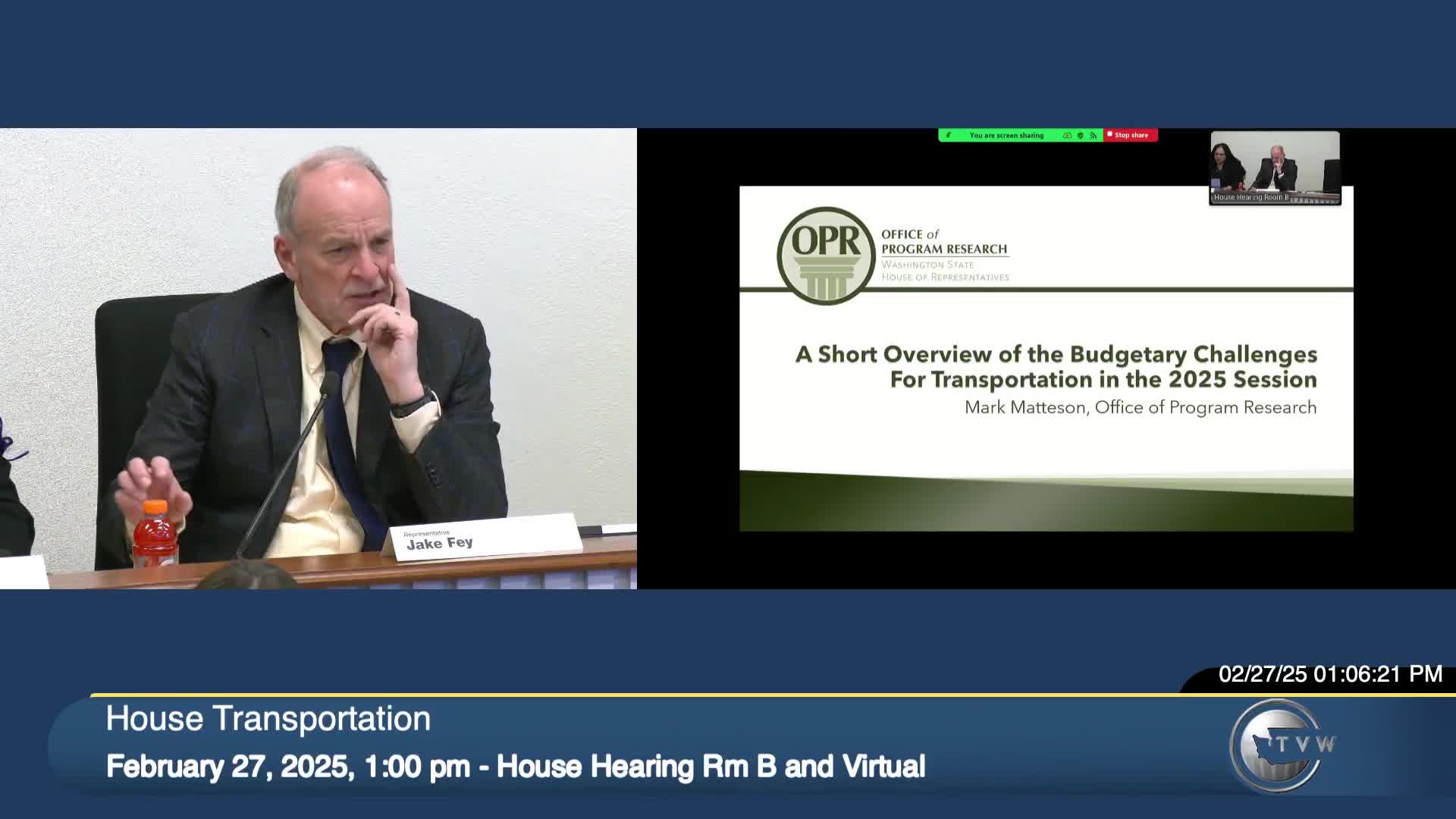
State transportation staff told a legislative committee on March 1 that the 2025–27 transportation financial plan faces a substantial shortfall driven by updated fuel revenue forecasts, rising project costs and a federal court injunction requiring culvert corrections.
Mark Madison, staff to the committee, told members the updated motor fuel tax revenue forecast now projects negative fuel‑tax growth and reduces expected revenue by about $440 million over the next two years and about $1.2 billion over six years. "The upshot of all the changes, both process and economic, is that the forecast now recognizes a recent downward trend in fuel consumption," Madison said.
Madison told the committee that higher construction costs — reflected in a sharp rise in the National Highway Construction Cost Index and seen in local bid results such as State Route 520 work — add roughly another $439 million to the two‑year deficit and about $1.5 billion over six years.
The presentation flagged a third major cost driver: compliance with a federal court injunction requiring correction of fish‑passage barriers at culverts. Madison said the state currently plans to correct roughly 75 percent of the required barriers but that achieving the injunction's 90 percent target would likely require about $5 billion over time, with an estimated near‑term impact of about $68 million over two years and about $1.8 billion over six years.
Madison summarized other cost risks—projects with costs not recently updated, ferry vessel procurement bids and ongoing maintenance needs—estimating an additional two‑year exposure of about $719 million and a six‑year exposure of about $2.2 billion.
He described Governor Inslee's proposed budget and financial plan as aiming to present a balanced two‑year budget primarily by leaving some capital project lists underfunded (about $1 billion in cuts to the capital program lists). But Madison said that approach does not fully account for the culvert mandate and other cost risks; including those would raise the two‑year deficit to about $1.8 billion and push the six‑year cumulative deficit toward $8 billion.
"The options include reducing spending, increasing resources or a combination of both," Madison said, adding that "because the six‑year deficits are so large, either extreme — deep cuts or large new revenue sources — would be consequential." He noted that very large capital projects are often planned over multiple biennia and that capital planning typically uses a six‑year horizon while some packages have included longer, multi‑year plans.
Committee members asked for more granular breakdowns. Representative Lee requested a breakdown of the two‑ and six‑year figures by project or category; Madison said staff would provide more detailed assumptions where available. Representative Griffey asked whether the culvert cost estimate included newly identified barriers; Madison said the estimate reflected what WSDOT had identified to date but that newly identified barriers would add costs.
Why it matters: the transportation budget funds highways, ferries, ferries procurement, preservation and maintenance programs, and the presentation indicates program lists and service levels are at risk if the state does not identify more resources or cut projects.
What's next: Madison said the revenue forecast update in late March will inform budget rollouts and that the Senate is expected to release its transportation budget first this session. The committee's work will continue in the budget cabinet and through public hearings once legislative revenue forecasts are updated.