Get Full Government Meeting Transcripts, Videos, & Alerts Forever!
Get email alerts on the Ecsd Grant Massdep topic
No spam. Unsubscribe anytime.
MassDEP details ECSDC grants for small and disadvantaged water systems; $57,453,000 allocated so far
Summary
Abigail Jacobs of MassDEP described the Emerging Contaminants in Small and Disadvantaged Communities (ECSDC) grant: eligibility, project categories, noncompetitive needs assessment survey, technical assistance from UMass Amherst and MassDEP, and funding availability windows tied to federal award years.
Abigail (Abby) Jacobs, ECSDC grant manager at the Massachusetts Department of Environmental Protection, told attendees at an RCAP Solutions webinar that Massachusetts has received $57,453,000 in ECSDC funding from EPA so far and described who is eligible and how to apply.
Jacobs said ECSDC provides states with funds to help small and disadvantaged public water systems address emerging contaminants (PFAS, manganese and others listed on the EPA contaminant candidate list). She said the initial federal allocations for Massachusetts (federal fiscal years 2022 and 2023) are generally available to projects through 2029, and the 2024 allocation is available through 2030; she said additional federal fiscal-year allocations are hoped for in later years.
On eligibility, Jacobs said eligible applicants include publicly or privately owned community public water systems and nonprofit noncommunity systems; systems may also qualify if they serve a disadvantaged community (as defined by the Massachusetts Clean Water Trust tiers) or are small (serving fewer than 10,000 people) and lack capacity to incur debt. She explained that small systems not located in a designated disadvantaged community can still qualify if they demonstrate limited financial capacity — for example, inadequate financial controls, lack of staff or inability to take on debt.
Jacobs listed eligible project categories drawn from the ECSDC needs-survey form: research and testing (including pilot testing), planning and design, construction of treatment for emerging contaminants, source-water activities (for example, new wells), storage, water-system restructuring or interconnection, technical services (consulting), public communication and workforce development. She said connecting private wells with contamination to a community public water system is commonly funded by routing ECSDC funds through the receiving community system.
She urged interested systems to complete the noncompetitive needs-assessment survey form on MassDEP’s ECSDC web page and submit it to program.director-gwp@mass.gov with “ECSDC” and the public-water-system ID in the subject line. “If you believe you’re eligible for the funding, please complete a needs assessment survey form,” Jacobs said. She added MassDEP and UMass Amherst provide technical assistance — including pilot testing support, permitting guidance, operator training and help preparing grant and loan paperwork — and MassDEP staff will follow up with systems that submit needs-assessment forms.
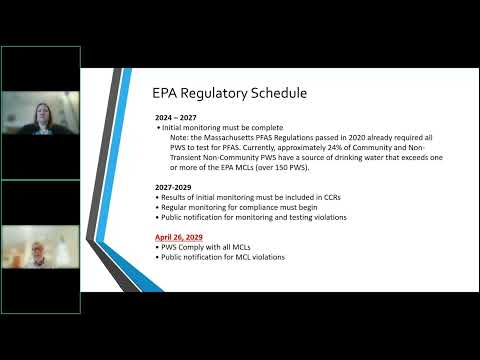
Jacobs also directed attendees to the state’s data portal to look up PFAS testing results by town or public-water-system name and noted other funding sources such as the Drinking Water State Revolving Fund (SRF) and programs for cybersecurity improvements. She closed by encouraging systems to begin planning now because projects often take longer than expected and because the compliance timeline tied to EPA’s rule will create near-term needs for many systems.