Get Full Government Meeting Transcripts, Videos, & Alerts Forever!
Get email alerts on the Pfas Regulations Treatment topic
No spam. Unsubscribe anytime.
EPA rule puts PFAS compliance timeline on small systems; technical options limited to removal for now
Summary
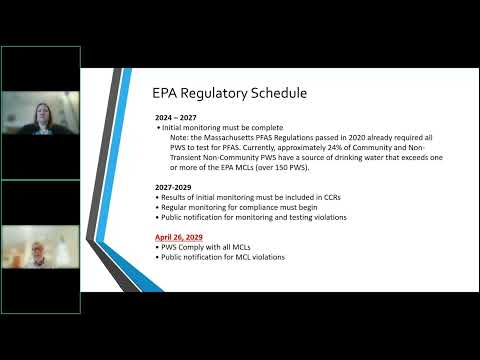
At an RCAP-hosted webinar, a technical presenter summarized EPA’s PFAS drinking-water rule, the 2024–2027 monitoring window, the April 26, 2029 enforcement date and the limited set of proven treatment options such as granular activated carbon, ion exchange and membrane filtration. MassDEP maintains a preapproved treatment list under 310 CMR 22.
Bridal Liam, a technical presenter, told attendees at an RCAP Solutions webinar that public water systems in Massachusetts must plan now to meet the U.S. Environmental Protection Agency’s new PFAS drinking-water rule, including an enforcement date that he said could allow EPA to begin issuing violations on April 26, 2029.
The regulation matters because, the presenter said, initial monitoring from 2024 through 2027 has already shown “about 150 water systems in Massachusetts [have] PFAS exceeding the federal MCLs,” and those exceedances include community and non-transient noncommunity systems. He added that the compliance schedule and the long lead time for planning and constructing treatment mean systems should begin planning immediately.
PFAS — per- and polyfluoroalkyl substances — are a class of persistent chemicals that the presenter summarized as “globally dispersed” and detected at very low concentrations that modern laboratories can measure. He said the final EPA regulation lists a small set of PFAS for mandatory monitoring and sets maximum contaminant levels at parts-per-trillion scales, noting those concentrations are far lower than many traditional drinking-water limits.
On treatment, Bridal Liam explained that technologies that destroy PFAS in dilute drinking-water streams are still under development and not yet commercially established for routine drinking-water treatment. “There’s more than one way out of this problem, but I’ll tend to focus on treatment,” he said, and then outlined currently established removal technologies: granular activated carbon (GAC), powdered activated carbon (PAC), ion-exchange resins, and high-pressure membranes such as reverse osmosis and nanofiltration. He described those methods as non‑destructive — they move PFAS out of the distribution water but do not chemically degrade it — and noted tradeoffs in cost, disposal and effectiveness depending on the specific PFAS compounds present.
Bridal Liam also directed attendees to a MassDEP-maintained list of preapproved treatment technologies under 310 CMR 22 and recommended systems consult their regional MassDEP contact when planning pilots or full-scale installations. He emphasized that conventional treatment trains (for example, coagulation and conventional filtration) typically do not remove PFAS effectively and that pilots are often required to select and size a solution that matches local water quality.
He closed by reiterating the schedule drivers: a multiyear monitoring and routine-monitoring transition period followed by the potential for EPA enforcement beginning April 26, 2029, and warned that planning, design and construction for treatment or interconnection projects can take several years.
Less urgent technical details, pilot requirements, and local permitting steps were discussed during the webinar and attendees were directed to MassDEP and regional staff for specific follow-up.