Get Full Government Meeting Transcripts, Videos, & Alerts Forever!
Get email alerts on the Governance topic
No spam. Unsubscribe anytime.
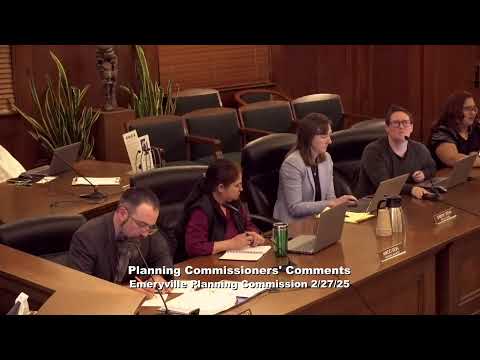
Emeryville planners review committee diversity survey, discuss outreach and mentorship
Summary
The Planning Commission reviewed a voluntary demographic survey of commission and committee members and discussed whether to add optional diversity questions to future advisory-board applications. Commissioners favored collecting data and expanding outreach, while cautioning against legally problematic or rigidly designated seats.
The Emeryville Planning Commission discussed committee and commission composition on Feb. 27 after staff presented the results of a voluntary, anonymous survey of advisory body members and asked whether demographic and socioeconomic questions should be added to application forms.
Senior Planner Navarro Oakes told the commission the short, voluntary survey was open for six days and had a 65% participation rate among committee and commission members. "It was open for 6 days. It was anonymous. There was a 65% participation rate," Oakes said.
Why it matters: City Council directed a review of committee composition as part of its housing-cycle and governance work, seeking to ensure advisory bodies better reflect Emeryville's population and to advise on outreach approaches.
What staff presented and commissioners asked - Staff summary: The survey results showed relative underrepresentation of seniors and younger residents; a disproportionate share of respondents identified as White; and fewer respondents reported lower household incomes. Staff said the housing committee specifically has objectives to include at least one resident living in a BMR unit, at least one tenant, and at least one homeowner. - Commissioners' views: Panel members generally supported adding voluntary demographic and socioeconomic questions to future applications to guide outreach. Several commissioners urged practical outreach strategies, including word-of-mouth recruitment, using local community centers and schools, and mentoring or advising potential applicants so they can improve their chance of appointment. One commissioner recommended hard-copy flyers and increased presence at community hubs to reach residents who may not use online channels. - Legal and practical limits: Commissioners and staff noted the city cannot set aside seats based on protected classes; any designated-seat approach would need to prioritize rather than limit eligibility and must comply with legal constraints.
Next steps Staff said results will be shared with City Council and that the city will re-run the voluntary survey annually. Commissioners recommended targeted outreach, mentorship for prospective applicants and exploring youth engagement through school partnerships or ECCL programs.
Attribution: Quotes and presentation details above are from Navarro Oakes, Senior Planner, and the commissioners named in the meeting record. No formal action was taken on this item; the commission closed the discussion and asked staff to report the baseline results to City Council.