Get Full Government Meeting Transcripts, Videos, & Alerts Forever!
Get email alerts on the Health Care Primary Care Rates topic
No spam. Unsubscribe anytime.
Governor’s budget would add primary care to state rate review; advocates urge broader scope
Summary
A proposal in the governor’s fiscal 2026 budget to add primary care to the Office of the Health Insurance Commissioner’s (OHIC) biennial rate review drew support from providers and advocates Feb. 27 while stakeholders urged technical fixes covering payor mix, community health centers and non–fee-for-service payments.
A proposal in Gov. McKee’s fiscal 2026 budget to include primary care in the Office of the Health Insurance Commissioner’s biennial social and human services rate review drew support and technical questions at a Feb. 27 hearing of the Senate Finance Committee.
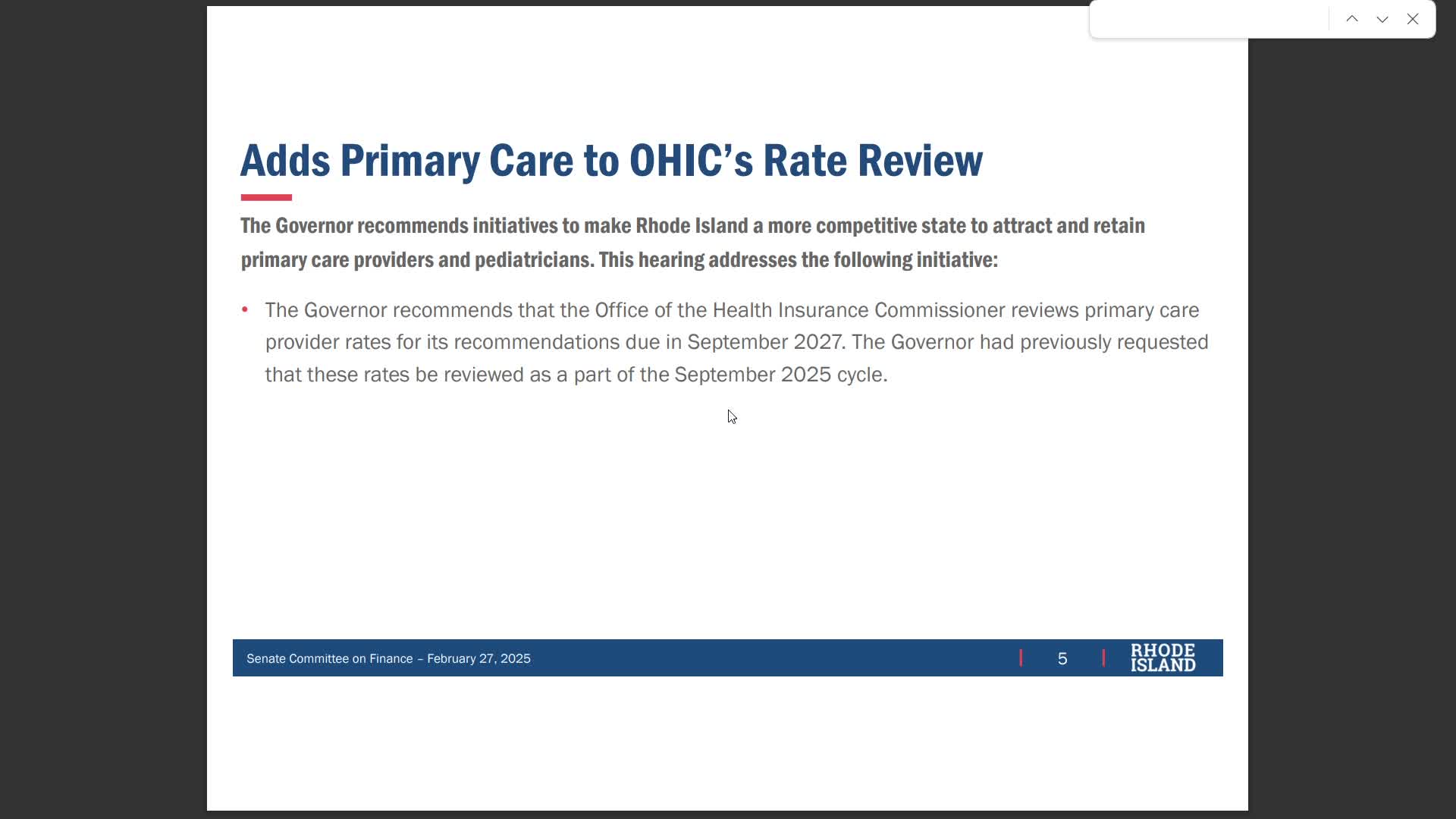
The provision (Article 8, section 8 of the proposed budget, cited in testimony as H5076 Article 8 Section 8) would direct OHIC to review primary care provider rates as part of its next scheduled rate-review cycle, with the report currently scheduled for the September 2027 cycle.
Supporters said the review is a needed first step to address shortages in pediatric and primary care, particularly for Medicaid enrollees. "We love the idea of having OHIC conduct a rigorous review," said Sam Salganek, executive director of Riipen, a statewide social-service nonprofit whose board and staff include parents of children with disabilities. "Primary care is actually quite different than social and human services," Salganek added, urging changes to how the review handles payor mix and payment methodologies.
Mikaela Carroll, health policy associate at Rhode Island Kids Count, told the committee that pediatric primary care is in crisis: "More than half of the pediatric primary care offices in the state are not accepting new patients," she said, noting that more than half of Rhode Island children rely on Medicaid. Carroll urged lawmakers to consider accelerating the review timetable and to treat pediatric care as a distinct subtopic within the broader primary-care review.
"Passage of this budget article would be a big step in the right direction to ensure that infants, young children, and adolescents have access to critical primary health care," said Elizabeth Burke Bryant, professor of the practice of health services policy and practice at Brown’s School of Public Health, who testified in support of the measure.
OHIC Commissioner Corey King told the panel the governor’s proposal gives the office latitude to consider broader payment models and non–fee-for-service arrangements used in primary care. "The way I read the proposal is it does allow us to take a broader view of primary care payment models and payment methods," King said, citing team‑based care and per‑member per‑month payments as examples the review could assess.
Several technical concerns were raised during testimony and questions from senators: Sam Salganek warned the committee that the existing social and human services review is primarily oriented toward Medicaid-funded services and could miss commercial and Medicare payment practices that affect primary care. He also said community health centers might be excluded under current statute because some reimbursement methods are set by law. King acknowledged those limits and said OHIC will seek to incorporate payor mix and alternative payment methodologies into the analysis where possible.
Senators also asked whether the review should be staggered so primary care analysis does not always coincide with reviews of other service categories. Salganek and others recommended staggering to avoid cycles that review many things at once and then nothing in subsequent years.
Practical and budgetary details surfaced in the hearing. King noted OHIC’s biannual rate review is normally a high‑intensity work cycle followed by a lower‑intensity year and said the office had identified additional federal matching funds that reduce the general‑revenue requirement for related consumer‑assistance work. The office also cited a separate statutory responsibility: the recently enacted Dental Loss Ratio Study Act, which OHIC must administer and which the agency accounted for in its revised budget.
No formal committee vote on the budget article occurred during the hearing. Committee members and agency officials agreed the provision will be considered as part of the broader budget process; King said OHIC will consult with Medicaid and other stakeholders as it develops the review framework.
Context and next steps: the governor’s budget presents the scope change as part of a broader health and economic plan. The current schedule sets the primary‑care review for completion in the September 2027 cycle; several witnesses urged lawmakers to consider moving the review earlier and to convene advisory stakeholders to refine the review’s scope and methods.
Why it matters: advocates said a statewide, methodical review of primary‑care payment could inform Medicaid rates, commercial reimbursements and policy actions intended to stabilize pediatric and family primary‑care practices that serve Medicaid patients.
For now, the proposal remains part of the fiscal 2026 budget conversation; OHIC and committee staff will be working with stakeholders on technical language and implementation details as the budget process continues.