Get Full Government Meeting Transcripts, Videos, & Alerts Forever!
Get email alerts on the Water Regulation topic
No spam. Unsubscribe anytime.
Panel holds hearing on regulating private water companies; sponsors propose rate-justification review for surface-water systems
Summary
Committee heard a substitute (LC550562S) proposing oversight of private water companies that use surface water, including a requirement that companies justify rate increases over a three-year window to the Public Service Commission (PSC); hearing was informational with no committee vote.
Committee members held a hearing on a substitute to HB 449 (LC 550562S) that would apply oversight to certain private water companies that rely on surface water and would require rate-justification filings for significant increases over a three-year period.
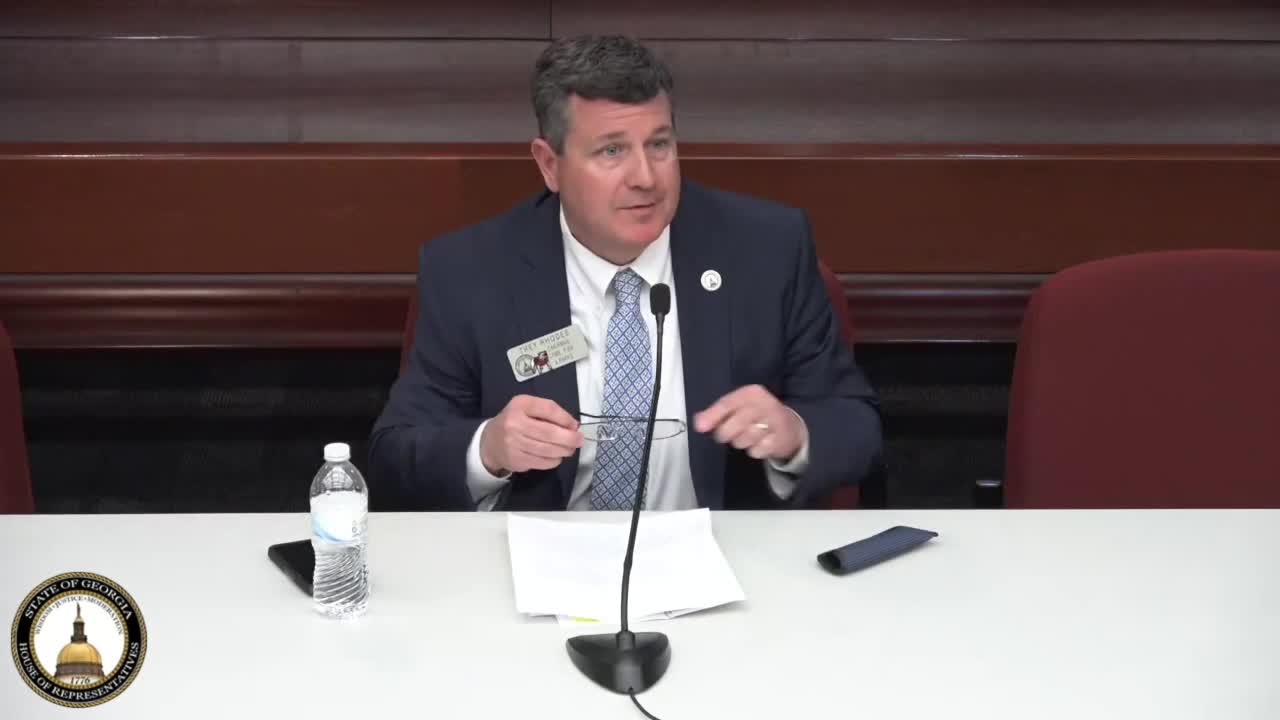
Representative Rhodes, who presented the substitute, said the bill would affect private companies using lakes and other surface waters and would require action if a company seeks a cumulative increase of 15 percent over a three‑year period. The sponsor said the measure excludes tap fees and capital expenditures from that percentage calculation and limits initial application to systems using surface water.
Tom Bond, director of utilities at the Georgia Public Service Commission, told the committee the PSC currently regulates electric, natural gas and telephone utilities but does not regulate water. He said the commission would need additional staff and resources to process water rate cases and that a review of the substitute language would be required to estimate costs and staffing needs.
Representatives of the private water industry testified. Adam Schafer, president and CEO of Piedmont Water Company, described substantial recent investment in infrastructure around Lake Oconee and said the firm has invested tens of millions of dollars in new treatment plants and system upgrades. Schafer said the company follows a model “loosely” similar to regulated utilities when setting rates and warned that applying regulation to only some systems could raise costs that would be passed to customers. He also provided specifics on tap fees and pump costs in his system.
Mark Smith, CEO of Water Utility Management, said his firm operates many small, rural systems and stressed that private companies have historically provided service where local governments did not. Both industry witnesses urged continued study and careful drafting.
Committee members discussed tap‑in fees, ownership history, private equity investment and the customer impact of large connection charges. The PSC representative offered to provide a cost estimate for administering water rate cases if the legislature sought to assign the commission that role.
The committee concluded the hearing without a vote and said it would return at a later date to consider the bill in more detail.