Get Full Government Meeting Transcripts, Videos, & Alerts Forever!
Get email alerts on the Transportation Budget topic
No spam. Unsubscribe anytime.
Transportation budget faces multibillion-dollar shortfall; staff outlines cuts, delays or revenue options
Summary
State transportation staff told the Senate Transportation Committee that a $1 billion shortfall in the upcoming biennium could grow to roughly $4 billion over six years, and presented options including operating cuts, capital delays and revenue increases.
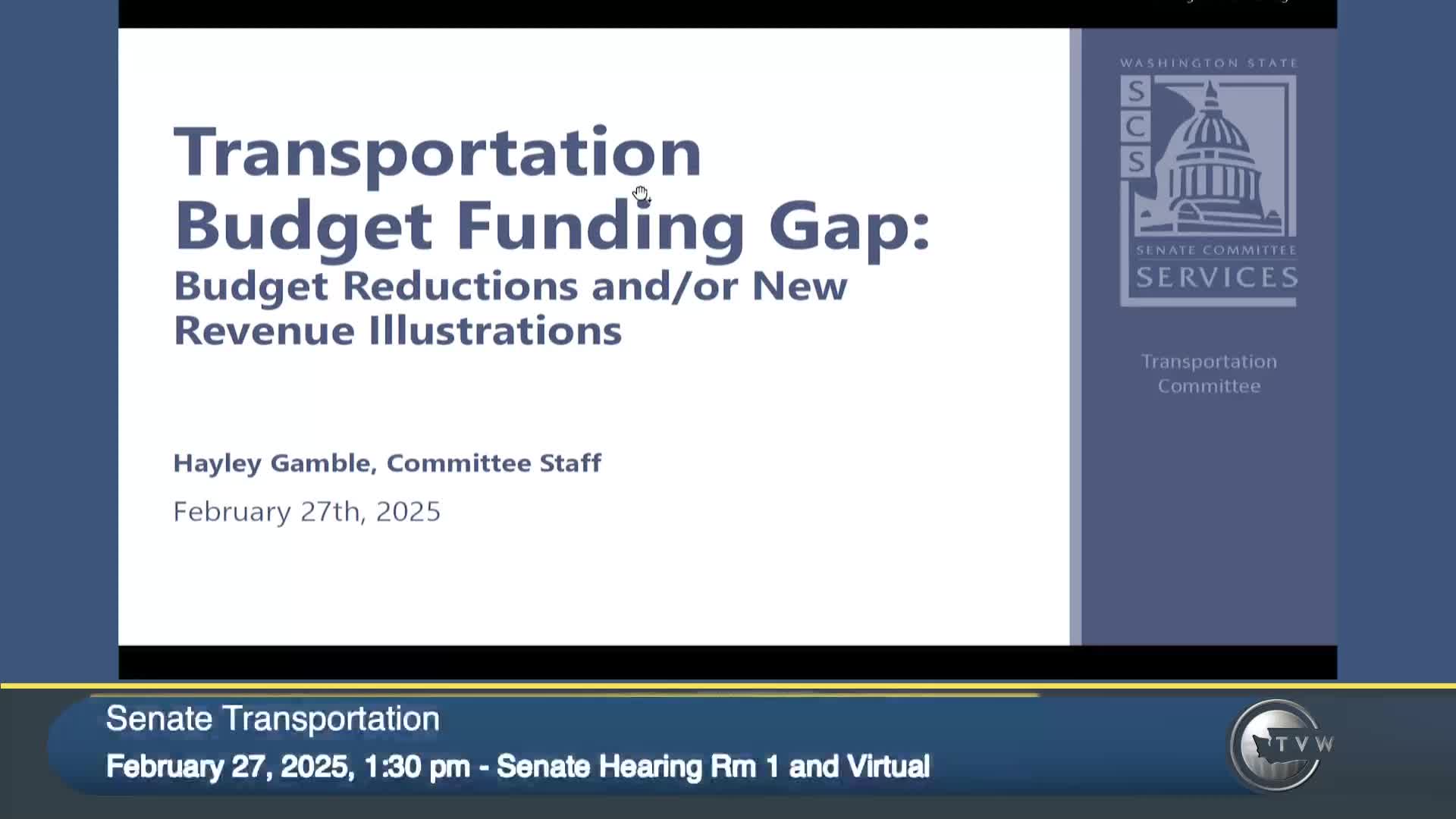
Haley Gamble, the committee’s budget coordinator, told the Washington State Senate Transportation Committee on Feb. 27, 2025, that the transportation budget faces a multi‑billion dollar gap and laid out options of reductions, delays or new revenue to close it.
Gamble said the governor’s budget included a $1,000,000,000 placeholder to balance the 2025–27 budget and that, without that placeholder, the accounts would be short by about $1 billion in the upcoming biennium and the shortfall would grow to roughly $2.6 billion in 2027–29 and nearly $4 billion over six years.
The shortfall reflects lower-than-expected transportation revenues and rising project costs. "Since the forecast that was used for the adopted budget, the gas tax has gone down by $332,000,000, so 9.7%," Gamble said. She also told the committee that the transportation budget lost about $2.5 billion in revenues since 2020 because of COVID‑era declines and that project cost increases have strained the financial plan.
Why it matters: the shortfall forces tradeoffs among the state’s operating obligations, large capital projects and ferry and transit operations. Committee members were told that addressing the gap solely through operating reductions would require cuts approaching 25% of discretionary operating spending; addressing it solely through capital reductions would require roughly a 12% reduction to the capital program in 2025–27.
Gamble reviewed order‑of‑magnitude options. On the operating side she said total transportation operating spending is about $6.2 billion and that, after excluding debt service, roughly $4.3 billion remains available for discretionary reductions. "To get to that $1,000,000,000, you're looking at almost 25% across the board cuts if you wanted to accommodate this reduction in just the operating budget," she said.
On the capital side, Gamble said the governor’s 2025–27 capital plan totaled about $8.9 billion and that trimming uncommitted projects could yield savings but would not by itself close the longer‑term hole. She presented an analysis showing about $1.1 billion in highway improvement projects were not yet under contract for 2025–27 (excluding fish‑passage, culvert preservation, some safety and stormwater projects), with similar uncommitted sums in later biennia.
Gamble also outlined revenue options modeled by staff. An illustrative package would include an 8.7¢ increase to the gas tax (currently cited on the slide as 4.49¢ in the transcript), a $10 increase to vehicle registration fees (from $30), and adjustments to passenger weight and freight fees; the package would raise several hundred million dollars in 2025–27 but, by staff calculation, would fall slightly short of $1 billion in the current biennium.
Senator Lovellott asked whether the ferry hybrid‑vessel budget shown included vessels currently out for bid. "You're seeing the budget for, I believe, is for 5 new vessels," Gamble replied, saying the budgeted amount covered the vessels for which funding is reserved and would include those awaiting bids.
Gamble cautioned that the committee’s likely approach will be a mix of operating reductions, capital reductions and revenue increases. She added that several significant needs remained unfunded in the governor’s package: estimates to replace COVID‑era losses in program spending were mentioned as roughly $5 billion or more; the Department of Transportation has previously estimated about $1.5 billion per year would be required to restore all modes to a state‑of‑good‑repair; and about half the ferry fleet has reached its useful life, implying potential replacement at roughly one vessel per year to maintain current service levels.
The committee’s budget cabinet — identified in committee comments as Senators King and Gaynor, Chair Leah and Vice Chair Ramos — has been meeting on the issue and plans to present a proposed committee budget in about a month, Gamble said. The presentation concluded with Gamble noting that some projects are only partially funded and that cost estimates continue to come in above bids.
The committee then moved on to executive session items.
Gamble: "This is just sort of a check‑in, and I look forward to talking to members about this as we move forward."