Get Full Government Meeting Transcripts, Videos, & Alerts Forever!
Get email alerts on the Water Management topic
No spam. Unsubscribe anytime.
Water-policy center outlines Habitat Conservation Plan, alternative wells to protect Lower Flint flows
Summary
Mark Masters of the Georgia Water Planning and Policy Center told the Natural Resources committee that a data-driven Habitat Conservation Plan (HCP) and ARPA-funded alternative groundwater wells aim to protect stream flows in the Lower Flint Basin, support farmers and address endangered-mussel habitat concerns.
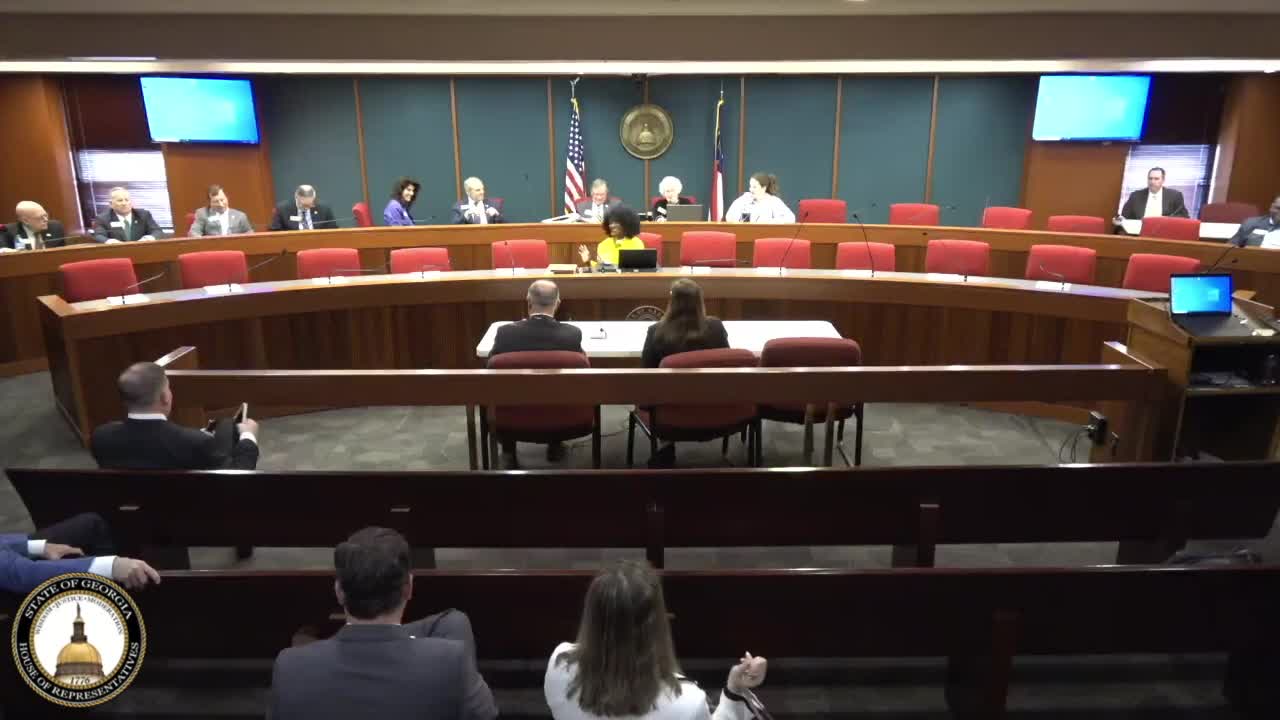
Mark Masters, director of the Georgia Water Planning and Policy Center at Albany State University, told the House Natural Resources committee that the center is preparing a Habitat Conservation Plan (HCP) and deploying ARPA-funded alternative groundwater sources to protect flows in the Lower Flint Basin and provide water certainty for farmers.
Masters said the center has built a linked database of measured agricultural withdrawals, field-verified irrigated acreage and irrigation-system details that supports more targeted water management. He told lawmakers that work on regional planning and metering has positioned Georgia to pursue both conservation and certainty for users.
"We were put together to answer the so what questions," Masters said, describing the center's role in turning research into practical decisions for stakeholders and policymakers.
Masters outlined specific steps in the Lower Flint project: expanded monitoring wells in deeper aquifers; alternative groundwater production wells for surface-water users; voluntary farmer incentives and conservation technologies; easements and sedimentation controls at dirt-road stream crossings; and planned augmentation in select locations. He said the HCP is being assembled for submission to the U.S. Fish and Wildlife Service and will document management practices designed to maintain habitat for endangered freshwater mussels while providing legal certainty for water users.
Masters said the center has secured ARPA funding to drill alternative-source wells and that it has reached approximately 60 landowner agreements and drilled roughly 60–65 test holes, with production wells being installed. He also credited a decade of regional planning and earlier investments, including the 2002 Metropolitan North Georgia Water Planning District Act and a 2003 agricultural metering law, for creating the data foundation the state uses today.
Representative Viola Davis asked about industrial and municipal withdrawals, citing constituent questions about data centers and auto plants seeking "1,000,000 to 6,000,000. Is that gallons per day?" Masters said permitting and metering for industrial and municipal withdrawals are administered by the Georgia Environmental Protection Division and that the Water Policy Center provides technical and stakeholder support to EPD but has no regulatory authority.
Masters emphasized variability in Georgia rainfall and the role of irrigation to bridge dry periods; he cited statewide irrigated acreage of about 1.7 million acres (data through 2020), said farmers have invested more than $3 billion in irrigation infrastructure, and noted roughly 27,400 center pivots in the state with approximately 16,000 already mapped in the center's database. He said these measures were critical to defending Georgia's water use in interstate litigation and to building a management toolset for future dry spells.
Masters concluded by noting the advisory board had unanimously approved the draft HCP to go to the U.S. Fish and Wildlife Service at a meeting the previous week and invited committee questions and further collaboration.
The committee discussed groundwater monitoring, storage options and regional capture ideas; Masters said storage and capture will be highly regionalized and that metro and rural solutions differ. He provided contact information to the committee and the panel thanked him for the presentation.