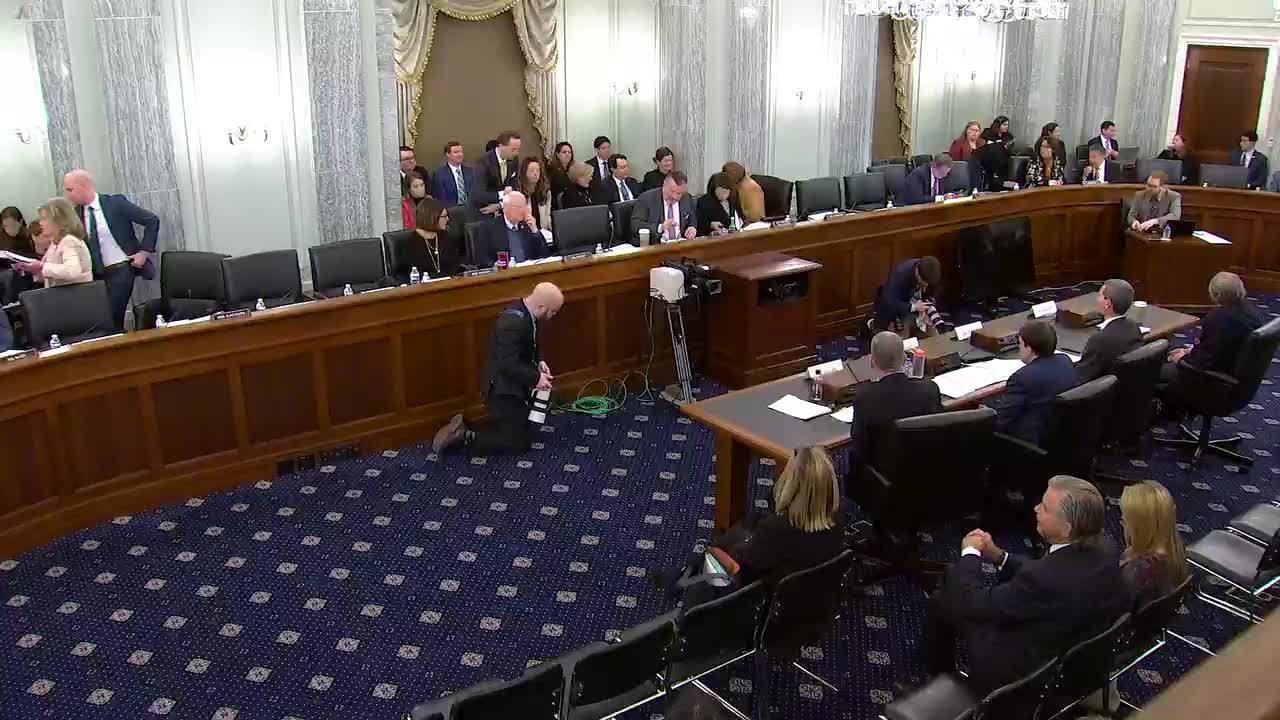
Senate Commerce hearing: lawmakers, experts press to restore FCC auction authority and debate spectrum pipeline vs. military needs
Get AI-powered insights, summaries, and transcripts
SubscribeSummary
The Commerce Committee heard testimony that restoring FCC auction authority and creating a mid‑band pipeline are essential to U.S. economic and technology leadership, while senators and witnesses emphasized the need to protect Defense Department mission‑critical spectrum.
The Senate Committee on Commerce, Science and Transportation heard broad agreement that spectrum policy will be central to U.S. economic and national security competitiveness — but members diverged on how quickly to press auctions and how to protect Defense Department missions.
"Auctioning Spectrum has been one of the most successful drivers of American innovation, economic growth and global technology leadership," Chairman Crews said in opening testimony, framing auctions as critical to unlocking private investment and enabling technologies from smartphones to generative AI. Multiple witnesses and senators urged Congress to restore the Federal Communications Commission's auction authority, which the panel was told lapsed in March 2023, and to set clearing targets so companies can invest with certainty.
Witnesses described a three‑part case: auctions and clear mid‑band access spur commercial investment; adaptive technology and dynamic sharing can reduce conflict between commercial and federal users; and national security considerations require careful, engineering‑level study. Matt Pearl of the Center for Strategic and International Studies warned that ceding leadership in next‑generation networks to Chinese firms would be grave. "It's catastrophic for national security," Pearl said of a scenario in which Huawei and other firms set global network standards.
Military officials and security witnesses cautioned against hasty reallocation of federal bands without rigorous feasibility work. Brian Clark of the Hudson Institute said the electromagnetic spectrum is "increasingly where one wars are gonna be won and lost," and senators pressed for classified, engineer‑level briefings to examine specific systems, frequencies and physics before any clearing or auctioning of bands used for missile defense, radar or other mission‑critical systems.
Academia and industry witnesses urged parallel investments in sharing technology. Dr. Charles Bayless, director of SMART Hub, described work on adaptive and reconfigurable radios, rapid reconfiguration circuits and a dynamic spectrum management system (DSMS) to provide real‑time interference reports and coordinate spectrum use across military and commercial systems. Bayless said his center asked for an ongoing appropriation and that SmartHub had been operating at a $5,000,000 annual funding level to accelerate prototypes and demonstrations.
Economist Dr. Thomas Hazlett outlined historical auction outcomes and argued market mechanisms and overlays have unlocked large amounts of spectrum for commercial use. He cited auction 107, where bidders paid roughly $94 billion and incumbents received about $13 billion as part of a reconfiguration, and noted that auctions since 1993 have generated roughly $233 billion for the Treasury.
Senators repeatedly framed the debate as seeking a "both/and" outcome: secure and capable military systems alongside robust commercial access that sustains U.S. technology leadership. Senators asked whether the Spectrum Pipeline Act — described in the hearing as legislation introduced by committee members to restore auction authority and define a mid‑band pipeline — would force the Defense Department to vacate critical spectrum. Witnesses replied that the bill could accommodate exclusive or shared use but stressed the need for interagency engineering work, test beds and potential location or geographic carve‑outs.
On process, witnesses and senators highlighted several policy levers: reforming the Spectrum Relocation Fund so agencies can upgrade to comparable or improved systems, giving NTIA more authority to study bands, and mandating clearing targets while requiring feasibility studies before auctions. Senator Kim and others pressed for classified briefings and engineer‑level exchanges to resolve disputed claims about continuous DOD use of particular bands.
No formal committee votes on spectrum legislation were recorded at the hearing. Senators and witnesses left three clear requests: (1) Congress should consider restoring FCC auction authority and adopt pipeline clearing targets; (2) the executive branch should undertake technical feasibility studies with strong White House leadership and agency cooperation; (3) Congress should fund technology development (witnesses requested SmartHub funding and noted that adaptive technologies could accelerate safe sharing).
The hearing included numerous examples and quantitative claims that committee staff can verify: the FCC auction authority lapse (March 2023), historical auction proceeds (~$233 billion since 1993), auction 107 proceeds (~$94 billion with ~$13 billion to incumbents), C‑band private investment figures (~$81 billion cited in testimony), and a CBO estimate mentioned on the record that a pipeline could raise roughly $10–$15 billion in a 10‑year window but might require a longer transition period.
Committee members said senators will continue the record after the hearing and requested follow‑up materials and classified briefings from Defense Department engineers to anchor future legislative decisions.