Lifetime Citizen Portal Access — AI Briefings, Alerts & Unlimited Follows
Senate Commerce Committee hearing presses for a spectrum pipeline while senators press DOD, industry and researchers on sharing and timelines
Loading...
Summary
Witnesses and senators debated restoring FCC auction authority, military spectrum needs, dynamic sharing technologies and timelines. Committee chair urged a spectrum pipeline to boost U.S. innovation and revenues while others stressed protecting critical defense capabilities and testing sharing approaches.
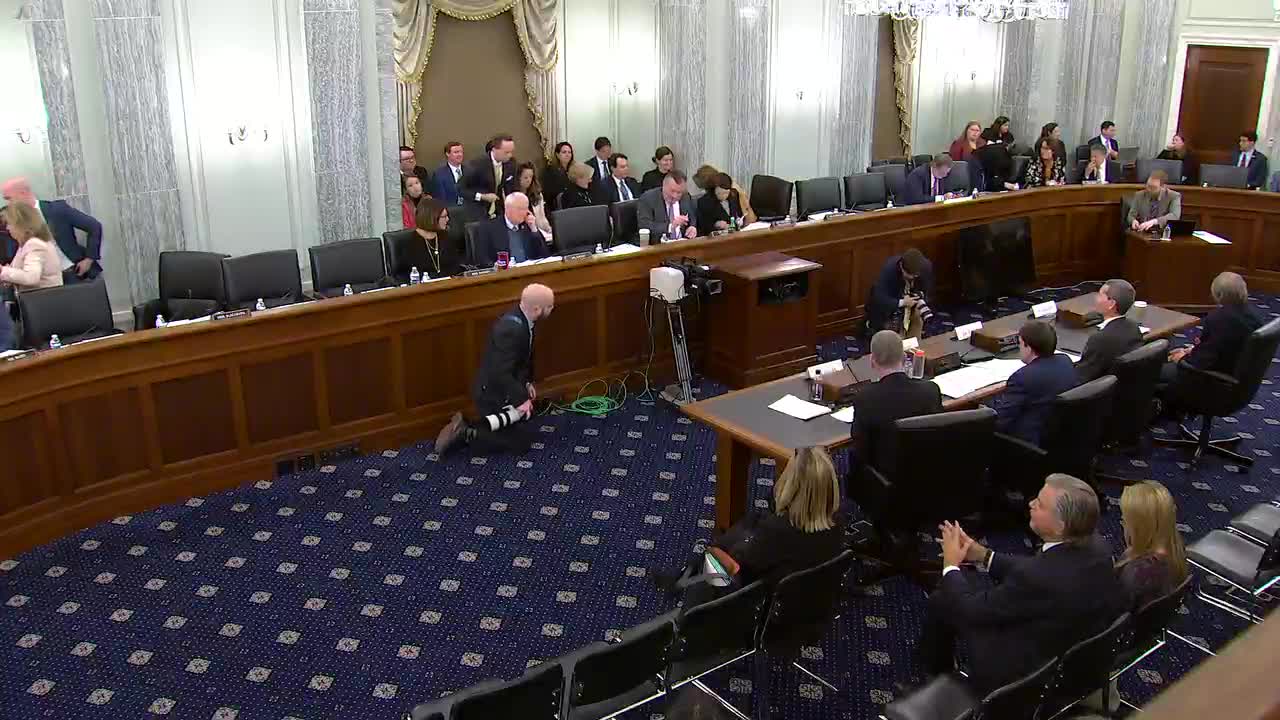
WASHINGTON — The Senate Committee on Commerce, Science and Transportation on opened a hearing to examine "the critical role of spectrum policy in driving the U.S. economy," with members and witnesses debating how to expand commercial access while preserving military and federal systems that rely on radio frequencies.
Chairman Crews told the panel that "Auctioning Spectrum has been one of the most successful drivers of American innovation, economic growth and global technology leadership," and urged passage of a Spectrum Pipeline Act that he said "would restore FCC auction authority and end our spectrum drought." He argued that auctions unlock investment and warned that slowing or ceding leadership to China risks long‑term economic and security costs.
The hearing drew four witnesses: Dr. Thomas Hazlitt, professor of economics at Clemson University; Dr. Charles Bayless, professor of electrical and computer engineering at Baylor University and director of SMART Hub; Matt Pearl, director of strategic technologies at the Center for Strategic and International Studies (CSIS); and Brian Clark, senior fellow and director of the Center for Defense Concepts and Technology at the Hudson Institute. Each described different levers for expanding commercial use of spectrum while addressing national security concerns.
Why it matters: Spectrum auctions and reallocation have historically funded significant private investment and supported the growth of wireless industries, witnesses said. Senators pressed witnesses on whether restored auction authority would harm critical Department of Defense systems and on the time and cost of testing sharing approaches and modernizing incumbent military equipment.
Key testimony and points
- Dr. Thomas Hazlitt said market‑oriented spectrum policy and mechanisms such as overlays and auctions have unlocked broad economic gains; he cited a recent auction (Auction 107) where winning bidders paid about "$94,000,000,000" and about "$13,000,000,000" was passed through to incumbents. Hazlitt characterized artificial scarcity driven by regulation as an economic impediment and urged greater liberalization.
- Dr. Charles Bayless described SMART Hub's work on adaptive and reconfigurable technologies to enable coexistence between military and commercial systems. He testified that technologies such as "Sense, React and Avoid" and a dynamic spectrum management system (DSMS) can support near‑real‑time coordination and reduce interference, and said his center demonstrated initial capabilities for the Pentagon and others two weeks before the hearing.
- Matt Pearl of CSIS urged restoring FCC auction authority and setting aggressive clearing targets, arguing auctions create a "chain reaction" of network upgrades, private investment and downstream innovation. He called the prospect of Chinese firms setting global telecommunications standards "catastrophic for national security," saying U.S. policy should prevent foreign dominance.
- Brian Clark emphasized military dependence on spectrum, saying modern conflicts — citing examples from Ukraine — show that electromagnetic operations are decisive. He said some bands (for example lower S‑band and X‑band radar frequencies) have physical characteristics essential for air and missile defense and that wholesale relocation of those systems may be infeasible.
Senators' questions and concerns
- Ranking Member Cantwell framed the tradeoff succinctly: "First, the commercial industry needs access to more spectrum to innovate and bring new technologies to market. But second, the vital national security, aviation security, and essential federal capabilities that rely on spectrum must be protected." She and others urged collaborative, engineering‑based feasibility studies before auctions.
- Several senators pressed on timelines and costs. Senator Fisher warned that clearing DoD bands and replacing systems could cost "hundreds of billions of dollars" and take decades; Mr. Clark estimated that upgrading military systems to incorporate new sharing technologies could take "10 to 20 years," while Dr. Bayless said his center showed "tremendous progress" at a six‑month demonstration.
- Senators asked about prior sharing successes: witnesses pointed to CBRS and the AMBIT process as existing examples of sharing and geographic carve‑outs, but warned that technology, test beds and interagency engineering work were necessary to extend sharing into other bands.
- Lawmakers asked about reforming the Spectrum Relocation Fund (SRF) and giving NTIA a stronger role in feasibility studies. Mr. Pearl recommended clearer White House leadership and legislative clearing targets to focus interagency work.
Technical and program details recorded in testimony
- FCC auction authority: witnesses noted the authority lapsed in March 2023, and multiple speakers urged Congress to renew it.
- Auction history and revenue: Dr. Hazlitt referenced Auction 107 results (cited figures: $94,000,000,000 in winning bids; $13,000,000,000 passed to incumbents). Chairman Crews and others referenced potential high revenue figures for a spectrum pipeline; one figure cited in the hearing was "a hundred billion dollars or more," while Senator Fisher cited a CBO estimate of roughly "$10 to $15,000,000,000" in a 10‑year window for certain pipeline proposals.
- SmartHub funding request: Dr. Bayless said SMART Hub has received one appropriation to date and is "asking for $5,000,000 for this year" to continue research, demonstrations and workforce development.
- Implementation timelines: Dr. Bayless said the research center had shown "tremendous progress" at a six‑month demo; Mr. Clark said fielding advanced sharing capabilities into legacy military platforms could take 10–20 years in some cases.
Where senators left off
Lawmakers pressed for more detailed, engineering‑level analysis and suggested classified briefings with Defense Department engineers to reconcile national security red lines with commercial clearing targets. Several senators asked witnesses to submit written recommendations on resolving interagency disputes, reforming SRF, and preparing for international spectrum meetings such as World Radiocommunication Conference 2027.
Ending: The committee closed the hearing portion by inviting additional questions for the record and asking witnesses to provide written recommendations. Senators were given until the close of business on Wednesday, February 26 to submit questions for the record, with witnesses to respond by March 12, according to the chairman's closing instructions.