Get Full Government Meeting Transcripts, Videos, & Alerts Forever!
Get email alerts on the Appropriations Supplemental Budget topic
No spam. Unsubscribe anytime.
Joint Appropriations Committee approves amended draft of 2025 supplemental budget, creates wildfire loan program and targets teacher pay
Summary
The Joint Appropriations Committee approved committee formal draft LSO 0781 as amended, advancing the 2025 supplemental budget to the floor and adopting a package of program changes that includes a $100 million wildfire loan authority, targeted teacher pay increases, and multiple funding reductions and restorations.
The Joint Appropriations Committee approved committee formal draft LSO 0781 as amended during a meeting, advancing the 2025 supplemental budget to the floor and adopting a set of reallocations and policy conditions that reshape several major programs.
The committee turned the governor’s proposed wildfire restoration grant into a $100 million loan program, added loan authority and program conditions at the Office of State Lands and Investments, adopted targeted adjustments to K‑12 funding that increase the teacher component of the education resource block grant model by 6.78 percent, and adopted multiple program reductions and restorations across state agencies.
The committee approved the formal draft on a roll-call vote at the end of the meeting; the roll call recorded 12 ayes and no nays (see “Actions” below). Don Richards, LSO budget fiscal administrator, and Elizabeth Martineau, senior fiscal analyst, led the committee through page‑by‑page language and footnotes in the draft bill and a summary report that compares the committee’s actions to the governor’s recommendations.
What changed: big-picture budget moves - Wildfire restoration: The committee converted the governor’s $130 million wildfire restoration grant request to a $100 million loan program (section 3‑46). That loan authority is funded from the LSRA (Land/Severance Revenue Account) and includes program rules the committee added in the bill text. - Loan program design: The loan program allows loans to persons and political subdivisions for disaster mitigation and restoration activities, sets a maximum 20‑year term, and imposes a 2 percent interest rate. The committee added that the Office of State Lands and Investments may retain half of interest receipts for administration and required reporting to the Joint Agriculture Committee and JAC. The committee also: (a) set a $100,000 minimum damage threshold to qualify as a “catastrophic event,” (b) required applicants to have “reasonably” pursued other federal and state funding (the committee added the word “reasonably”), and (c) directed staff to include insurance among the forms of reasonable mitigation applicants must show they pursued. - Collateral and lien position: Following committee discussion, the membership approved language that allows the state to accept a subordinated position on collateral (that is, the state may agree to be behind private lenders in lien priority) to increase the loan program’s usability for borrowers who otherwise could not secure bank participation.
Sector‑specific changes - K‑12: The committee adopted multiple adjustments for K‑12 funding. Members approved $33.9 million for entitlement tied to property tax declines, $35.3 million for special education, and adopted $48.8 million in changes to the education resource block grant (ECA) model. The ECA amendment applies consultant cost indices across categories and specifically targets a 6.78 percent increase for teacher pay (defined in the amendment to include core teachers, specialist teachers, tutors and instruction facilitators). The committee’s school‑finance analyst described the change as narrowing, but not eliminating, the gap between the legislative model and consultant recommendations. - Health and behavioral health: The Department of Health received several adjustments: $672,000 for home‑health rate increases, and $3.8 million (combined state and federal) one‑time for home and community‑based service providers (footnote restricting it to a one‑time appropriation). The committee also reduced $1.2 million and 13 FTE from behavioral health; the committee approved a separate $100,000 for the Wyoming Life Resource Center Cantina. - Family services and foster youth: The committee added roughly $504,000 for adult protective services and about $487,000 for independent living supports for current and former foster youth; language was reinserted that the appropriation “shall not be transferred or expended for any other purpose.” - State lands and property tax matters: The committee added appropriations and contingency language to address property tax implications for state trust lands, including a $420,000 appropriation and $2.8 million in school‑foundation funds contingent on enactment of separate legislation (Senate File 68 or 81). The committee also increased appropriations for invasive species work in the Wyoming Wildlife Natural Resource Trust Fund from $9 million to $20 million and clarified fund sources to permit use of the trust income account rather than general fund where appropriate. - University of Wyoming and energy projects: The committee added $550,000 for a University of Utah School of Medicine cohort and $2 million for the School of Energy Resources pyrolysis demonstration project; the committee also restored vetoed language on endowments and matching funds and added restrictions on diversity/equity/inclusion program activity consistent with earlier motions. - State parks and cultural resources: The committee reduced the arboretum appropriation by roughly $3.3 million, and members voted to make the Wyoming Centennial Farm and Ranch Program a one‑time appropriation by reinserting the word “not” so the appropriation will not be included in the standard budget going forward. - Wyoming State Shooting Complex: The bill appropriates funding (including $10 million previously designated and additional amounts) and creates parameters for future state participation, including a 4:1 nonstate match requirement and a capped annual state contribution for operations.
Key committee motions and procedural items - The committee adopted a number of specific language amendments and accompanying footnotes to implement policy intent and to limit or define how appropriations may be spent. Committee staff said the SR (summary report) will be updated if changes are made and that the draft bill will be posted and printed to comply with 24‑hour rule requirements before floor action.
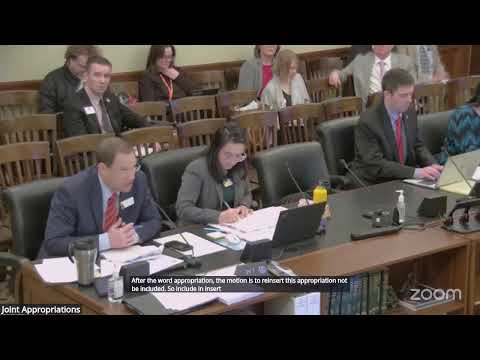
Votes at a glance (selected motions) - Amendment to add “community crisis centers/shelters” to Family Services language — mover: Representative Angelos; second: Representative Sherwood; voice vote: approved. - K‑12 ECA amendment that targets teacher pay at +6.78% and reallocates ECA indices (total $48.8 million) — mover: Chair (moved from the chair); second: Representative Smith; voice vote: approved. - Catastrophic damage threshold for wildfire loan program raised to $100,000 — mover: Representative Angelos; second: Representative Smith; voice vote: approved. - Committee approved language allowing the state to accept a subordinated lien position on collateral to improve loan program access — mover: Senator Driscoll; second: Co‑chair Salazar; voice vote: approved. - Amendment adding insurance to the list of “reasonable” mitigation actions applicants must pursue before receiving loans — mover: Representative Pendergraft; second: Representative Smith; voice vote: approved. - Motion requiring reporting on certain position increases in the bill (sections B and C) — mover: Senator Driscoll; second: Co‑chair Salazar; voice vote: approved. - Motion to make the Wyoming Centennial Farm and Ranch Program a one‑time appropriation (reinsert “not” in footnote language) — mover: Representative Pendergraft; second: Representative Aleman; voice vote: approved. - Final committee approval of LSO 0781, committee formal draft 1 as amended — roll‑call vote: 12 ayes, 0 nays (see Actions for vote record and names).
What to watch next The committee asked staff to post the updated SR and the formal draft and to prepare copies for lawmakers’ floor materials. Committee members noted that the supplemental bill may require further changes during floor debate if other large revenue or transfer bills pass; staff warned that the committee’s available balance in the budget reserve and general fund may change as additional legislation is acted on.
Ending The committee completed its markup and adjourned after the roll call approving the draft. The committee indicated it expects to print the bill and post materials promptly to meet rules for floor consideration.