Get Full Government Meeting Transcripts, Videos, & Alerts Forever!
Get email alerts on the Roads Speed Limits topic
No spam. Unsubscribe anytime.
Committee backs compromise letting local authorities lower speed limits on unpaved roads to 35 mph without study
Summary
After extended debate, the joint committee replaced previous amendments with a compromise allowing local authorities to permanently or temporarily lower maximum speed limits on unpaved roads to no less than 35 mph without conducting a speed study; the change passed by voice vote.
A joint committee voted to replace pending amendments and approve language that allows local authorities to permanently or temporarily decrease maximum speed limits on unpaved roadways to not less than 35 miles per hour without first conducting a speed study.
The change is intended to give county governments more flexibility to respond to local safety concerns — for example, speed reductions near new subdivisions or during periods of heavy truck traffic — while setting a statutory floor to avoid arbitrary, very low limits that some legislators warned could create unsafe conditions.
Jonathan Russell of the Wyoming County Commissioners Association described the process of negotiation: "We're looking for something that gives us some flexibility," and said counties sought a workable solution they could agree on. Russell testified that counties and other stakeholders met repeatedly and reached a compromise on the draft language.
Several senators voiced concerns about the scope and technical detail in one house amendment and the limits of lowering or raising limits without engineering input. Senator Rothfuss said an earlier draft risked unintended increases and proposed restoring much of a House Standing Committee amendment while limiting how low authorities could go without a study; he suggested adding a minimum that would prevent lowering below a set threshold without analysis. Representative Singh described the amendment adopted earlier on the House floor as the result of a compromise intended to provide public input and parameters for local action: "by having these parameters around that Fourth Amendment, it creates more opportunity for the actual public to have input on this change that they're going to end up having to deal with."
Testimony referenced a University of Wyoming study that found travel behavior on many unpaved roads clustered near 45 mph; some county stakeholders had originally sought a statutory drop from 55 to 45. WACERS (an association of local road/engineering stakeholders) did not support the bill as initially drafted but participated in the compromise discussions.
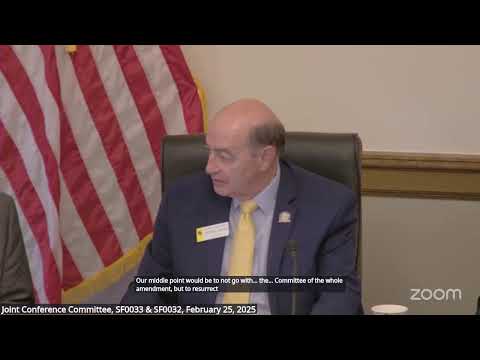
After further negotiation on minimums and temporary authorization (for example, to address short-term industrial traffic), a motion was made to delete the standing and committee-of-the-whole amendments and amend subsection F so that "a local authority may permanently or temporarily decrease a maximum speed limit to not less than 35 miles per hour for unpaved roadways ... without first conducting a speed study or providing justification for the maximum speed limit." The motion was seconded and carried by voice vote.