Get Full Government Meeting Transcripts, Videos, & Alerts Forever!
Get email alerts on the Education Policy topic
No spam. Unsubscribe anytime.
Conference committee adopts several Senate changes to HB 199, sets pre‑K scholarship at $7,000 for families up to 250% of poverty
Summary
A joint conference committee reconciled House and Senate differences on House Bill 199, adopting Senate amendments that rename a scholarship, clarify certification and testing language for ESA students, and set a $7,000 pre‑K scholarship for families up to 250% of the federal poverty level.
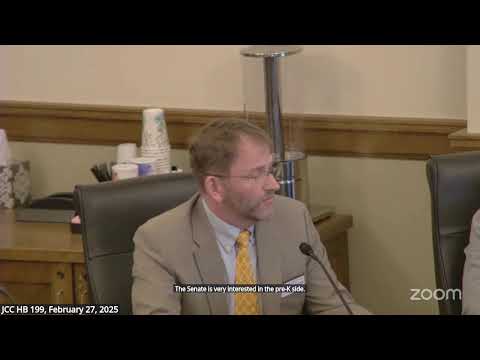
A joint conference committee on House Bill 199 adopted four Senate changes to the bill and agreed to a compromise on pre‑K eligibility, setting a $7,000 scholarship for families at or below 250% of the federal poverty level.
The committee, meeting as the Joint Conference Committee on House Bill 199, approved a non‑substantive name change that replaces the “Wyoming Freedom Scholarship Act” with the “Steamboat Legacy Scholarship Act.” The panel also approved a clarified certification provision and reinstated testing requirements for students who receive education savings accounts (ESA).
The session’s nut graf: the committee accepted amendments intended to align the bill with the Senate’s priorities while negotiating a middle ground on pre‑K, where the Senate favored universal pre‑K at $7,000 and the House opposed adding pre‑K to the program. After multiple proposals and votes, the committee settled on limited, income‑based eligibility for pre‑K rather than universal coverage.
Most important facts first: the committee adopted an amendment that renames the scholarship program the Steamboat Legacy Scholarship Act. The change was offered as a Senate amendment and adopted by voice vote. The committee also adopted a Senate clarification to the bill’s certification requirement. Representative Andrew, a member of the House delegation on the committee, said the intent of that amendment was “to clean up some of the language that the House had originally” and to clarify that learning required subjects can be shown over a student’s kindergarten‑through‑12th‑grade tenure rather than at every moment of education.
On student assessment, the conference restored language requiring students who receive an ESA to take either a statewide assessment administered pursuant to statute (referred to in the discussion as “YTOP”) or a nationally normed achievement exam such as the ACT or SAT. Committee members described that change as reinserting prior statutory language to maintain accountability for students using public funds.
Pre‑K proved the most contested item. The Senate caucus initially pressed for universal pre‑K at a $7,000 scholarship; the House opposed adding pre‑K to the program. Committee debate produced multiple motions and counterproposals, including proposals to limit eligibility to 150%, 250%, 300% and 400% of the federal poverty level and alternative tiered scholarship amounts. One motion to set eligibility at 150% of poverty with a $7,000 scholarship failed. A later set of proposals (300% and other variants) also failed. After further negotiation the committee voted to set pre‑K eligibility at 250% of the federal poverty level with a $7,000 scholarship; that amendment passed by voice vote and closed the outstanding differences the members identified.
Members repeatedly noted financial and programmatic tradeoffs during the debate. Committee members cited an enrollment figure of “just under 50” students already in the existing pre‑K scholarship process and discussed the approximately $7,000 average annual cost for pre‑K programs statewide when weighing scholarship amounts. Several members said a higher scholarship level was intended to cover typical market costs for a private pre‑K placement; others argued for narrower means testing to limit fiscal exposure.
The committee’s final direction was procedural: because HB 199 originated in the House, the house attorneys will prepare the final enrolled bill paperwork reflecting the committee’s agreed amendments.
Ending: The committee adopted the four Senate changes and the pre‑K compromise and adjourned to have the house attorneys prepare final paperwork for HB 199. Additional technical edits and statutory drafting by House counsel were referenced as the next steps.