Get Full Government Meeting Transcripts, Videos, & Alerts Forever!
Get email alerts on the Energy Generation topic
No spam. Unsubscribe anytime.
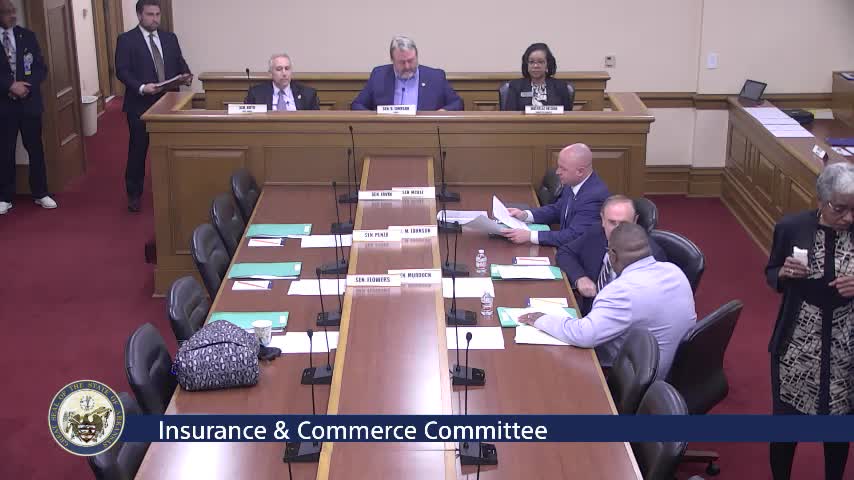
Senate committee approves bill to let utilities recover construction costs during build, sets oversight limits
Summary
The Senate Insurance & Commerce Committee voted to advance Senate Bill 307, a measure authorizing construction work‑in‑progress (CWIP) recovery for utilities with annual true‑ups, caps on certain capital metrics and procedural guardrails intended to limit ratepayer impacts.
The Senate Insurance & Commerce Committee voted to advance Senate Bill 307, a measure that would allow investor‑owned utilities and other qualifying entities to recover construction costs during plant build‑out and creates a framework of oversight, caps and annual reviews intended to limit ratepayer impacts.
Senator Jonathan Disbang, state senator for District 18, who introduced the bill, told the committee the measure accepts two realities: Arkansas needs new generation and new generation will raise energy costs. “This proposal gives us a new path and one that I believe is more efficient, provides more oversight than the current structure that we have, and will ultimately lead into a lower overall cost for the implementation of new generation,” he said.
The measure creates a statutory path for recovery of construction work in progress (CWIP) through a rider and sets multiple guardrails the sponsors and regulators described as consumer protections. The bill: shortens PSC review timelines in some filings from 240 days to 180 days; requires annual filings and “true‑ups” so the Public Service Commission reviews what construction occurred and what costs were recovered; caps a utility’s equity portion for capital structures at 50% (the PSC noted a prior practical cap used in a recent portfolio review was 47%); and limits overall rates so they may not exceed a threshold described in the bill as “10% below the national average” unless the utility petitions the PSC and the commission finds that exceeding the threshold is in the public interest.
Doyle Webb, chairman of the Arkansas Public Service Commission, told the committee the PSC would retain authority to review and adjudicate project filings and would perform annual reviews of CWIP activity. “We believe that we have the capacity today and the manpower to do what this bill requires,” Webb said, but he added that if filings grow rapidly the commission may need to add specialized financial analysts and higher‑paid positions to handle the workload.
PSC staff said the CWIP mechanism would allow utilities to recover costs during construction rather than only after a plant goes into service. Danny Hofer, chief of staff at the PSC, explained the operational change: under current practice, recovery typically occurs after a project is complete; the proposed rider permits staged recovery with annual reporting and an established prudence review at the end of the construction period.
Supporters from the economic development community urged passage, saying access to reliable and timely capacity is a gating factor for large industrial investments. Brad Lacy, president and CEO of the Conway Area Chamber of Commerce, said site selectors repeatedly ask, “How much power do you have?” and that Arkansas risks losing multibillion‑dollar projects without a mechanism to make new generation bankable. Robert Birch, Jacksonville’s director of economic development, said the inability to answer that question has cost opportunities.
Public commenters provided sharply different views. Brandy McClain and Phyllis McMillan, both members of Petit Jean Electric Cooperative in Van Buren County, urged greater oversight and called the bill as written likely to reduce PSC review in some co‑op contexts and to increase costs for rural members. McClain said recent co‑op borrowing and investments—she pointed specifically to broadband/fiber investments—have produced rising bills for some members and that members were often unaware of debt levels. “The lack of oversight and competition in the electric cooperatives is already taking a toll on the members, especially in rural areas,” she said.
Terry (Teresa) Christie, a resident and commenter, described what she called acute hardship among some co‑op members and urged committee members to delay or substantially amend the bill so existing complaints and investigations can be resolved. Christie told the committee she had submitted a complaint to the PSC and said the bill as drafted would “codify” exemptions that make it harder for the PSC to open investigations initiated by the commission itself. The sponsors and PSC staff described the provisions differently: the bill narrows scenarios in which the commission may initiate certain processes for co‑ops absent either (a) a board election to be subject to rate case procedures, (b) a change in rates exceeding 10% of total gross revenues, or (c) petitions from at least 10% of members — down from a prior 15% threshold mentioned in committee discussion.
Committee members questioned details including how the equity cap affects rates, whether the PSC’s current staffing is sufficient, whether the 180‑day review timeline is realistic, and whether riders and other fees could be used to shift costs without sufficient oversight. Senator McKee, a co‑sponsor who worked on the measure’s technical drafting, said he initially had concerns about earlier drafts but concluded the bill better protects ratepayers than existing options. Webb told senators the PSC can meet the bill’s current requirements but warned that successful deployment could require additional hires and specialized pay to retain analysts.
The committee also heard technical points from PSC staff, including that the bill reduces a statutory processing window in some applications and requires annual construction reporting and year‑end prudence reviews. PSC staff identified an existing adjudicatory docket on cooperative procedures and said they were reluctant to comment on pending matters beyond the informational memo the commission provided to the committee.
After roughly three hours of questions and public comment, a motion to advance Senate Bill 307 was moved and seconded (the transcript records the second as Senator McKee). The committee decided by voice vote to advance the bill; the chair announced the bill passed the committee.
The bill contains several items committee members flagged for clarification or future amendment: the exact application of the 10% below national average rate cap (sponsors and PSC staff noted it applies to base rates and referenced a specified national report in the bill); the equity cap mechanics and how lenders and equity levels affect weighted average cost of capital; how co‑op exclusions and the lowered petition threshold (15% to 10%) interact with pending PSC dockets; and the PSC’s staffing and budget needs if filings increase.
Committee action: voice vote to advance SB 307; no roll‑call tally recorded in the transcript. Sponsors and PSC staff said they would continue working with members and stakeholders to answer technical questions and to provide additional documentation.
Votes at a glance: the committee approved advancing Senate Bill 307 by voice vote; the transcript records a motion and a second, and the chair announced passage.
Sources: committee transcript, testimony from Sen. Jonathan Disbang (bill sponsor), Sen. McKee (co‑sponsor), Doyle Webb and Danny Hofer (Public Service Commission), economic development representatives and multiple public commenters.