Get Full Government Meeting Transcripts, Videos, & Alerts Forever!
Get email alerts on the Defense Installation Jber topic
No spam. Unsubscribe anytime.
JBER commander outlines runway, munitions and community priorities and flags homeless encampments on federal land
Summary
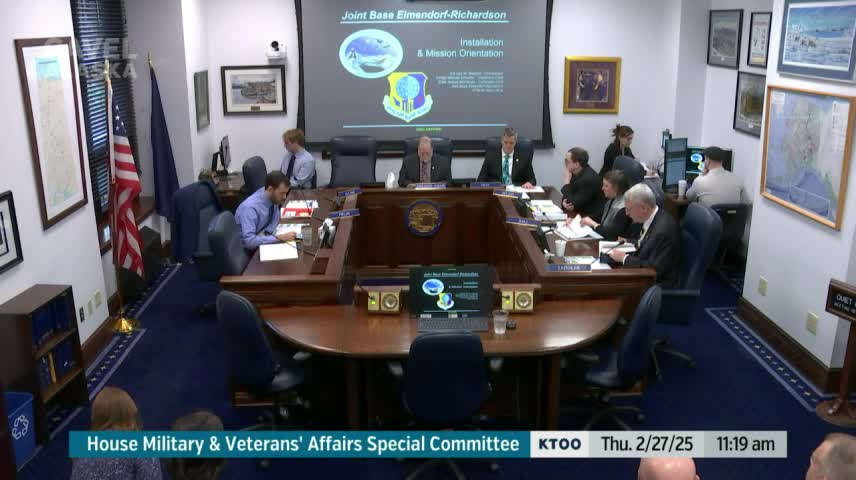
Juneau — Colonel Lisa Mabot, commander of Joint Base Elmendorf‑Richardson (JBER) and the 673rd Air Base Wing, gave a mission and installation orientation to the House Special Committee on Military and Veterans Affairs on Thursday, Feb. 27, 2025, describing ongoing infrastructure projects, energy‑resilience work, community partnerships and recent incursions of homeless encampments onto land associated with the installation.
Juneau — Colonel Lisa Mabot, commander of Joint Base Elmendorf‑Richardson (JBER) and the 673rd Air Base Wing, gave a mission and installation orientation to the House Special Committee on Military and Veterans Affairs on Thursday, Feb. 27, 2025, describing ongoing infrastructure projects, energy‑resilience work, community partnerships and recent incursions of homeless encampments onto land associated with the installation.
Mabot told the committee that JBER remains a strategic power‑projection hub for U.S. forces in the Indo‑Pacific and for homeland defense, and that the base contributes about $4.2 billion and roughly 35,000 jobs to the Alaska economy. “Alaska is, as you all know, the most strategic place in the world,” she said. She described multiple construction projects intended to increase JBER’s throughput and combat support capacity, and she flagged local quality‑of‑life and access issues that require coordination with municipal authorities.
The presentation matters because the base’s infrastructure and its relationship with Anchorage, Eagle River and the Matanuska‑Susitna region affect military readiness, local economic activity and public safety. Committee members pressed Mabot on homelessness on federal lands, energy supply and resilience, school quality for military families, environmental monitoring and base access policies.
Major projects and readiness investments
Mabot described several large construction efforts on JBER: an expansion to create a second 10,000‑foot north–south runway (about one‑third of a billion dollars so far), covered and paved storage for war reserve materiel (WRM), a weapons‑generation complex for safer munitions handling, and a joint mobility complex to better stage and equip troops and aircraft for deployment. She said those projects help position Elmendorf and Eielson Air Force Base as throughput locations for forces moving into theater.
The commander said the installation is working with the U.S. Army Corps of Engineers and prime contractors on the runway and related earth‑moving and pavement work. She described WRM and related acronyms used at the base as stockpiles for rapid repair, cargo movement and medical supplies for the Indo‑Pacific theater.
Homeless encampments on associated federal land
Committee members asked about people living on or near installation‑associated federal land, including Davis Park and parts of Arctic Valley. Mabot said JBER has recorded a small number of incursions onto installation‑associated land in the seven months she has been in command and that most have not, to date, caused mission‑level impacts. She said the situation has recently risen to a level that is concerning from a security standpoint and that she is preparing to raise the issue with municipal leaders to coordinate a response.
“I have been long tracking homeless populations on Davis Park,” Mabot told the committee. “It rises to a level of my concern when it starts to be a threat to our populations and to the installation. I have just reached that point where I'm going to initiate those conversations.”
Committee members described fires and public‑safety risks in areas near the base and told Mabot the municipality is short staffed for camp removal. The commander said she expects to work with the city and other partners on a coordinated approach.
Energy supply and resilience
Members asked about energy projects tied to base resilience, including a local methane plant and broader regional transmission projects. Mabot said she is familiar with the methane project at a high level and will supply more detailed information to the committee. She described strong working relationships with local utilities — including Chugach and Doyon Electric — and noted that JBER has supported and participated in grants to improve regional energy resilience.
Mabot said JBER helped secure a Defense Community Infrastructure Program (DCIP) grant for Port of Anchorage energy resilience and that the port completed about $10 million in work. She also described an upcoming Energy Resilience Readiness Exercise (ERIE) planned for the summer: “we flip the switch on the base and see what happens for about 10 hours,” she said, adding the exercise will reveal dovetails with the municipality and help plan for a significant power loss.
On small modular nuclear reactors, Mabot said she is watching the pilot at Eielson Air Force Base and will consider lessons learned there as the conversation evolves.
Security posture and visitor access
Mabot reviewed the base’s access posture and said JBER is currently in a “no trusted traveler” status, meaning visitor entry requires processing through the visitor center. She said the posture is intelligence‑based and balanced against the need to keep the installation accessible for employees, contractors and community members who provide essential services. Mabot described online visitor application procedures and specific accommodations (for cemetery access on holidays, burials and certain events).
Schools, families and community partnerships
Mabot emphasized that the installation prioritizes service members’ and families’ readiness, and she told the committee that schools and childcare are among the top concerns for personnel at JBER. She described ongoing cooperation with the Anchorage School District and noted four elementary schools serve the installation; she said one of those schools sustained earthquake damage and that grant funding is being pursued for replacement or repairs.
Environmental monitoring and contamination questions
Committee members asked about environmental cleanup and testing. Mabot said the installation maintains environmental staff and works with state and federal regulators during construction and maintenance. On PFAS (PFOS/PFOA) contamination — a recurring topic at many installations — she said JBER is awaiting additional direction and guidance, and that the base conducts annual water‑quality assessments and other inspections.
Follow‑up and next steps
Mabot told members she would provide additional details requested by the committee, including the status of the methane energy project and specifics about environmental cleanup and contracts. No formal committee actions or votes occurred during the presentation; the session was a briefing and Q&A.
Quotes
“Alaska is, as you all know, the most strategic place in the world,” Colonel Lisa Mabot said as she framed JBER’s role. “It is a place where we defend the homeland, and this is a place where we have the easiest access around the world.”
“I have just reached that point where I'm going to initiate those conversations” with municipal leaders about homeless encampments on installation‑associated land, Mabot said.
Ending
The committee adjourned at 12:10 p.m. The panel scheduled its next meeting for Tuesday, March 4, when it will take public testimony on House Joint Resolution 8 and hear a presentation from Alaska Aerospace Corporation. Colonel Mabot and other JBER officials said they will follow up with the committee on energy and environmental questions raised during the briefing.