Get Full Government Meeting Transcripts, Videos, & Alerts Forever!
Get email alerts on the State Budget topic
No spam. Unsubscribe anytime.
Labor subcommittee reviews Department of Labor FY26 budget; AVTEC expansion, vacancies and training funds highlighted
Summary
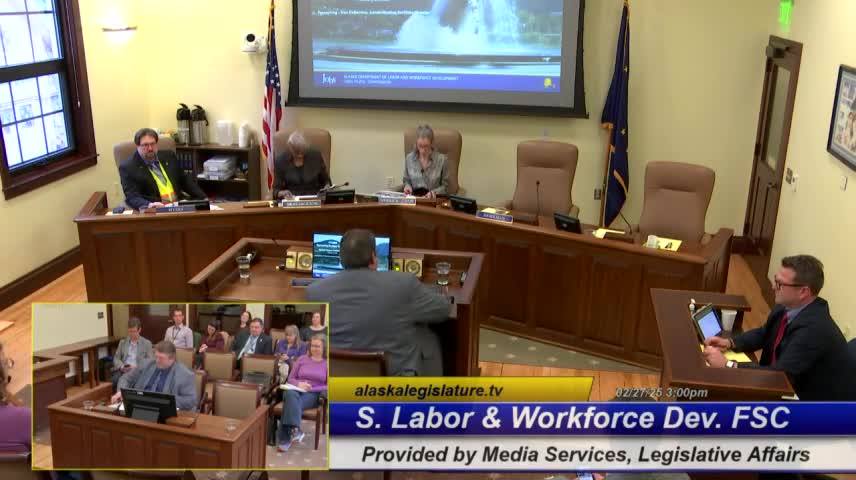
The Senate Department of Labor and Workforce Development Finance Subcommittee on Thursday, Feb. 27, 2025, in Juneau heard a high-level overview of the department’s FY26 budget request, including a proposed expansion of AVTEC’s industrial-electric program, the Office of Citizenship Assistance rollout and concerns about staffing vacancies and shifting training revenues, Administrative Services Director Dan DeBartolo said.
The Senate Department of Labor and Workforce Development Finance Subcommittee on Thursday, Feb. 27, 2025, in Juneau heard a high-level overview of the department’s FY26 budget request, including a proposed expansion of AVTEC’s industrial-electric program, the Office of Citizenship Assistance rollout and concerns about staffing vacancies and shifting training revenues, Administrative Services Director Dan DeBartolo said.
DeBartolo told the subcommittee that AVTEC (the Alaska Vocational Technical Center) is full in its industrial electricity program and that the department seeks both a one-time supplemental this year and an ongoing instructor increment for FY26 to expand capacity. "Of the 15 seats that were in there this year, we had, something on the order of 40 applicants this year," DeBartolo said, describing demand.
Why it matters: the requests aim to add training capacity quickly to meet employer demand and the governor’s direction to expand electrical and plumbing training; the supplemental also affects the department’s near-term request calendar and would require legislative approval.
Key requests and details
- AVTEC expansion: DeBartolo said the department has a FY25 one-time supplemental request for AVTEC of roughly $886,600 UGF to purchase curriculum equipment, cover shipping to Seward and pay an adjunct instructor during the build-out. He itemized equipment at approximately $659,000 and a barge/shipping estimate of about $80,000, and said a portion (about $91,200) would fund adjunct personal services to prepare the lab in summer months. The department is also seeking a $182,000 ongoing UGF increment for FY26 for a second full-time instructor in the industrial-electric program.
- Timing rationale: DeBartolo said the supplemental is requested in FY25 so equipment can be ordered and installed over the summer and classes can begin by late August; the $182,000 would move into the base FY26 budget for ongoing instruction.
Other budget and program notes
- Training fund authority: DeBartolo described a recent reauthorization that increased the portion of revenue that flows to TVEP (the technical-vocational/education program) from 0.16 of 1% to 0.25 of 1%, which expanded DGF authority available to training grantees. He said moving TVEP authority into language (rather than numbers) allows the department and Office of Management and Budget to deploy newly identified revenue more quickly for grants during the fiscal year.
- STEP grants and availability: DeBartolo said STEP (State Training and Employment Program) awards are competitive; AVTEC would need to apply and compete with other applicants for STEP funds if it sought those dollars instead of requesting UGF.
- Workforce partnership decrement: the department had an interagency authority increment of $2.4 million tied to a planned partnership with the Department of Transportation; DOT received a smaller allocation than expected and the partnership did not proceed, so DeBartolo said the department will include a $2.4 million decrement for that authority.
- Unemployment Insurance (UI) authority: DeBartolo described a multi-year reduction in extraordinary federal UI authority that was granted during the pandemic and has since been stepped down; he said the department continues to reduce that extraordinary authority and the change is not expected to negatively affect operations as presented.
Staffing, vacancies and implementation
- Vacancies: DeBartolo told senators the department had 154 vacant positions as of Feb. 1, 2025. He provided a breakdown by division: Administrative Services 7; AVTEC 10; Commissioner's Office and AWIB 6; Division of Employment and Training Services 77; Division of Vocational Rehabilitation 26; Labor Standards and Safety 20; Workers' Compensation 8. He said some of those vacancies are in entry-level or seasonal UI technical positions with higher turnover and that federal funding rules mean the department only draws down certain funds when positions are filled.
- Office of Citizenship Assistance (OCA): DeBartolo said the Legislature funded OCA last year and that it began after July 1; the department completed a space build-out in Midtown (Eel Street building) and has hired a supervisor and an administrative assistant, with another project assistant under interview. Adam Weiner, special assistant to the commissioner, was noted as available online for further questions.
- IT/help desk: DeBartolo said several technology/help-desk positions consolidated to the Office of Information Technology during earlier consolidations have been returned to the department; he said five help-desk positions are now under Administrative Services and that an interagency (IA) funding adjustment of roughly $608,000 covered returning those staff.
Workers' compensation and other operations
- Workers' compensation: Charles Collins, director of workers' compensation, told the committee that while total claim counts and hearings have declined, the department still sees a similar number of contentious claims and that mediation has replaced some hearings. "We have almost the same amount" of contentious claims, Collins said, noting hearings and mediations continue to require staff time and resources.
- Capital request for mechanical/certificates: DeBartolo said the only capital request tied to mechanical inspection and labor standards this year is about $85,000 to replace an aging Microsoft Access–based certificate-of-fitness licensing system with a modern off‑the‑shelf solution; staff expect the new system will speed licensing issuance.
Questions and follow-up
- Senators asked for additional detail. Senator Greg Jackson asked for the department’s exact lapse numbers for FY24 and a copy of the vacancy sheet; DeBartolo agreed to provide that information to committee members. Senator Bjorkman questioned whether STEP funds could be used to cover the AVTEC expansion; DeBartolo explained STEP is competitive and AVTEC would have to apply and may or may not receive awards.
Next steps
DeBartolo and committee members said more detailed hearings on TVEP and STEP and follow-ups on vacancy and lapse figures will occur in future sessions. No formal votes were recorded during the Feb. 27 hearing.