Get Full Government Meeting Transcripts, Videos, & Alerts Forever!
Get email alerts on the Bicycle And Pedestrian Mobility topic
No spam. Unsubscribe anytime.
Sammamish holds first public workshop for bike-and-pedestrian mobility plan; city seeks input on sidewalks, bike lanes and school routes
Summary
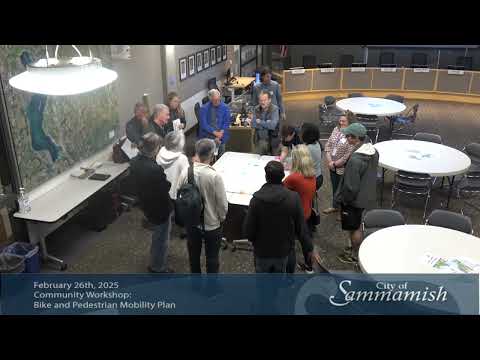
Sammamish City officials and consultants on the evening presented the first community workshop for a new Bike and Pedestrian Mobility Plan and invited residents to flag sidewalk and bike-lane gaps on an interactive map that will remain open through March 21.
Sammamish City officials and consultants on the evening presented the first community workshop for a new Bike and Pedestrian Mobility Plan and invited residents to flag sidewalk and bike-lane gaps on an interactive map that will remain open through March 21.
The workshop, led by Audrey Starci, Sammamish’s director of public works, set out the plan’s goals, schedule and how recommended projects could be folded into the city’s Transportation Improvement Program (TIP). “This is one of our very important plans for this next biennium. This is a critical plan for the city,” Starci said, noting that Sammamish has not previously adopted a stand-alone bike-and-pedestrian plan and that elements will be incorporated into the city’s Transportation Master Plan.
Consultant project manager Wintana Miller of DKS Associates described the project’s near-term schedule and objectives and reviewed existing conditions, facility gaps and collision data. “The goal is to get projects onto the city's transportation improvement plan, that would then get funded and move forward in the 6 year plan,” Miller said. Miller and city staff highlighted a five-year (2019–2023) WSDOT-derived crash dataset showing roughly 45 reported collisions involving a pedestrian or bicyclist in Sammamish; five were classified as serious injuries and one was a pedestrian fatality in 2023. The presentation said about 16% of those reported crashes occurred on East Lake Sammamish Parkway and about 20% on 220 (as shown in the city map).
Staff and consultants described how the plan will identify network priorities by roadway classification (local street, collector, minor arterial, principal arterial), propose facility types appropriate to each, and produce a prioritized project list for the city to consider for the six-year TIP and longer-term unconstrained lists. Lindsay (surname not specified), the city’s transportation manager and project manager for the plan, guided attendees through the city website and an interactive SocialPinpoint comment map where residents can place specific requests (for example, “add crosswalk here” or “add bike lanes along this corridor”). Lindsay reported about 23 comments already submitted on the map.
During a question-and-answer session, residents raised recurring concerns about safe routes to school, e-bikes and motorized scooters, snow removal and obstructions (including garbage bins) in bike lanes. City staff said they are coordinating with the Lake Washington and Issaquah school districts, the Sammamish Police Department and the city’s traffic engineering team, and that the plan will consider school routes as part of project prioritization. Staff noted existing city programs and criteria used to select nonmotorized projects within the current six-year capital plan and said the plan will be used to refine those priorities.
City staff described outreach and next steps: reviewers will compare the city’s currently planned projects to identified gaps, recommend facility types and specific new projects, produce a prioritized list, return to the public in a late-spring community workshop (target: May), and then bring a draft plan to city council in the summer. The interactive comment map and project website are intended to collect input that staff and consultants will analyze as they prepare recommended projects and policies.
The workshop also noted sources of data and prior work that will inform the plan, including the City of Sammamish Transportation Master Plan, WSDOT collision records (reported crashes only), the city’s SeeClickFix records, and examples of bike-and-pedestrian plans from neighboring jurisdictions. Staff emphasized that the collision numbers presented reflect reported crashes involving a motor vehicle and a pedestrian or bicyclist and therefore undercount some nonmotor-vehicle incidents.
The presentation concluded with an invitation to use on-site iPads or the online map to submit detailed location-specific comments and with staff encouragement that residents share the opportunity with neighbors. The city will continue to post updates and draft materials on the project webpage.