Get Full Government Meeting Transcripts, Videos, & Alerts Forever!
Get email alerts on the Higher Education Policy topic
No spam. Unsubscribe anytime.
Ohio Senate passes Senate Bill 1 reshaping public higher education governance and classroom rules
Summary
The Ohio Senate passed the Advance Ohio Higher Education Act (Senate Bill 1) after hours of debate and dozens of amendments; the bill limits DEI programs, restricts faculty strikes, requires a civic literacy course, and increases trustee and transparency requirements. Final vote: 21 yeas, 11 nays.
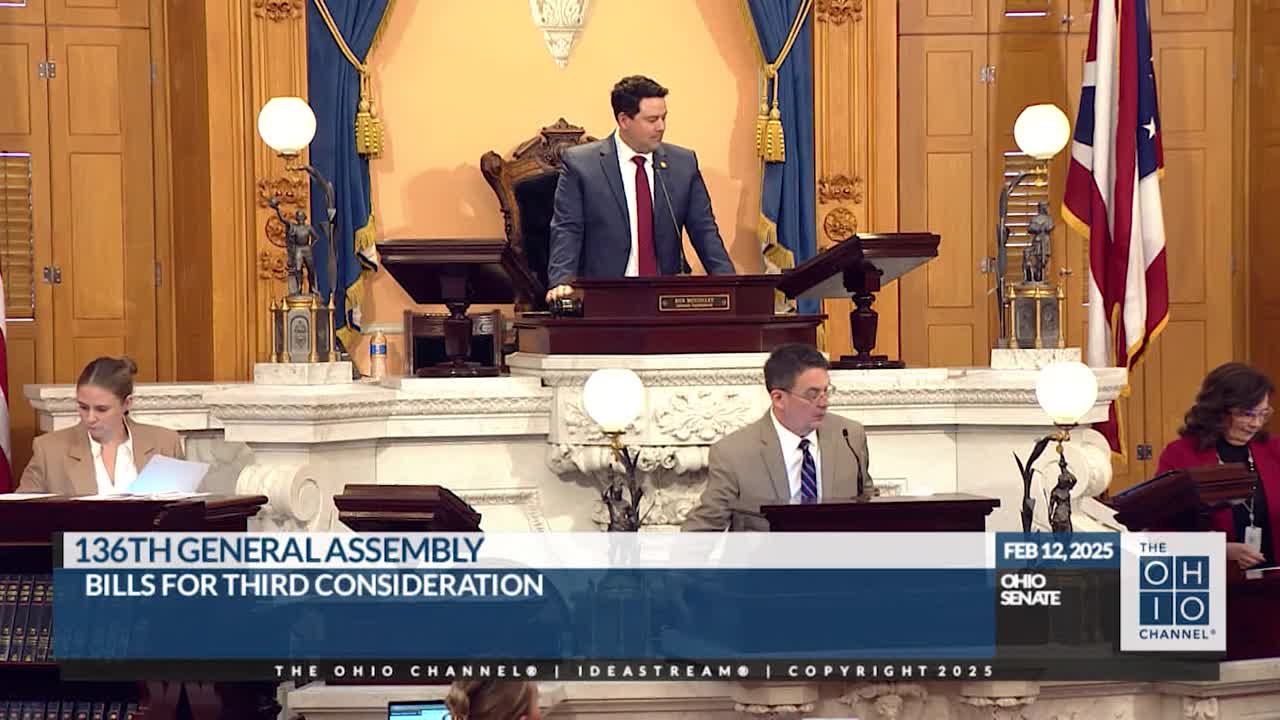
The Ohio Senate passed Senate Bill 1, the Advance Ohio Higher Education Act, on Feb. 11, 2025, changing state oversight and several operating rules for public universities and community colleges. The final roll call showed 21 yeas and 11 nays, and the bill was declared passed and titled.
The bill’s sponsors and supporters said SB 1 will restore academic balance, increase transparency on course content and finances, and give trustees stronger management tools; opponents said it is a major overreach that threatens academic freedom, labor rights and programs serving historically underserved students.
Senator Theresa Serino, sponsor of Senate Bill 1, said the legislation is intended to “restore public confidence in these institutions” and argued the state has a duty to act if institutions do not address problems internally. “This bill will better empower boards of trustees to direct future strategies and to do so with dispatch,” Serino said on the floor.
Opponents framed the bill as an attack on faculty and students. “I rise in opposition to this bill, what I call the Ohio Higher Education Destruction Act,” said Senator Vernon DeMora, who criticized provisions banning strikes for full‑time faculty and broad, vague limits on “controversial” classroom material.
Senator Rogner, chair of the higher education committee, said the measure responds to what legislators view as systemic problems and described SB 1 as a tool for trustees and presidents to drive change. “As policymakers, we have the responsibility to ensure that our universities and colleges are rigorously held to the highest standards,” Rogner said.
Major provisions and amendments
- DEI and related programs: SB 1 directs state institutions to eliminate certain diversity, equity and inclusion (DEI) requirements for orientation, training, offices and positions and restricts the creation of new scholarships or donor funds that use DEI as an eligibility factor. Several proposed amendments seeking to preserve DEI programs were offered and then laid on the table after roll calls.
- Intellectual diversity and controversial beliefs: The bill defines requirements intended to promote “intellectual diversity” and restricts trainings that assert anyone should feel guilt or psychological distress on account of protected characteristics. Opponents said the definition is too broad and could chill classroom discussion.
- Labor and collective bargaining: The bill prohibits strikes by full‑time faculty and imposes changes to collective bargaining in higher education; critics said these are the most consequential labor changes and likened the approach to earlier, controversial legislation affecting public employees.
- Faculty evaluation, post‑tenure review and workload: The version considered on the floor removed several of the strictest, prescriptive provisions after amendments; the bill retains requirements that institutions adopt faculty evaluation and workload policies but eliminated specified mandatory evaluation formats and trimmed post‑tenure review language in the amendment package adopted in committee.
- Civic literacy requirement: SB 1 requires a three‑hour American civics literacy course as a condition for awarding bachelor’s degrees; an amendment offered on the floor sought to let universities control course content rather than the legislature, but that amendment was laid on the table.
Floor debate and amendment process
Lawmakers debated the bill for several hours and considered a long list of amendments that were repeatedly laid on the table. Supporters urged that state oversight is necessary to improve outcomes and workforce alignment; opponents emphasized testimony from hundreds of witnesses and warned of damage to recruiting students and faculty, accreditation risks, and harm to programs that serve veterans and students with special needs.
Senator Ben Weinstein, who spoke against the bill, called it “legislative big government overreach” and argued it would politicize classroom content and weaken academic freedom. Senator Craig, a vocal critic, said the bill would deprive students of a full telling of history and urged a no vote; Senator Brenner said he supports changes but that DEI had moved from original intentions in some contexts and defended the bill as a step toward reform.
Votes and next steps
The final passage vote on the floor was 21 yeas and 11 nays. Several specific amendments (including measures to preserve DEI programming and return curriculum control to faculty) were put on the table by roll call votes earlier in the session. The bill, having passed the Senate, will proceed to the next steps in the legislative process.
Why this matters
Senate Bill 1 affects Ohio’s 14 public universities and 22 community colleges. It touches curriculum, academic freedom, faculty labor rights and donor‑supported scholarships — areas that university leaders, faculty and professional accrediting bodies say can affect federal and private grant compliance, accreditation and student recruitment.
The bill’s broad language and several provisions that alter institutional practices mean implementation will require policy changes by campus boards of trustees and likely further administrative rulemaking and guidance from state higher education authorities.
The debate on SB 1 brought extended public testimony and sharply divided the Senate; sponsors say the changes will improve performance and transparency, while opponents warn of unintended consequences to academics, accreditation and workforce pipelines.