Get Full Government Meeting Transcripts, Videos, & Alerts Forever!
Get email alerts on the School Budget topic
No spam. Unsubscribe anytime.
Bethlehem budget preview: pilot extension cuts planned tax increase but leaves gap to close
Summary
District business staff presented a preliminary $117.5 million spending plan and said a late extension of a major PILOT will reduce but not eliminate a multi-million-dollar gap that still points toward a likely tax levy rise next year.
John McPhillips, presenting on behalf of the business office, gave the board an initial look at the Bethlehem Central School District’s proposed 2025–26 budget, saying the figures were still “in draft form” and likely to change before final adoption.
McPhillips said the district’s preliminary budget shows $117.5 million in expenditures against roughly $111.2 million in projected revenue, producing an initial gap of about $6.3 million that would have required an 8.6% tax levy increase if left unaddressed. He told the board that an unexpected action by the Bethlehem Industrial Development Agency earlier the same morning altered that math: the IDA approved another one-year extension of the PILOT agreement for the site now known as GB2 Power New York LLC, keeping roughly $3,476,000 in pilot revenue for the district for 2025–26.
“The initial gap today or before this morning was $6,300,000. That does not include the pilot revenue coming back on,” McPhillips said, adding that with the PILOT included the gap would shrink to about $2.8 million and would translate to a draft tax-levy increase of roughly 2.8% before other adjustments.
Why it matters: the district calculates its allowable tax-levy increase under New York’s property tax cap law; McPhillips said the tax-cap calculation treats PILOT payments and tax revenue “as sort of tax, taxable dollars,” so the late retention of the PILOT reduces the maximum levy the district can lawfully propose without a voter override. He said the tax-cap formula limits the district to about a 1.1% levy increase for 2025–26 unless the board seeks an override that would require a 60%+1 approval by voters.
McPhillips walked the board through major revenue and expense drivers: school taxes (just under two-thirds of revenue), state foundation aid (about 31%), and a roughly $3.5 million loss tied to earlier PSEG/Vista Tech Park pilot revenue the district had planned for in prior cycles. On the expenditure side, salaries and fringe comprise the largest shares — roughly $60.8 million for salaries and $30.8 million for fringe benefits — and McPhillips highlighted a roughly $2 million (12%) projected increase in health-insurance costs and a projected 20% rise in pharmaceutical costs for the district’s self-insured plan.
McPhillips characterized the draft as “conservative” — meaning requests were pared to needs rather than wants — and warned the board that the district has reduced some of its financial flexibility to contain the levy increase. He also noted federal funding streams that are not reflected in the general fund (reflected instead in the F fund), about $2.3 million in total federal allocations, and cautioned that changes in federal-to-state funding flows could affect state aid down the line.
On reserves and capital planning, McPhillips proposed placing a new capital reserve on the May ballot. He explained the district’s existing 2022 capital reserve has a not-to-exceed cap of $20 million, of which $17.2 million has been funded to date; some leftover funds from earlier projects will add roughly $1.4 million back to that reserve. The proposed ballot measure would ask voters to allow a new reserve the district can fund in future years if year-end funds permit; McPhillips emphasized that a reserve is a savings mechanism, not a commitment to specific projects.
Board members pressed McPhillips on the timing and practical effects of the IDA decision. “The 8.6 drops immediately because of the pilot rolling on,” he said, but he cautioned that the district still faces choices to get from the roughly 2.8% draft levy down to the 1.1% that the tax-cap calculation would allow without an override. He said he would refine the numbers and consult state officials before next week’s meeting.
Votes at a glance: The board approved routine action items during the meeting by voice vote. These included approval of minutes and a set of finance and personnel action items; the motions carried by voice vote with no roll-call tallies recorded in the transcript.
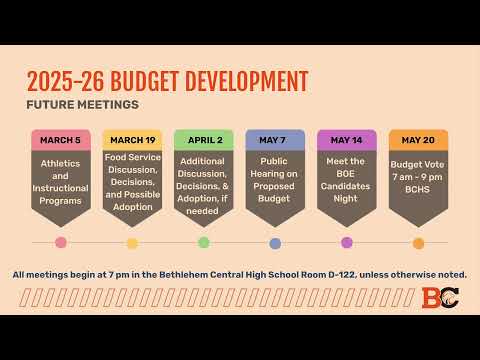
Context and next steps: McPhillips said the presentation was an initial step and that next meetings will include athletics, instructional programs, food service and more detailed budget decisions. He provided a tentative schedule: further budget presentations on March 5 and March 19, a possible adoption window in early April, and the public hearing and budget vote in May. He told the board, “We’ll have a more secure number next week,” and flagged the IDA’s late decision as a timing complication for normal budget processing.