Get Full Government Meeting Transcripts, Videos, & Alerts Forever!
Get email alerts on the Medicaid Expansion And FMAP topic
No spam. Unsubscribe anytime.
Medicaid expansion, FMAP shifts and postpartum coverage draw committee scrutiny
Summary
Analyst and department officials reviewed why expansion costs exceeded early projections, explained a partial FMAP shift to state funds, and updated the panel on postpartum coverage and emergency Medicaid spending.
Committee members asked why Medicaid expansion costs exceeded the Milliman report forecasts and what changes to federal match rates (FMAP) mean for state costs.
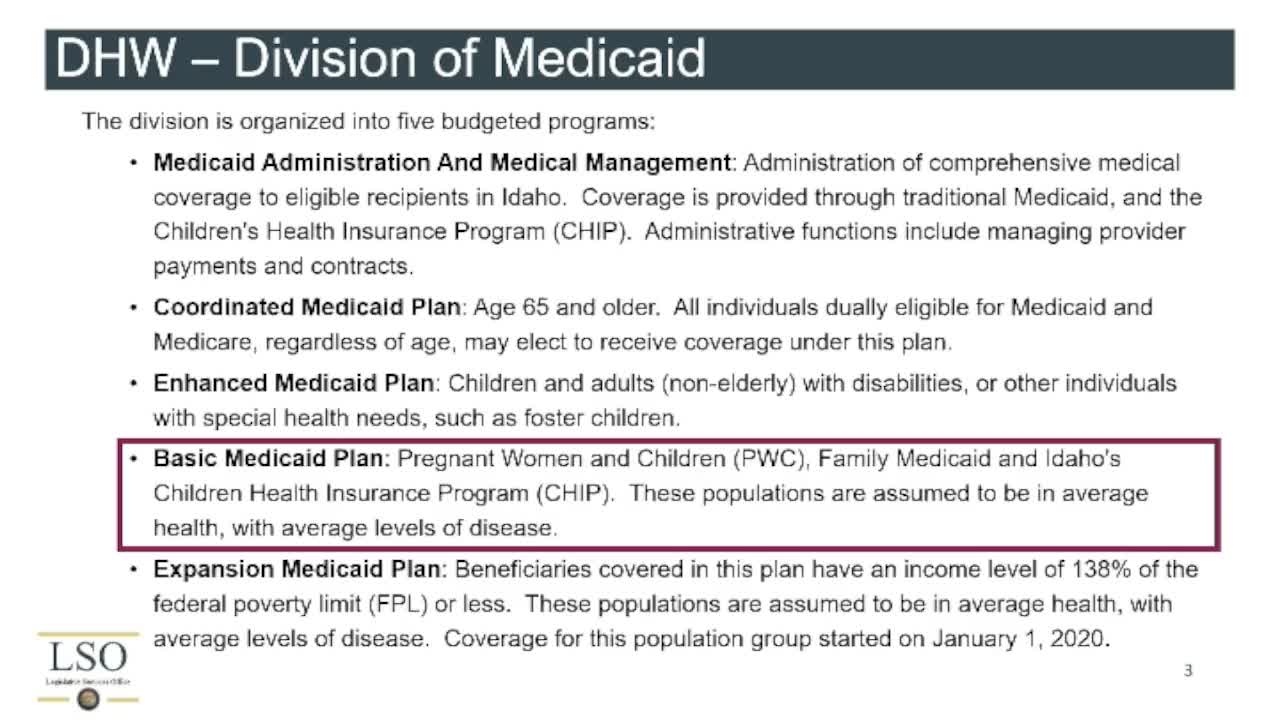
Alex Williamson told JFAC the expansion population originated from a voter initiative (2018/2019) and that the legislature authorized expansion with a Jan. 2020 go‑live. Forecasts used the Milliman report (2018), which “were a best guess” and did not anticipate a global pandemic or later provider rate increases, she said.
Williamson presented examples of the 2025 federal poverty guideline thresholds used for eligibility: a single person qualifies at about $21,597 annual income (about $10.38/hour at full time); a household of four qualifies below $44,367 (roughly $10.65/hour per worker full time). She reiterated that the expansion population first registered a full year of expenses in FY2021 when coverage began mid‑FY2020.
FMAP and fiscal impact: Deputy Director Adams explained that the non‑expansion population FMAP moved slightly (roughly from 69% to 68% in his rounded example), creating an estimated $45,000,000 shift from federal funds onto the state general fund in the department’s forecast. Adams noted expansion currently operates under an enhanced 90/10 federal–state split for the expansion population; if that enhanced match were tapered to the traditional 68/32 ratio immediately, the state would face a shift “more than $200,000,000” today, he said.
Emergency Medicaid and postpartum coverage: Adams told the committee that emergency Medicaid—which covers emergency services for non‑citizen populations—costs the state roughly $10,000,000 per year. Regarding postpartum coverage that the state recently implemented, Adams said the state plan amendment is live and about 2,800 women have received postpartum coverage so far. He also said a portion of Idaho’s postpartum plan was rejected by the Biden administration as inconsistent with Idaho abortion law; the state filed an appeal and the department expects a hearing on that appeal in April.
Why it matters: Forecasts that underpredict utilization and costs create supplemental needs; sudden reductions in federal match rates or federal policy reversals on coverage rules can materially and quickly alter Idaho’s fiscal exposure.
Ending: Legislators asked for additional breakdowns on postpartum coverage services and on caseload forecasting; the analyst and department staff said they would follow up with detailed materials.