Get Full Government Meeting Transcripts, Videos, & Alerts Forever!
Get email alerts on the Hospital Assessment topic
No spam. Unsubscribe anytime.
Legislators press department on hospital assessment and capitation increases
Summary
Committee members questioned whether Idaho's hospital assessment and related capitation changes effectively benefit Medicaid patients or primarily augment hospital revenue; department staff said changes stem from SB 1350 (2022) and federal UPL calculations.
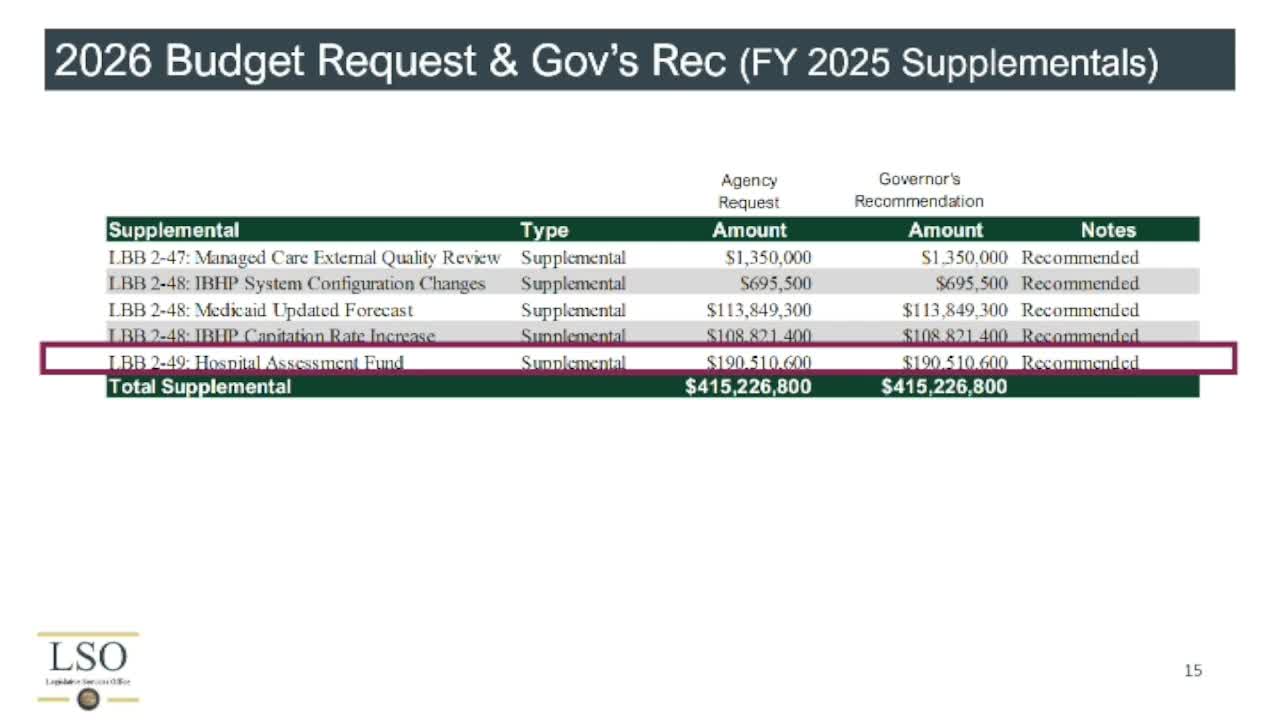
Lawmakers at the Feb. 26 JFAC hearing pressed Department of Health and Welfare staff about a proposed $190 million supplemental tied to hospital assessments and changes to upper payment limit (UPL) methodology.
Representative Tanner said the hospital assessment “looks more like a blank check to the hospitals” and asked whether the Legislature could redirect assessment proceeds to offset expansion medical costs rather than increasing hospital receipts. Alex Williamson, the Legislative Services analyst, said the $190,000,000 figure includes $77,000,000 from the hospital assessment dedicated fund and $113,000,000 from federal funds and tied the request to the UPL methodology changes enacted in Senate Bill 1350 (2022).
Department Director Alex Adams told the committee that the assessment is sized by hospital net patient revenue calculations and that a portion of the assessment does remain with the state to offset provider rate increases. “The full amount is not going back to the hospitals,” Williamson later told the panel, adding that policy changes would be required to alter the current flow of assessment funds.
Why it matters: Hospital assessments are a mechanism states use to draw federal matching dollars; methodology determines how much state and federal funding flows through the assessment. Lawmakers asked how much discretion the state has to change that flow and whether legislative policy action would be necessary to redirect funds toward other Medicaid cost offsets.
Committee follow-up: Representatives asked staff to provide more detail on the assessment calculations and policy levers. Williamson and Adams both recommended follow-up meetings to work through technical options, noting that some uses of assessment proceeds are specified by statute and federal law and would likely require legislative changes.
Ending: The department said it will follow up with technical detail on the assessment methodology and the committee signaled interest in further policy options to ensure assessment dollars meet state priorities.