Get Full Government Meeting Transcripts, Videos, & Alerts Forever!
Get email alerts on the Aging Services topic
No spam. Unsubscribe anytime.
Idaho Commission on Aging outlines ARPA spending, asks for $162,600 ongoing to cover inflation
Summary
The Idaho Commission on Aging told the Joint Finance-Appropriations Committee how it has spent federal ARPA awards on meal programs, caregiver support and modernization and requested $162,600 ongoing from the general fund to cover inflationary increases in FY2026. Agency staff said remaining ARPA funds must be spent by Sept. 30, 2025.
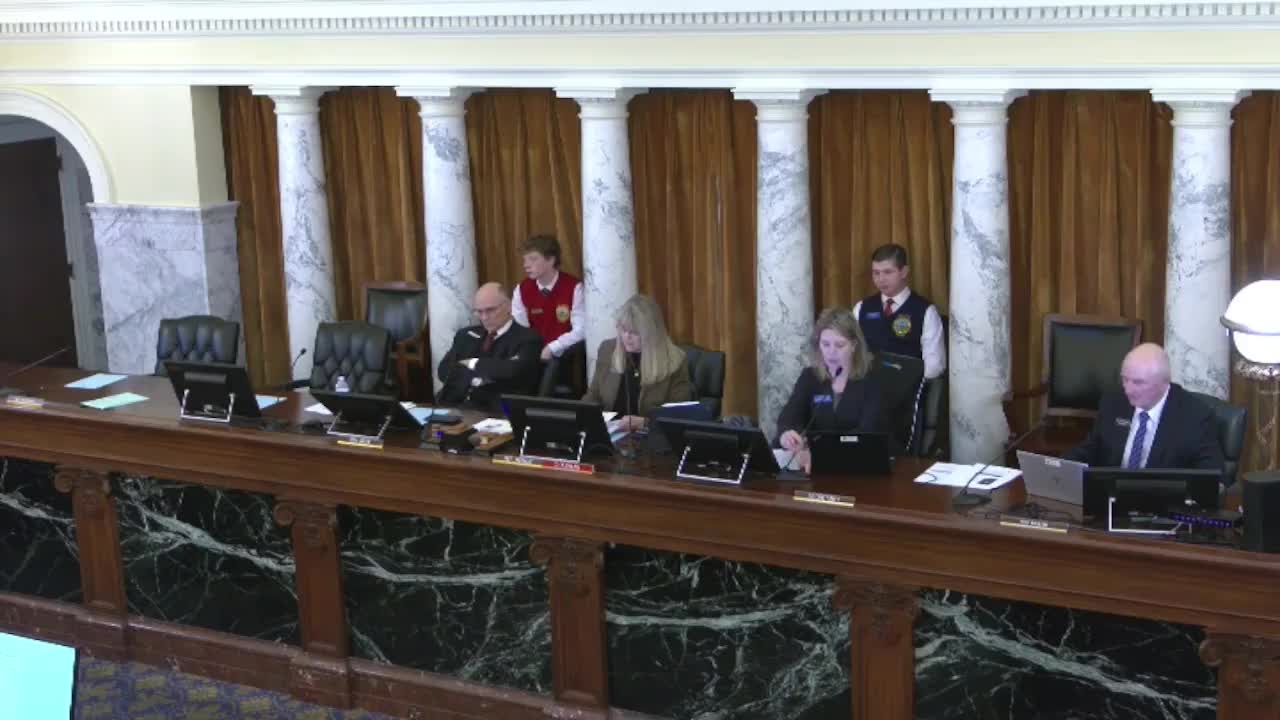
The Idaho Commission on Aging told the Joint Finance-Appropriations Committee on Feb. 24 that it has used federal American Rescue Plan Act (ARPA) awards for one-time modernization and service enhancements and is requesting a modest ongoing general fund increase to cover inflation.
Colin McGurkin, a budget and policy analyst with Legislative Services, told the committee that the commission ‘‘implements the Federal Older Americans Act and Idaho Senior Services Act’’ and works through six local Area Agencies on Aging to deliver meal service, transportation, caregiver assistance and adult protective services.
McGurkin said the commission’s FY2024 expenditures totaled about $16.7 million, with roughly 88% of that used for trustee and benefit payments to local AAAs (approximately $10.4 million in federal funds and $4.2 million from the general fund). He said the agency has followed a consistent pattern of requesting one-time federal appropriations tied to ARPA: "The agency since FY 2022 has consistently requested 1 time federal appropriations to utilize available American Rescue Plan Act funds or ARPA for 1 time purposes and modernization projects," and identified roughly $7.4 million in ARPA-related expenditures to date.
Judy Taylor, director of the Idaho Commission on Aging, told the committee the ARPA funding paid for targeted caregiver education and outreach, COVID-related services, enhancements to adult protective services and an expansion of a pilot program supporting unpaid caregivers for people with dementia. Taylor said the commission received a $5.2 million one-time federal ARPA appropriation and has requested an additional $500,000 one-time federal appropriation to pay final invoices and draw down remaining ARPA funds before the federal deadline of Sept. 30, 2025. "Of that amount, 450,000 is for payments to AAAs that cover final invoices... The remaining 50,000 will be divided to cover staff time spent on processing contracts and managing program implementation and to cover operating expenditures," she said.
Taylor described caregiver support as one of the commission’s top priorities alongside nutrition and adult protective services. She said the commission operates two caregiver programs: an Older Americans Act-funded program providing respite, support groups and education primarily to caregivers age 60 and older, and a state-funded high-risk caregiver program targeted at people caring for those with memory disorders. Taylor described a role for community health workers in the high-risk caregiver pilot: "Community health workers literally are embedded in their communities... We were able to put a community health worker in each of our [AAAs] that went out and did the assessment and the planning for our caregivers in our high risk caregiver program. Those workers will stay."
On the commission’s FY2026 request, McGurkin said the agency and the governor aligned on an ongoing general fund appropriation of $162,600 to cover inflationary increases, including approximately $155,000 intended as a 3% increase in trustee and benefit payments to AAAs and $7,600 for a 2% operating increase for the commission itself. He said the request also included a 1 full-time position and stated FTP counts: the commission is authorized for 15 FTE with one vacancy reported.
Committee members pressed for specifics. Senator Cook asked whether funds were being spent specifically on Alzheimer’s programs; McGurkin replied, "I apologize, I don't have a specific amount to give you that would be specifically related to Alzheimer's and dementia. If I go back for a moment, I'll see if the agency can answer your question and if not I'll follow-up with you." Taylor confirmed some ARPA-supported activity was directed to caregivers of persons with dementia but did not provide a dollar figure in committee.
Taylor assured the panel that the commission has followed the guidance that one-time federal funds should be used for one-time needs: "We have followed that guidance to the T... There are some things that will go away," she said, citing professional association memberships for adult protective services workers and extra respite hours that may be reduced when ARPA funds expire. She added the commission planned to prioritize salaries if necessary and said it had tried to avoid adding ongoing obligations funded by one-time federal awards.
The commission’s presentation also noted prior general-fund enhancements, including FY2023 support for caregiver services (roughly $798,000 in enhancements that included $720,000 from the general fund for dementia-related caregiver support and 1 FTE). Taylor closed by reaffirming the commission’s mission: "At the Commission on Aging, we are inspired to improve systems for efficiency and quality... Our budget request reflects that strategic planning. I confidently assure you that all appropriated funds will be used to advance our mission, invested wisely, with outcomes monitored and reported transparently."