Get Full Government Meeting Transcripts, Videos, & Alerts Forever!
Get email alerts on the Dfcs Corrective Action Plan topic
No spam. Unsubscribe anytime.
DFCS reports progress on corrective action plan; auditors and new tools to monitor safety plans
Summary
Department of Family and Children Services told the committee it has developed audit tools and expanded trainings intended to address corrective action plan findings; the committee requested follow-up reporting and asked DFCS to place the Child Abuse and Neglect (CAN) call center on a future agenda for performance review.
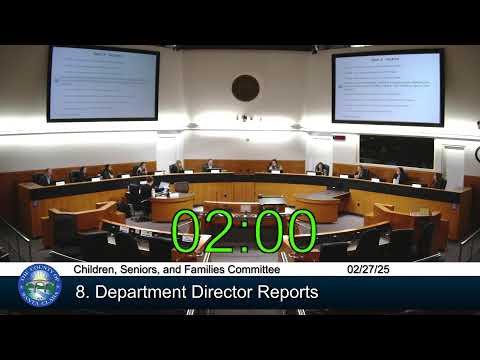
Department of Family and Children Services officials described new tools, trainings and partnerships on Feb. 27 as part of their effort to implement Santa Clara County’s corrective action plan (CAP) negotiated with the California Department of Social Services.
DFCS staff said they have completed development of a safety-plan audit tool to assess whether active safety plans for children identify threats, include a protective adult, are signed and otherwise accomplish the intended safety actions. DFCS said the audit tool is being built into the department’s technology platform and will produce a dashboard for tracking results. DFCS also outlined plans or completed work for a set of additional quality-improvement tools: a child-and-family-team (CFT) tool to track who participates in team meetings; a structured-decision-making (SDM) safety assessment tool and an SDM risk-assessment tool; and a visits CQI tool to examine case contacts.
“Most of our trainings have been really aimed at the front end,” DFCS staff said, acknowledging feedback from staff about the need for continued learning for teams working with families on an ongoing basis. DFCS reported it has conducted multiple safety-planning trainings (it said 17 trainings to date) and will continue rollouts; staff estimated about “a handful” (roughly 30–40 people) remain to be trained in March on safety planning.
Committee members pressed DFCS for assurances on how the CAN (Child Abuse and Neglect) call center handles incoming calls and callbacks. Several public commenters told the committee they had repeatedly reported suspected abuse and said they had not received screenings or adequate follow-up. In response the committee voted to receive the DFCS CAP update and requested a separate agenda item and off-cycle updates on CAN center operations and callback performance—including counts of calls handled by clerical staff versus social workers and typical callback times.
Ending
DFCS said it is closely coordinating with the state and with technical partners such as Evident Change and UC Berkeley in developing and validating the CQI tools. The committee asked DFCS to return with a training dashboard and to bring CAN center operational data back to CSFC for review; the motion to receive the report and agendize CAN center reporting carried on a recorded vote (Vice Chair Young: yes; Chair Arenas: yes).