Get Full Government Meeting Transcripts, Videos, & Alerts Forever!
Get email alerts on the Child Welfare Roundtable topic
No spam. Unsubscribe anytime.
Supervisors direct staff to form community child-welfare roundtable, favor hybrid approach
Summary
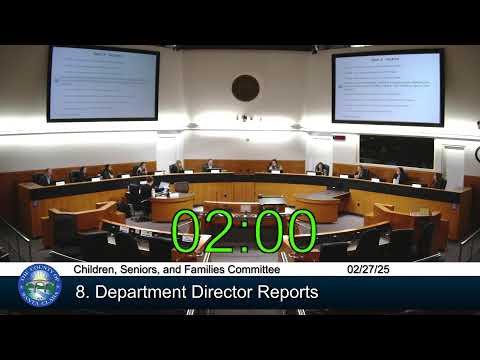
The Santa Clara County Children, Seniors and Families Committee on Feb. 27 directed staff to establish an administrative child-welfare community roundtable and to return with a plan that explores later integration with the Child Abuse Prevention Council.
The Santa Clara County Children, Seniors and Families Committee on Feb. 27 directed county staff to pursue creation of an administratively run child-welfare community roundtable and to return to the committee with a refined recommendation that explores integrating that roundtable with the Child Abuse Prevention Council.
The committee’s discussion followed a presentation by Department of Family and Children Services (DFCS) staff of three options for creating a community forum: (1) designate the existing Child Abuse Prevention Council (CAPC) for the role, (2) form a new 15–20 member administrative roundtable of community-based and DFCS affinity groups, or (3) repurpose DFCS’s quarterly community forum of roughly 200 participants. DFCS described tradeoffs for each option: CAPC is a structured Brown Act body with established membership and monthly DFCS report-outs but would require bylaw changes; a new administrative roundtable would be quicker to stand up and easier to keep informal; and the large DFCS community forum reaches many stakeholders but would require changes to yield deeper, actionable feedback.
Supervisor Arenas framed the committee’s goal as producing useful deliverables for the county’s corrective action plan (CAP) and the Strategic Improvement Plan (SIP). She recommended a hybrid, phased approach: stand up an administrative roundtable now to gather stakeholder voices (including Project Phoenix, Black Kitchen Cabinet and affinity groups within DFCS) and simultaneously ask CAPC whether it can be restructured to receive and steward that input. DFCS said it is leaning toward CAPC as a vehicle because of its facilitation structure but acknowledged CAPC is a Brown Act body and would need to vote to accept a new role.
James Shapiro Givens, identified in the meeting as president of the Child Abuse Prevention Council, cautioned the committee that “the Child Abuse Prevention Council and its subcommittees are Brown Act bodies,” meaning membership meetings must be in person under county rules; he recommended clarifying the roundtable’s deliverables so CAPC or another forum can provide actionable input to the board and DFCS.
Committee members emphasized three priorities for any forum: (1) ensure representation from people with lived experience and equity-focused stakeholder groups, (2) craft a clear deliverable such as feedback to the CAP and SIP or other reform tools, and (3) avoid creating duplicative meetings that tax community and staff time. The supervisors asked staff to return with refined recommendations after outreach to CAPC and proposed roundtable participants.
Ending
The committee voted to receive the DFCS report and to direct administration to pursue option 2 (an administrative child-welfare community roundtable) while continuing parallel conversations with CAPC about possible integration in the future. The motion carried on a recorded voice vote (Vice Chair Young: yes; Chair Arenas: yes). Staff said they would return to the committee with a more detailed plan and whether further full-board action would be required depending on the path chosen.