Get Full Government Meeting Transcripts, Videos, & Alerts Forever!
Get email alerts on the Community Health Assessment topic
No spam. Unsubscribe anytime.
Regional health assessment: 402 Revere survey responses so far; housing, behavioral health, economic stability and environment remain top concerns
Summary
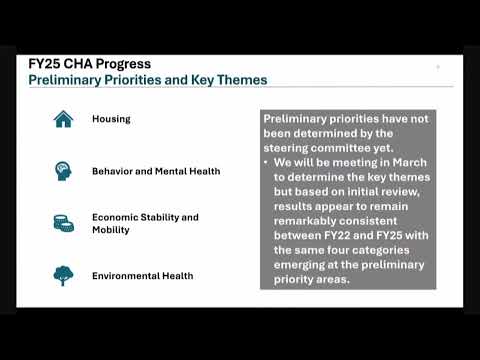
The preliminary community health assessment for Revere shows 402 survey respondents to date, with housing, behavioral and mental health, economic stability, and environmental health continuing as the likely priorities.
Vanessa Gurdado Menhevar, regional epidemiologist working on a community health assessment for Revere, Chelsea and Winthrop, presented preliminary findings to the Revere Board of Health and outlined next steps toward a community health improvement plan.
Menhevar said the assessment uses surveys, focus groups and interviews to identify priorities with an emphasis on populations experiencing inequities. As of the presentation she reported 402 survey respondents from Revere and seven focus groups, including an Arabic-speaking focus group and groups with health workers and regional mental health teams. She said the steering committee includes roughly 20 active members and that Cambridge Health Alliance and other hospitals are partners to avoid duplicative outreach.
Demographic results from the preliminary Revere sample included: about 38% reporting a primary language other than English; about 68% identifying as women; 13 respondents identifying as having a disability; roughly 10% identifying as gay, lesbian, bisexual, pansexual, queer or questioning. On race and ethnicity, Menhevar reported approximately 39% of respondents identified as Hispanic, 20% as white, 18% as Black or African American, and 9% as Asian.
Menhevar presented four priorities carried forward from the 2022 assessment: housing; behavioral and mental health; economic stability and mobility; and environmental health. Early findings specific to housing included that 48% of Revere respondents selected more affordable housing as the top improvement they want; 31% reported trouble paying for housing costs (rent, mortgage, taxes, insurance) in the past 12 months; and 16% disagreed or strongly disagreed that they felt secure about their current housing situation.
On behavioral and mental health, focus groups raised concerns about social isolation among older adults, challenges navigating the behavioral-health system and youth mental-health concerns. In the survey, 28% of Revere respondents included mental health among the top five health problems facing the community; 54% described the mental health of people in their community as "fair" or "poor." Among respondents who reported barriers to accessing mental-health care, 19% cited cost, followed by fear of discrimination and lack of information on available services.
Economic vulnerability indicators included 45% of respondents naming better access to good jobs among top-five concerns, 21% prioritizing more affordable childcare, and 30% identifying limited opportunities for career advancement as a barrier to employment.
Environmental-health concerns raised in focus groups included drinking-water and beach-water safety, aging water infrastructure, limited open space, trash and litter, air and noise pollution, and pest or mold issues in housing; about 11% of respondents indicated their housing was not safe or of good quality in terms of pests or mold.
Menhevar said the survey and interviews remain open through early April and that the steering committee will meet next month to begin prioritization conversations; final reports will stratify results by age, race and other factors. She described planned community listening sessions (Cambridge Health Alliance has started sessions) and said local listening sessions are expected around June. Board members suggested outreach strategies — high-school incentives, faith-based organizations and local community liaisons — to increase participation among 18- to 24-year-olds and other underrepresented groups. Menhevar said incentives are available for focus groups and interviews and that survey incentives could be discussed.
No board action was taken; the presentation was informational.